
Quick Conversion Table
| Brand | Equivalent | Match |
|---|---|---|
| Anchor | 1206 | close |
| Madeira | 0512 | close |
| Cosmo ⚠ | 2589 | close |
| Sullivans | 45114 | close |
The Variegated Wild Card: Why DMC 115 Divides Stitchers
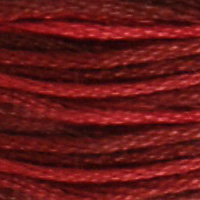
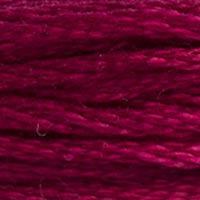
Variegated threads occupy a strange position in the cross-stitch world. Some stitchers adore them for the effortless depth they bring to a design. Others refuse to touch them, insisting that color placement should be intentional, not random. DMC 115 Variegated Garnet sits right at the center of this debate — a thread that shifts between deep wine, rich garnet, and dusky rose within a single strand, creating effects that no solid color can replicate and that no amount of planning can fully predict.
The base hex (#9A3050) represents the median point of the color transitions, but it only tells part of the story. In practice, 115 moves through a range from a dark, almost burgundy depth to a lighter mauve-pink, with the garnet midtone serving as the thread's home key. The transitions are gradual rather than abrupt — this is not a thread that jumps from dark to light in two inches. The color shifts unfold over several stitches, which means on 14-count Aida, you will see the full spectrum play out across roughly 20-30 stitches of continuous stitching.
That gradual transition is both the appeal and the challenge. When stitching cross-country — completing each X before moving to the next — the color shifts align somewhat unpredictably with your stitching direction. When working in rows using the Danish method, the bottom half-stitches will be one shade and the return pass completing each X may be a different shade, creating a subtle tweedy effect within individual stitches. Neither approach is wrong, but they produce genuinely different results, and it is worth stitching a test swatch before committing to a technique for your project.
Where Variegated Garnet Actually Shines
The natural home for DMC 115 is in designs where organic, non-uniform color is an asset. Rose petals are the classic application — real roses are not a single shade of red, and a variegated thread captures that living quality in a way that would otherwise require blending three or four solid colors. Specifically, old garden roses and cabbage roses benefit enormously from 115's range, because their dense, layered petals create natural shadows and highlights that the thread's color shifts echo.
Redwork patterns with a twist are another strong application. Traditional redwork uses a single red thread for all stitching, typically DMC 321 or 816. Substituting 115 adds dimension without changing the fundamental character of the design — the piece still reads as monochrome red, but with a richness that flat color cannot achieve. This works particularly well in backstitch-heavy redwork, where the continuous line of stitching allows the color variation to flow smoothly along curves and outlines.
Autumn foliage benefits too. The garnet-to-rose range of 115 captures the specific moment when maple leaves transition from deep red to faded pink, that late-autumn stage when the brilliant peak color has passed but the leaves have not yet gone brown. Paired with DMC 921 (Copper) and DMC 3830 (Terra Cotta), it fills out the warm end of a fall palette with organic variation.
The Practical Realities of Stitching with Variegated Thread
Thread management with variegated skeins requires more attention than with solids. Each length you cut from the skein will begin at a different point in the color cycle, which means adjacent sections stitched with different thread lengths may create visible color boundaries. Some stitchers solve this by cutting all their thread lengths from the same position in the color cycle, untwisting the skein carefully and marking the starting points. Others embrace the randomness as part of the charm.
Railroading — using your needle to keep the two strands of floss lying flat and parallel — matters more with variegated threads than with solids. When two strands twist together and one is in the dark phase while the other is in the light phase, the twist creates a muddy, mottled appearance instead of the clean color transition you want. Taking the extra half-second to railroad each stitch pays visible dividends in the finished piece.
One more consideration: dye lot consistency is especially important with variegated threads, because the transition pattern itself can shift between lots. Two skeins from different lots may have the same colors but different transition lengths — one might shift from dark to light over three inches while another shifts over five inches. The resulting patterns in your finished piece will not match. Buy all the skeins you need at once, and buy one extra as insurance.
Coverage is standard for DMC cotton — two strands on 14-count provides full coverage. The thread handles identically to solid-color DMC in terms of twist, separation, and drag through fabric. Whatever opinions stitchers hold about the aesthetics of variegated threads, the mechanical behavior of 115 is entirely unremarkable, which in this context is a compliment.
The Variegated Substitution Challenge
Substituting any variegated thread is inherently trickier than substituting a solid, because you are matching not just a color but a color transition pattern. Anchor 1206 is listed as a close match, and it captures the general garnet-to-rose range of DMC 115. However, the transition lengths and the specific shade endpoints may differ — Anchor's variegated threads tend to have slightly shorter transition cycles, which creates more frequent color changes and a busier visual texture. On small motifs this is not noticeable; on large filled areas, the difference in transition rhythm becomes apparent.
Madeira 0512 is also a close match. Madeira's variegated threads are well-regarded for their smooth transitions, and their garnet range sits in a similar territory to DMC's. The silk-like finish of Madeira thread can actually enhance the variegated effect, as the slight sheen catches light differently on the dark and light sections of the thread, adding another dimension to the color variation. If you can find it, Madeira is worth trying as an alternative for 115.
Cosmo 2589 offers a close match with Cosmo's characteristically soft hand. The color range overlaps well with DMC 115's garnet spectrum, though Cosmo's transitions may lean slightly more pink than wine at the light end. For rose designs this is actually flattering; for autumn or wine-themed projects where you want the dark end to dominate, it may read slightly differently.
If you cannot source any variegated substitute at all, consider approximating the effect with solid DMC threads using a blended needle technique. Thread one strand of DMC 816 (Garnet) with one strand of DMC 3859 (Light Rosewood) to create a two-toned effect that captures the spirit of the variegated original. It will not replicate the gradual transitions, but it creates a similar tonal complexity. Alternatively, alternate rows between DMC 815 and DMC 3858 (Medium Rosewood) for a more deliberate version of the color variation.
Reference quality
How We Validate This Color Record
Use this page as a reference card for DMC 115: the structured data, quick conversions, and long-form copy are all tied back to the same stored color record.
- Methodology
- This page renders DMC 115, its hex value, and every brand equivalent from the site's source-of-truth color record, then checks long-form body copy against those same stored fields.
- Verification status
- Source-field checked. The page content is audited against the stored DMC number, brand equivalents, and match-quality labels before publishing.
- Last reviewed
- 2026-04-20
- Approximation warning
- Screen hex values, thread photos, and cross-brand conversions are reference aids. Dye lots, thread sheen, and fabric color can still shift the result in hand.
Decision guide
When to use the DMC 115 reference page
This page should help you decide faster between palette planning, brand substitution, and shade comparison without turning the color record into a thin lookup page.
Best for
- + Palette planning when you want the stored DMC 115 Variegated Garnet record, hex value #9A3050, and linked brand equivalents in one place.
- + Checking the quickest cross-brand shortlist before you buy floss, compare stash substitutes, or route into a more specific conversion page.
- + Finding nearby shades in the reds family before you commit to accents, shading, or background blends.
Watch for
- ! Screen previews are only reference aids. Variegated Garnet can shift on real fabric because thread sheen, stitch coverage, and room lighting change how the color reads.
- ! A stored equivalent is still a shortlist, not a guarantee that two brands will disappear into each other in the same stitched motif.
- ! Older charts, discontinued kit floss, and dye-lot variation can all introduce small but visible differences that the page cannot detect for you.
Before you commit
- Confirm the role of DMC 115 Variegated Garnet: decide whether you need an exact hero shade, a forgiving background, or a rough stash substitute.
- Compare on project fabric: view the skein or stitched sample on the same fabric count and color you will actually use.
- Use the linked conversion pages next: open the brand-specific pages when you need match-quality caveats before substituting away from the DMC reference.
DMC 115 FAQ
These questions appear on the page so the FAQ schema stays aligned with what visitors can actually read.
What is the Anchor equivalent of DMC 115?+
The closest Anchor equivalent to DMC 115 (Variegated Garnet) is Anchor 1206. This is a close match.
What color is DMC 115?+
DMC 115 is called "Variegated Garnet" and has a hex color value of #9A3050. It belongs to the reds color family.
What is the Madeira equivalent of DMC 115?+
The closest Madeira equivalent to DMC 115 (Variegated Garnet) is Madeira 0512. This is a close match.
How DMC 115 Looks on Fabric
The same thread appears different depending on your fabric. Always test on your project fabric.
White Aida
Cream / Ecru
Black Aida
Pairs Well With
DMC colors commonly used alongside 115 Variegated Garnet.
Suggested Palette
Shading Companions
Detailed Conversions
Where to Buy DMC 115
This section contains affiliate links. We may earn a small commission at no cost to you.
Related Guides
Free Printable Thread Conversion Chart
Pick a brand, enter your email, and we'll send you a printable chart mapping all 552 DMC colors to that brand's equivalents. Zero spam, one chart.
Thanks! Here's your free chart:
Download Your ChartOpens in a new tab. Use your browser's Print → Save as PDF.
No spam. Your email is stored securely and never shared.