
Quick Conversion Table
| Brand | Equivalent | Match |
|---|---|---|
| Anchor | 897 | exact |
| Madeira | 2501 | close |
| Cosmo ⚠ | 226 | close |
| Sullivans | 45252 | close |
| J&P Coats | 3044 | close |
| Dimensions | 13082 | close |
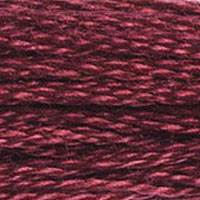
Garnet the gemstone gets its name from the Latin granatum — pomegranate — because the deep red crystals embedded in their matrix look like pomegranate seeds. That etymology matters for stitchers, because DMC 902 Very Dark Garnet carries exactly that quality: it's not a blood red, not a wine, but something that suggests depth and mineral richness, the way light passes through a faceted stone rather than sitting flat on a painted surface. Understanding that quality helps you use 902 well rather than treating it as just another dark red.
In the DMC red family, 902 occupies the darkest and most blue-shifted position before you hit the true burgundy and plum territory of DMC 915 (Dark Plum) and DMC 3685 (Very Dark Mauve). Lighter garnet shades — DMC 815 (Medium Garnet) and DMC 816 (Garnet) — complete the family and give you a shading range with real depth for roses, berries, and gemstone-effect pieces. DMC 814 (Dark Garnet) sits just one step lighter than 902, making it a useful transition color when 902 feels too heavy as an immediate shadow.
The Outlining Question
There's a productive debate in the cross-stitch community about when to use DMC 902 as an outline color versus defaulting to DMC 310 (Black) or DMC 3371 (Black Brown). For designs with a warm, rich color palette — think Victorian florals, Renaissance-inspired imagery, wine and food subjects — a 902 backstitch outline often produces a more harmonious result than black. The dark garnet keeps the warmth of the composition intact rather than introducing a neutral anchor that pulls the eye toward the edge.
The technique has limits, of course. On very pale or cool-toned fills, a 902 outline can feel jarring. And on small or intricate backstitched details, the color is dark enough that it often reads as black from any distance. But for that specific application — outlining warm-toned fills, creating shadow work in red-dominated pieces — it's a genuinely elegant choice that experienced stitchers reach for deliberately.
Historical and Seasonal Context
The garnet color family has long associations with formal occasions and historical costume: Victorian mourning dress used deep garnets and burgundies, medieval heraldry employed them extensively, and ecclesiastical needlework reaching back centuries shows this hue in vestments and altar cloths. If you're working on a heritage-style sampler or a piece with historical references, DMC 902's depth and slight formality make it feel period-appropriate in a way that brighter reds don't.
Seasonally, 902 lands squarely in winter holiday territory. It's commonly used in Christmas designs alongside DMC 321 (Christmas Red) and DMC 498 (Dark Red), often serving as the deepest shadow or the fill for dark holly berries. It appears in Advent and Christkindl-themed samplers, in poinsettia designs where it anchors the darkest petal bases, and in winter botanical motifs where it suggests the deep color of dried cranberries or rose hips.
Working With 902
On white Aida, DMC 902 reads clean and true — the darkness is enough that the weave of the fabric doesn't lighten it significantly. On antique white or natural linen, it picks up a subtle warmth that actually deepens the garnet quality nicely. This is one of those colors that often looks better on cream than white, because the slightly yellowed ground reduces the contrast enough to let the color itself be the focus rather than the edge between thread and fabric.
When using 902 in large fill areas, watch the dye lot. Garnet shades can show subtle lot-to-lot variation, and because the color is so saturated and dark, any slight shift reads more visibly than it might in a mid-tone. If your project requires multiple skeins, compare them under consistent lighting before you start — ideally the same lighting you'll use when stitching. Parking your needle between color changes in cross-country stitching keeps thread waste low and helps you monitor coverage as you go.
Anchor 897 matches DMC 902 exactly by rating, and stitchers who've worked with both confirm it's one of the more reliable conversions in the dark red range. Anchor's garnet-family threads have historically held their color consistency well, so this is a safe swap for entire projects or for supplementing a short skein.
Madeira 2501 also earns an exact rating and is a strong alternative — Madeira's silk-like finish gives garnet tones a particular depth that some stitchers actually prefer for certain subjects, especially anything meant to suggest gemstones or jewel-toned fabrics. The colorfastness of Madeira in this range is generally excellent.
Cosmo 226 and Sullivans 45252 both rate as close rather than exact. The Cosmo version may lean marginally cooler and slightly more toward burgundy than true garnet. For most designs this won't matter, but if you're using 902 specifically for its warm-red quality against cool purples or blues, test the Cosmo version in context before committing. Sullivans 45252 is serviceable but Sullivans' coverage in very dark shades can occasionally feel slightly lighter than equivalent DMC — something to watch in large fill areas.
If DMC 902 is completely unavailable, DMC 814 (Dark Garnet) is the nearest lighter substitute and will maintain the color family. For a darker substitute, DMC 3685 (Very Dark Mauve) shifts slightly purple but reads closely in most contexts. Avoid substituting DMC 815 or 816 — they're too light and the value shift will be obvious in any shaded work where 902 was intended as the shadow anchor.
Reference quality
How We Validate This Color Record
Use this page as a reference card for DMC 902: the structured data, quick conversions, and long-form copy are all tied back to the same stored color record.
- Methodology
- This page renders DMC 902, its hex value, and every brand equivalent from the site's source-of-truth color record, then checks long-form body copy against those same stored fields.
- Verification status
- Source-field checked. The page content is audited against the stored DMC number, brand equivalents, and match-quality labels before publishing.
- Last reviewed
- 2026-04-20
- Approximation warning
- Screen hex values, thread photos, and cross-brand conversions are reference aids. Dye lots, thread sheen, and fabric color can still shift the result in hand.
Decision guide
When to use the DMC 902 reference page
This page should help you decide faster between palette planning, brand substitution, and shade comparison without turning the color record into a thin lookup page.
Best for
- + Palette planning when you want the stored DMC 902 Very Dark Garnet record, hex value #822637, and linked brand equivalents in one place.
- + Checking the quickest cross-brand shortlist before you buy floss, compare stash substitutes, or route into a more specific conversion page.
- + Finding nearby shades in the reds family before you commit to accents, shading, or background blends.
Watch for
- ! Screen previews are only reference aids. Very Dark Garnet can shift on real fabric because thread sheen, stitch coverage, and room lighting change how the color reads.
- ! A stored equivalent is still a shortlist, not a guarantee that two brands will disappear into each other in the same stitched motif.
- ! Older charts, discontinued kit floss, and dye-lot variation can all introduce small but visible differences that the page cannot detect for you.
Before you commit
- Confirm the role of DMC 902 Very Dark Garnet: decide whether you need an exact hero shade, a forgiving background, or a rough stash substitute.
- Compare on project fabric: view the skein or stitched sample on the same fabric count and color you will actually use.
- Use the linked conversion pages next: open the brand-specific pages when you need match-quality caveats before substituting away from the DMC reference.
DMC 902 FAQ
These questions appear on the page so the FAQ schema stays aligned with what visitors can actually read.
What is the Anchor equivalent of DMC 902?+
The closest Anchor equivalent to DMC 902 (Very Dark Garnet) is Anchor 897. This is an exact match.
What color is DMC 902?+
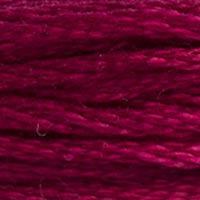
DMC 902 is called "Very Dark Garnet" and has a hex color value of #822637. It belongs to the reds color family.
What is the Madeira equivalent of DMC 902?+
The closest Madeira equivalent to DMC 902 (Very Dark Garnet) is Madeira 2501. This is a close match.
How DMC 902 Looks on Fabric
The same thread appears different depending on your fabric. Always test on your project fabric.
White Aida
Cream / Ecru
Black Aida
Pairs Well With
DMC colors commonly used alongside 902 Very Dark Garnet.
Suggested Palette
Shading Companions
Detailed Conversions
Where to Buy DMC 902
This section contains affiliate links. We may earn a small commission at no cost to you.
Related Guides
Free Printable Thread Conversion Chart
Pick a brand, enter your email, and we'll send you a printable chart mapping all 552 DMC colors to that brand's equivalents. Zero spam, one chart.
Thanks! Here's your free chart:
Download Your ChartOpens in a new tab. Use your browser's Print → Save as PDF.
No spam. Your email is stored securely and never shared.