
Quick Conversion Table
| Brand | Equivalent | Match |
|---|---|---|
| Anchor | 88 | exact |
| Madeira | 0707 | close |
| Cosmo ⚠ | 484 | close |
| Sullivans | 45166 | close |
| J&P Coats | 4089 | close |
| Dimensions | 14089 | close |
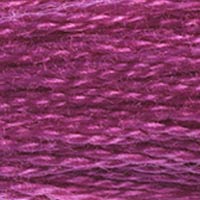
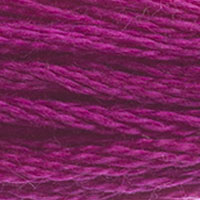
Plum is one of those colors with remarkable cultural range — it can read as simultaneously decadent and natural, regal and earthy, Victorian and modern. DMC 718's specific plum sits in the blue-purple-red zone, with its hex value #9C2462 showing a strong red component moderated by significant blue, giving it a rich, jewel-toned quality that reads as deep, saturated, and slightly cool. It's not a sweet or gentle color — it's dark and purposeful, closer to the wine-dark interior of a ripe plum than to the sugary purple of confectionery.
Cultural and Historical Associations
Purple has been associated with royalty since antiquity, and plum specifically carries that association in a more accessible, domestic form. Not the unapproachable purple of imperial court robes — that's more the territory of DMC 550 Very Dark Violet — but the purple of Victorian mourning dress, of old-fashioned cottage garden planting, of the deep-toned embroidery on ecclesiastical garments for Advent and Lent. Cross stitch designs for religious occasions and seasonal samplers in the traditional style often turn to DMC 718 for this resonance.
The Art Nouveau movement, with its love of jewel tones and botanical forms, used plum extensively — and contemporary cross stitch patterns inspired by that aesthetic reach for 718 to capture its characteristic palette. Mucha-style portraits, decorative alphabet designs with organic flourishes, and peacock-feather patterns all benefit from 718's combination of depth and warmth.
Design Applications
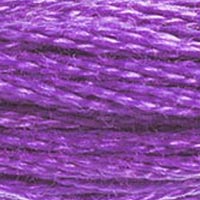
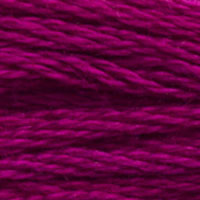
In floral embroidery, 718 serves as the deep shadow or body color for purple-red flowers: clematis, certain dahlias, black-purple tulips, and the dark-centered varieties of pansies. Paired with DMC 915 Dark Plum for deeper shadow and DMC 3607 Light Plum for mid-tones, it builds a complete plum shading sequence with real depth. For the lightest highlights in this family, DMC 3608 Very Light Plum and DMC 3609 Ultra Light Plum carry the pale range.
Fruit embroidery — plums, grapes, figs, and mulberries — uses DMC 718 in the darker areas where the fruit's skin shows its deepest color. Grapes in particular benefit from this family, with 718 working the shadow zones of dark purple grape varieties alongside DMC 550, 552, and 553 for a complete range. The color also appears in damson jam and blackcurrant-colored textile work, and in any design evoking the atmosphere of a Victorian kitchen larder.
Pairing Notes
DMC 718 paired with gold creates a particularly rich combination that appears throughout historical embroidery traditions — plum and gold, in various forms, has been used for decorated borders and luxury textiles across cultures and centuries. Pairing 718 with DMC 680 Dark Old Gold or DMC 729 Medium Old Gold replicates this classic pairing in cotton. Against green — particularly the muted sage or olive greens like DMC 3012 or 3013 — 718 creates the complementary contrast of plum foliage against a green garden background, common in Jacobean-style crewelwork translated to cross stitch.
Colorfastness in the deep plum range deserves a mention. Highly saturated blue-reds can occasionally transfer color when wet-blocked, particularly in warm water. DMC's standard advice applies: test a strand on your fabric before washing the finished piece, or use cool water for the first wash. The thread's color depth means any bleed, even minor, would be visible against lighter adjacent areas. In practice, most stitchers who work with 718 regularly report no issues with colorfastness, but the caution is reasonable for prized pieces.
Anchor 88 and Madeira 0707 are exact matches for DMC 718. These are reliable cross-brand swaps for a color that's specific enough in its blue-red balance that approximations can easily shift into either mauve (too blue) or burgundy (too red) territory.
Cosmo 484 and Sullivans 45166 are close. Cosmo 484 can read slightly more red than DMC 718 — edging toward burgundy rather than true plum. Sullivans 45166 is generally in the right zone but dye lot consistency can vary. For large fills or designs where plum is a primary featured color, comparing swatches against your DMC card before purchasing substitutes is worthwhile.
Within the DMC range, if 718 is unavailable, DMC 915 Dark Plum is darker and shifts slightly more purple; it serves for shadow areas if 718 was intended as the deepest value, but adds more darkness than may be wanted if 718 was carrying a mid-tone role. DMC 3607 Light Plum is one step lighter in the same family. For a color that reads similarly from a distance, DMC 3803 Dark Mauve is slightly more pink and less purple, but occupies a similar dark-warm-purple zone in the palette. A blended needle with one strand of DMC 915 and one strand of DMC 3607 creates a reasonable mid-plum approximation that reads close to 718's value and hue in two-strand coverage.
Reference quality
How We Validate This Color Record
Use this page as a reference card for DMC 718: the structured data, quick conversions, and long-form copy are all tied back to the same stored color record.
- Methodology
- This page renders DMC 718, its hex value, and every brand equivalent from the site's source-of-truth color record, then checks long-form body copy against those same stored fields.
- Verification status
- Source-field checked. The page content is audited against the stored DMC number, brand equivalents, and match-quality labels before publishing.
- Last reviewed
- 2026-04-20
- Approximation warning
- Screen hex values, thread photos, and cross-brand conversions are reference aids. Dye lots, thread sheen, and fabric color can still shift the result in hand.
Decision guide
When to use the DMC 718 reference page
This page should help you decide faster between palette planning, brand substitution, and shade comparison without turning the color record into a thin lookup page.
Best for
- + Palette planning when you want the stored DMC 718 Plum record, hex value #9C2462, and linked brand equivalents in one place.
- + Checking the quickest cross-brand shortlist before you buy floss, compare stash substitutes, or route into a more specific conversion page.
- + Finding nearby shades in the purples family before you commit to accents, shading, or background blends.
Watch for
- ! Screen previews are only reference aids. Plum can shift on real fabric because thread sheen, stitch coverage, and room lighting change how the color reads.
- ! A stored equivalent is still a shortlist, not a guarantee that two brands will disappear into each other in the same stitched motif.
- ! Older charts, discontinued kit floss, and dye-lot variation can all introduce small but visible differences that the page cannot detect for you.
Before you commit
- Confirm the role of DMC 718 Plum: decide whether you need an exact hero shade, a forgiving background, or a rough stash substitute.
- Compare on project fabric: view the skein or stitched sample on the same fabric count and color you will actually use.
- Use the linked conversion pages next: open the brand-specific pages when you need match-quality caveats before substituting away from the DMC reference.
DMC 718 FAQ
These questions appear on the page so the FAQ schema stays aligned with what visitors can actually read.
What is the Anchor equivalent of DMC 718?+
The closest Anchor equivalent to DMC 718 (Plum) is Anchor 88. This is an exact match.
What color is DMC 718?+
DMC 718 is called "Plum" and has a hex color value of #9C2462. It belongs to the purples color family.
What is the Madeira equivalent of DMC 718?+
The closest Madeira equivalent to DMC 718 (Plum) is Madeira 0707. This is a close match.
How DMC 718 Looks on Fabric
The same thread appears different depending on your fabric. Always test on your project fabric.
White Aida
Cream / Ecru
Black Aida
Pairs Well With
DMC colors commonly used alongside 718 Plum.
Suggested Palette
Shading Companions
Detailed Conversions
Where to Buy DMC 718
This section contains affiliate links. We may earn a small commission at no cost to you.
Related Guides
Free Printable Thread Conversion Chart
Pick a brand, enter your email, and we'll send you a printable chart mapping all 552 DMC colors to that brand's equivalents. Zero spam, one chart.
Thanks! Here's your free chart:
Download Your ChartOpens in a new tab. Use your browser's Print → Save as PDF.
No spam. Your email is stored securely and never shared.