
Quick Conversion Table
| Brand | Equivalent | Match |
|---|---|---|
| Anchor | 403 | exact |
| Madeira | 2400 | exact |
| Cosmo ⚠ | 600 | close |
| Sullivans | 45053 | approximate |
| J&P Coats | 8403 | close |
| Dimensions | 6150 | close |
| Bucilla | 420 | close |
| Candamar | 6150 | close |
Why DMC 310 Black Is the Thread You'll Always Need More Of
If you stitch long enough, you'll discover a universal truth: you can never have too many skeins of DMC 310. This is the workhorse of cross-stitch, the thread that defines almost every finished piece. It outlines characters in pixel art, provides the backbone of blackwork embroidery, and brings sharpness to lettering on samplers. For most stitchers, DMC 310 is the first color they reach for and the first they run out of.
Backstitching is where DMC 310 earns its reputation. That final pass of black outlining transforms a collection of colored squares into a recognizable image. Without it, cross-stitch motifs can look fuzzy or indistinct, especially at smaller counts. Many designers recommend using a single strand of 310 for backstitching on 14-count Aida and two strands on 11-count, though you should always defer to your pattern's instructions.
Beyond outlining, DMC 310 plays a starring role in several stitching traditions. Blackwork embroidery uses it exclusively to create intricate geometric fill patterns. Monochrome samplers rely on it for elegance. And in modern cross-stitch, large blocks of 310 form the dark backgrounds that make neon and bright colors pop.
One thing to be aware of: DMC 310 is a true, saturated black with a very slight sheen. Under certain lighting conditions, it can appear slightly less opaque than you might expect against a dark fabric. If you're stitching on black Aida (for a glow-in-the-dark or partial coverage design), you may find that stitched 310 looks subtly different from the fabric itself. That's normal and usually unnoticeable in the finished piece.
Because you use so much of it, DMC 310 is one of the few colors commonly sold in bulk packs of 12 or more skeins. If you're starting a large project that calls for extensive backstitching, buying in bulk can save you both money and the frustration of color-lot hunting mid-project.
Substituting DMC 310 Black in Other Brands
Black is one of the most straightforward colors to match across brands, but there are subtle differences worth noting.
Anchor 403 is the standard conversion and is an exact match in hue. The main difference most stitchers notice is in the twist and feel of the thread rather than the color itself. Anchor tends to feel slightly softer and looser in twist compared to DMC, which some people prefer for backstitch work because it lays flatter.
Madeira 2400 is also an exact match. Madeira's cotton thread has a noticeable sheen that is slightly more pronounced than DMC's, which can add a subtle richness to large filled areas of black.
Cosmo 600 is listed as a close match. In practice, Cosmo's black is virtually identical in color, but the thread itself has a different hand — it's silkier and slightly thinner, so your coverage may vary. You may need to adjust your tension or add an extra strand when substituting Cosmo for DMC on the same project.
For Sullivans 45053, the match is approximate. Some stitchers report that Sullivans' black can appear very slightly warmer (almost a hair toward dark charcoal) compared to DMC 310's cooler, bluer black. On a standalone project this difference is invisible, but avoid mixing them in the same piece.
- If you want a softer alternative to pure black for outlining, consider DMC 3371 (Black Brown) or DMC 413 (Dark Pewter Gray) instead.
- All black threads benefit from being kept away from light-colored threads in your storage to prevent lint transfer.
Reference quality
How We Validate This Color Record
Use this page as a reference card for DMC 310: the structured data, quick conversions, and long-form copy are all tied back to the same stored color record.
- Methodology
- This page renders DMC 310, its hex value, and every brand equivalent from the site's source-of-truth color record, then checks long-form body copy against those same stored fields.
- Verification status
- Source-field checked. The page content is audited against the stored DMC number, brand equivalents, and match-quality labels before publishing.
- Last reviewed
- 2026-04-20
- Approximation warning
- Screen hex values, thread photos, and cross-brand conversions are reference aids. Dye lots, thread sheen, and fabric color can still shift the result in hand.
Decision guide
When to use the DMC 310 reference page
This page should help you decide faster between palette planning, brand substitution, and shade comparison without turning the color record into a thin lookup page.
Best for
- + Palette planning when you want the stored DMC 310 Black record, hex value #000000, and linked brand equivalents in one place.
- + Checking the quickest cross-brand shortlist before you buy floss, compare stash substitutes, or route into a more specific conversion page.
- + Finding nearby shades in the neutrals family before you commit to accents, shading, or background blends.
Watch for
- ! Screen previews are only reference aids. Black can shift on real fabric because thread sheen, stitch coverage, and room lighting change how the color reads.
- ! A stored equivalent is still a shortlist, not a guarantee that two brands will disappear into each other in the same stitched motif.
- ! Older charts, discontinued kit floss, and dye-lot variation can all introduce small but visible differences that the page cannot detect for you.
Before you commit
- Confirm the role of DMC 310 Black: decide whether you need an exact hero shade, a forgiving background, or a rough stash substitute.
- Compare on project fabric: view the skein or stitched sample on the same fabric count and color you will actually use.
- Use the linked conversion pages next: open the brand-specific pages when you need match-quality caveats before substituting away from the DMC reference.
DMC 310 FAQ
These questions appear on the page so the FAQ schema stays aligned with what visitors can actually read.
What is the Anchor equivalent of DMC 310?+
The closest Anchor equivalent to DMC 310 (Black) is Anchor 403. This is an exact match.
What color is DMC 310?+
DMC 310 is called "Black" and has a hex color value of #000000. It belongs to the neutrals color family.
What is the Madeira equivalent of DMC 310?+
The closest Madeira equivalent to DMC 310 (Black) is Madeira 2400. This is an exact match.
Projects That Use DMC 310 Heavily
Nearly every cross-stitch pattern includes DMC 310 somewhere, but certain project types consume it in extraordinary quantities:
- Full-coverage pixel art: Video game sprites, retro game scenes, and pop culture portraits often use 310 for extensive outlining across dozens or hundreds of motifs.
- Blackwork embroidery: This technique uses 310 exclusively, creating elaborate geometric patterns and fills. A single blackwork piece can easily consume 5 to 10 skeins.
- Text-heavy samplers: Alphabet samplers, quote pieces, and wedding records use 310 for all lettering, which adds up quickly on larger designs.
- Dark background pieces: Some striking modern designs feature large areas of black background with bright foreground images. These can use 20+ skeins of 310.
Tip: if your pattern calls for large filled areas of 310, consider parking your needle method or working in columns to ensure even tension across the dark sections, since inconsistencies are more visible in solid-color areas.
How DMC 310 Looks on Fabric
The same thread appears different depending on your fabric. Always test on your project fabric.
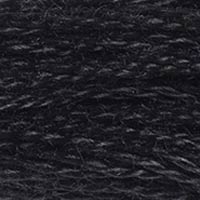
White Aida
Cream / Ecru
Black Aida
Pairs Well With
DMC colors commonly used alongside 310 Black.
Monochrome Grays
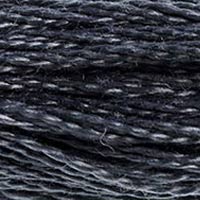
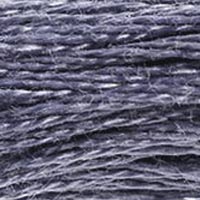
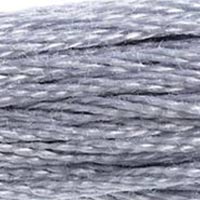

Christmas Palette
Shading Companions
Detailed Conversions
Where to Buy DMC 310
This section contains affiliate links. We may earn a small commission at no cost to you.
Related Guides
Free Printable Thread Conversion Chart
Pick a brand, enter your email, and we'll send you a printable chart mapping all 552 DMC colors to that brand's equivalents. Zero spam, one chart.
Thanks! Here's your free chart:
Download Your ChartOpens in a new tab. Use your browser's Print → Save as PDF.
No spam. Your email is stored securely and never shared.