
Quick Conversion Table
| Brand | Equivalent | Match |
|---|---|---|
| Anchor | 89 | exact |
| Madeira | 0706 | close |
| Cosmo ⚠ | 485 | close |
| Sullivans | 45263 | close |
| J&P Coats | 4089 | close |
| Dimensions | 6917 | close |
| Bucilla | 3917 | close |
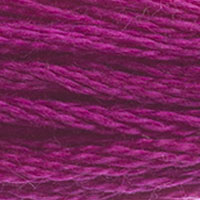
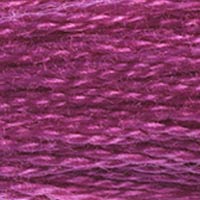
At #9B1359, DMC 917 Medium Plum sits at a chromatic crossroads: it's dark enough to function as a mid-shadow in many palettes, saturated enough to command attention as a primary color, and warm enough with its red-purple balance to feel richer than a purely cool purple. It reads differently depending on what surrounds it — next to pinks and magentas, it functions as a deep accent; next to blues and violets, it looks almost red; next to greens, the purple quality comes forward most strongly. This contextual flexibility makes it a designer's thread.
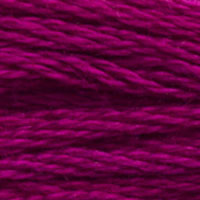
In the DMC plum family, 917 is the medium representative, positioned between DMC 915 (Dark Plum) and the lighter DMC 718 (Plum). It's the color that typically carries the largest fill area in plum-themed shading work — dark enough to have real depth, light enough to show texture and detail without requiring the work of bringing out value from a very dark fill. For iris petals, eggplant skin, plum fruit, or rich magenta-purple flowers, 917 is where the main body of color lives.
Complementary Relationships Worth Knowing
DMC 917 sits in an interesting position on the color wheel. Its closest complementary is a yellow-green, which means colors in the DMC 906–907 range (Medium and Light Parrot Green) create strong complementary contrast. The pairing that results — vivid red-purple against bright yellow-green — is intense and somewhat demanding, but used strategically in floral designs it creates the visual energy of an actual flower where petals and leaves naturally create complementary contrast.
A more controlled application of this complementary relationship: using 917 as a small accent in a design dominated by green foliage produces maximum visual interest with minimal thread. A single accent flower in 917 in a botanical design full of DMC 904, 905, and 906 will draw the eye immediately. This is how skilled botanical embroidery designers use color — not distributing accent colors evenly but concentrating them for impact.
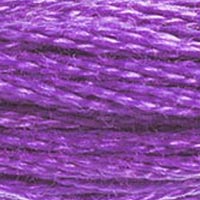
For analogous palettes, 917 bridges naturally to DMC 3685 (Very Dark Mauve) on the cooler/darker side and to DMC 3608 (Very Light Plum) on the lighter side. Moving into the red territory, DMC 814 (Dark Garnet) picks up the red component while losing the purple — useful knowledge when you're trying to understand where the palette boundaries are for your composition.
Specific Project Applications
Floral designs involving lavender, plum blossoms, wisteria, and dahlias frequently call for 917 as a primary or near-primary fill. For wisteria in particular — a popular subject in Japanese-influenced cross-stitch designs — the hanging cluster structure benefits from a careful gradient of 917 at the mid-range with 915 in the deeper recesses and DMC 3607 or 718 in the lighter outer sections.
Pop culture and character designs that include strong magenta elements sometimes reach for 917 when DMC 321 (Christmas Red) or straight magenta threads feel too bright or warm. The purple component of 917 cools it just enough to read as a sophisticated, gem-toned rather than cartoonish color. Some anime-inspired and fantasy character designs specifically use this tone for character details.
Anchor 89 and Madeira 0706 both carry exact ratings, giving DMC 917 good brand substitution support. Anchor 89 is a reliable choice and is consistently referenced as a strong equivalent. Madeira 0706 likewise performs well, with Madeira's colorfastness in the plum range being generally dependable.
One note on working with the exact-rated Anchor equivalent: Anchor thread has a slightly different surface texture and sheen than DMC, and with a medium-value saturated color like 917, this can produce a subtle difference in how the same design reads in each brand. The color is correct, but the thread quality interacts with light differently. In most contexts this isn't a problem; in projects where the relationship between thread sheen and design character is carefully considered, it's worth noting.
Cosmo 485 and Sullivans 45263 carry close ratings. The Cosmo version may lean slightly differently within the red-purple balance — worth testing if 917's specific warm character is important. Sullivans 45263 is serviceable but the close rating means some visual difference is possible, particularly in large fill areas.
Within DMC, if 917 is unavailable, DMC 915 (Dark Plum) goes darker while preserving the color family, or DMC 718 (Plum) goes lighter. For a similar saturation level in a different color direction, DMC 718 paired with DMC 915 in a blended needle (one strand each) creates an intermediate value that reads comparably to 917 in most contexts — a useful emergency substitution technique when you run short mid-project.
Reference quality
How We Validate This Color Record
Use this page as a reference card for DMC 917: the structured data, quick conversions, and long-form copy are all tied back to the same stored color record.
- Methodology
- This page renders DMC 917, its hex value, and every brand equivalent from the site's source-of-truth color record, then checks long-form body copy against those same stored fields.
- Verification status
- Source-field checked. The page content is audited against the stored DMC number, brand equivalents, and match-quality labels before publishing.
- Last reviewed
- 2026-04-20
- Approximation warning
- Screen hex values, thread photos, and cross-brand conversions are reference aids. Dye lots, thread sheen, and fabric color can still shift the result in hand.
Decision guide
When to use the DMC 917 reference page
This page should help you decide faster between palette planning, brand substitution, and shade comparison without turning the color record into a thin lookup page.
Best for
- + Palette planning when you want the stored DMC 917 Medium Plum record, hex value #9B1359, and linked brand equivalents in one place.
- + Checking the quickest cross-brand shortlist before you buy floss, compare stash substitutes, or route into a more specific conversion page.
- + Finding nearby shades in the purples family before you commit to accents, shading, or background blends.
Watch for
- ! Screen previews are only reference aids. Medium Plum can shift on real fabric because thread sheen, stitch coverage, and room lighting change how the color reads.
- ! A stored equivalent is still a shortlist, not a guarantee that two brands will disappear into each other in the same stitched motif.
- ! Older charts, discontinued kit floss, and dye-lot variation can all introduce small but visible differences that the page cannot detect for you.
Before you commit
- Confirm the role of DMC 917 Medium Plum: decide whether you need an exact hero shade, a forgiving background, or a rough stash substitute.
- Compare on project fabric: view the skein or stitched sample on the same fabric count and color you will actually use.
- Use the linked conversion pages next: open the brand-specific pages when you need match-quality caveats before substituting away from the DMC reference.
DMC 917 FAQ
These questions appear on the page so the FAQ schema stays aligned with what visitors can actually read.
What is the Anchor equivalent of DMC 917?+
The closest Anchor equivalent to DMC 917 (Medium Plum) is Anchor 89. This is an exact match.
What color is DMC 917?+
DMC 917 is called "Medium Plum" and has a hex color value of #9B1359. It belongs to the purples color family.
What is the Madeira equivalent of DMC 917?+
The closest Madeira equivalent to DMC 917 (Medium Plum) is Madeira 0706. This is a close match.
How DMC 917 Looks on Fabric
The same thread appears different depending on your fabric. Always test on your project fabric.
White Aida
Cream / Ecru
Black Aida
Pairs Well With
DMC colors commonly used alongside 917 Medium Plum.
Suggested Palette
Shading Companions
Detailed Conversions
Where to Buy DMC 917
This section contains affiliate links. We may earn a small commission at no cost to you.
Related Guides
Free Printable Thread Conversion Chart
Pick a brand, enter your email, and we'll send you a printable chart mapping all 552 DMC colors to that brand's equivalents. Zero spam, one chart.
Thanks! Here's your free chart:
Download Your ChartOpens in a new tab. Use your browser's Print → Save as PDF.
No spam. Your email is stored securely and never shared.