
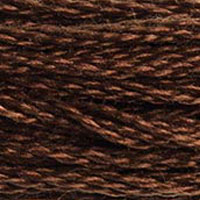
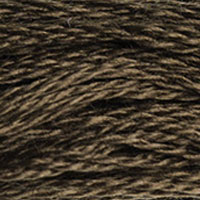
DMC 898 — Very Dark Coffee Brown
Browns family · Hex #492A13
Quick Conversion Table
| Brand | Equivalent | Match |
|---|---|---|
| Anchor | 380 | close |
| Madeira | 2007 | close |
| Cosmo ⚠ | 2311 | close |
| Sullivans | 45249 | close |
| J&P Coats | 5476 | close |
| Dimensions | 15476 | close |
| Bucilla | 898 | close |
| Candamar | 6300 | close |
Why Experienced Stitchers Reach for 898 Instead of Black
Here's a quiet debate that plays out in stitching forums and Facebook groups more often than you'd expect: should you backstitch in DMC 310 (Black) or DMC 898 (Very Dark Coffee Brown)? If you've only ever used black for outlining, pulling a skein of 898 out of your stash might change how you approach every warm-toned design from here on.
The argument is simple. Pure black doesn't actually exist much in nature — what we perceive as black in fur, bark, soil, and shadow is almost always a very dark brown, green, or blue. When you outline a woodland scene or a portrait in 310, the backstitching sits on top of the design like ink on a photograph. It's bold, it's graphic, and sometimes that's exactly what you want. But outline the same design in 898, and suddenly the lines sink into the composition. They belong there. The effect is subtler, warmer, and — for realistic or nature-inspired work — dramatically more professional.
I started making this swap about three years into cross-stitching, and honestly, I can't go back for most of my WIPs. On anything with warm undertones — autumn landscapes, skin tones, animals, coffee-themed kitchen pieces — 898 backstitching just looks right. You lose almost nothing in contrast (898 is genuinely dark; hold it against black fabric and you'll barely see the difference), but you gain a warmth and cohesion that 310 can't deliver.
Coffee, Chocolate, and the Deepest Brown in the Skein Box
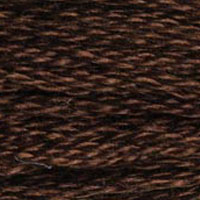
DMC named this one well. Very Dark Coffee Brown is the color of a double espresso in a white demitasse — that moment before you add cream, when the surface is so dark it's almost opaque but catches the light with a deep mahogany shimmer. It's 90% cacao dark chocolate snapped in half. It's rain-soaked garden soil in early spring. There's genuine warmth buried in this thread, a reddish-brown undertone that only reveals itself when you stitch it next to actual black.
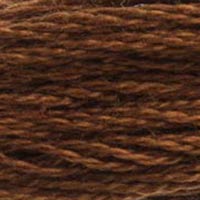
That warmth is what anchors the entire DMC warm brown family. Think of 898 as the foundation of a gradient system that builds upward through DMC 801 (Dark Coffee Brown), into DMC 433 (Medium Brown), through DMC 435 (Very Light Brown), and up to the tans like 437 and 738. Without 898 at the base, these gradients feel like they're floating — there's no convincing shadow to ground them. With 898 locking down the darkest value, the whole progression gains dimensionality. Tree trunks look round. Fur has depth. Wooden textures feel carved rather than flat.
Coverage-wise, 898 is well-behaved. Two strands on 14-count Aida give you solid, opaque stitches with no fabric peeking through, which matters enormously at this value — any white specks in a near-black area are instantly visible and will bother you forever. On 18-count, you can still get away with two strands if your tension is consistent, but keep your stitches snug and consider railroading to keep the strands lying flat and maximizing coverage. On evenweave or linen over two, two strands remain the standard, though some stitchers bump to three for absolute opacity in large dark areas.
Building Palettes Around the Darkest Brown
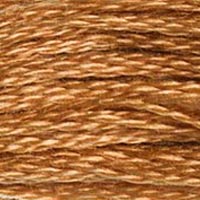
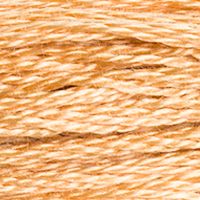
Because 898 lives at the extreme dark end of the brown spectrum, it plays well with virtually any warm palette. Pair it with DMC 433 and 435 for a classic three-value brown shading system that handles everything from tree bark to leather goods to wooden furniture. Expand the family with 801 between 898 and 433 for smoother transitions in larger designs where the jump between values would be too abrupt.
It's also a natural partner for the warm golds and ambers — DMC 975, 976, and 977 — where 898 provides the shadow tones for autumn foliage or honey-colored subjects. And for skin tone work, 898 serves as the deepest shadow in medium-to-dark complexion palettes, paired with threads like 3862, 3863, and 3864.
One combination worth noting: 898 with DMC 3371 (Black Brown) can be tricky. They're close enough in value to cause confusion on a chart but different enough in undertone (3371 is cooler, almost greenish-black) that using them side-by-side can create an odd temperature shift. If your pattern calls for both, stitch a small test area first and check it in natural light.
Finding the Right Match for DMC 898
The trick with matching 898 isn't getting the darkness right — plenty of threads are this dark. The trick is preserving that specific reddish-brown warmth that separates a true coffee brown from a cooled-down charcoal or a greenish near-black. Get the temperature wrong and your substitute will read as a completely different color, even if the value is spot-on.
Madeira 2007 is your safest bet here — it's rated an exact match, and in practice it delivers. The warmth comes through faithfully, and the thread handles similarly under the needle. If you're mid-project and your local shop is out of DMC, Madeira is the swap I'd make without hesitation.
Anchor 380 gets you close, but "close" at this depth of brown means you should compare skeins before committing to a large area. Most dye lots of Anchor 380 are an excellent match, but I've seen occasional batches that lean a shade cooler — not dramatically so, but enough that you'd notice the temperature difference in a large fill area on white or cream Aida. For backstitching or small detail areas, this is a non-issue. For stitching an entire dark background, buy enough to finish the project from one batch.
Cosmo 2311 is a close match that tends toward the warm side, which actually makes it a sympathetic substitute. Cosmo threads have a slightly different twist and a softer hand than DMC, so you may notice a texture difference in mixed-brand projects, but the color itself works well. One advantage of Cosmo here is that their dark browns tend to have excellent dye consistency between skeins.
Sullivans 45249 captures the depth convincingly. At this extreme dark value, pay attention to your stitch coverage — Sullivans has a slightly different strand thickness, and any gaps between stitches in near-black thread on light fabric create distracting white dots. Keep your tension even, railroad your stitches, and you should be fine.
If you're tempted to substitute DMC 3371 (Black Brown) because it's also a very dark brown in your stash, pause and compare them side by side in daylight. 3371 skews noticeably cooler with an almost olive-black quality, while 898 stays firmly warm and reddish. They're not interchangeable — they serve different purposes in a palette.
Reference quality
How We Validate This Color Record
Use this page as a reference card for DMC 898: the structured data, quick conversions, and long-form copy are all tied back to the same stored color record.
- Methodology
- This page renders DMC 898, its hex value, and every brand equivalent from the site's source-of-truth color record, then checks long-form body copy against those same stored fields.
- Verification status
- Source-field checked. The page content is audited against the stored DMC number, brand equivalents, and match-quality labels before publishing.
- Last reviewed
- 2026-04-20
- Approximation warning
- Screen hex values, thread photos, and cross-brand conversions are reference aids. Dye lots, thread sheen, and fabric color can still shift the result in hand.
Decision guide
When to use the DMC 898 reference page
This page should help you decide faster between palette planning, brand substitution, and shade comparison without turning the color record into a thin lookup page.
Best for
- + Palette planning when you want the stored DMC 898 Very Dark Coffee Brown record, hex value #492A13, and linked brand equivalents in one place.
- + Checking the quickest cross-brand shortlist before you buy floss, compare stash substitutes, or route into a more specific conversion page.
- + Finding nearby shades in the browns family before you commit to accents, shading, or background blends.
Watch for
- ! Screen previews are only reference aids. Very Dark Coffee Brown can shift on real fabric because thread sheen, stitch coverage, and room lighting change how the color reads.
- ! A stored equivalent is still a shortlist, not a guarantee that two brands will disappear into each other in the same stitched motif.
- ! Older charts, discontinued kit floss, and dye-lot variation can all introduce small but visible differences that the page cannot detect for you.
Before you commit
- Confirm the role of DMC 898 Very Dark Coffee Brown: decide whether you need an exact hero shade, a forgiving background, or a rough stash substitute.
- Compare on project fabric: view the skein or stitched sample on the same fabric count and color you will actually use.
- Use the linked conversion pages next: open the brand-specific pages when you need match-quality caveats before substituting away from the DMC reference.
DMC 898 FAQ
These questions appear on the page so the FAQ schema stays aligned with what visitors can actually read.
What is the Anchor equivalent of DMC 898?+
The closest Anchor equivalent to DMC 898 (Very Dark Coffee Brown) is Anchor 380. This is a close match.
What color is DMC 898?+
DMC 898 is called "Very Dark Coffee Brown" and has a hex color value of #492A13. It belongs to the browns color family.
What is the Madeira equivalent of DMC 898?+
The closest Madeira equivalent to DMC 898 (Very Dark Coffee Brown) is Madeira 2007. This is a close match.
Portrait Work and Hair Shadows
If you're stitching any kind of portrait — full coverage, realistic, large-scale — DMC 898 is almost certainly on your thread list. It's the go-to for the deepest shadows in brown and black hair, the dark crease of an eyelid, the shadow under a chin. Portrait designers love it because it provides maximum contrast without the flatness that true black brings to skin-adjacent areas. When you're parking threads across a face and working row by row, 898 creates those shadows that make features pop dimensionally. For dark brown hair specifically, a gradient of 898, 801, 433, and 434 gives you a four-value system with beautiful depth — add 3031 if you need something between 898 and 801 for extra-smooth shading in larger hair sections.
Animal Designs: Fur, Feathers, and the Dark Spaces Between
Wildlife cross-stitch patterns consume enormous quantities of 898. It's the dark banding in a hawk's tail feathers. It's the shadow between a bear's thick fur. It's a horse's dark mane catching the light. In animal eye detail work, 898 defines the pupil and deep eye socket without the hardness of black — the result is eyes that look alive rather than stamped on. If you're working a large-scale animal portrait on 18-count or higher, consider working cross-country for the 898 sections rather than parking, since the dark thread can leave shadow marks on light fabric if it's carried too far on the back.
Warm-Toned Redwork and Monochromatic Designs
Here's a use that might not be obvious: 898 makes a gorgeous alternative to the traditional red in redwork-style embroidery. Stitched as a monochromatic design on cream or natural linen, it creates something that reads as an antique chocolate-work piece — rich, warm, and surprisingly elegant. Pair it with a single lighter brown (try 801 or 433) for a two-tone variation that adds just enough dimension without abandoning the monochromatic concept. This works especially well for kitchen motifs, botanical illustrations, and vintage-style samplers where you want warmth without the intensity of true redwork. On 28-count evenweave over two, the coverage is beautiful and the warm brown against natural linen has a timeless quality that photographs wonderfully for your FO posts.
How DMC 898 Looks on Fabric
The same thread appears different depending on your fabric. Always test on your project fabric.
White Aida
Cream / Ecru
Black Aida
Pairs Well With
DMC colors commonly used alongside 898 Very Dark Coffee Brown.
Woodland Forest
Rustic Country
Shading Companions
Detailed Conversions
Where to Buy DMC 898
This section contains affiliate links. We may earn a small commission at no cost to you.
Related Guides
Free Printable Thread Conversion Chart
Pick a brand, enter your email, and we'll send you a printable chart mapping all 552 DMC colors to that brand's equivalents. Zero spam, one chart.
Thanks! Here's your free chart:
Download Your ChartOpens in a new tab. Use your browser's Print → Save as PDF.
No spam. Your email is stored securely and never shared.