
Quick Conversion Table
| Brand | Equivalent | Match |
|---|---|---|
| Anchor | 382 | close |
| Madeira | 2004 | close |
| Cosmo ⚠ | 2624 | close |
| Sullivans | 45163 | close |
The Shadow Beneath Everything
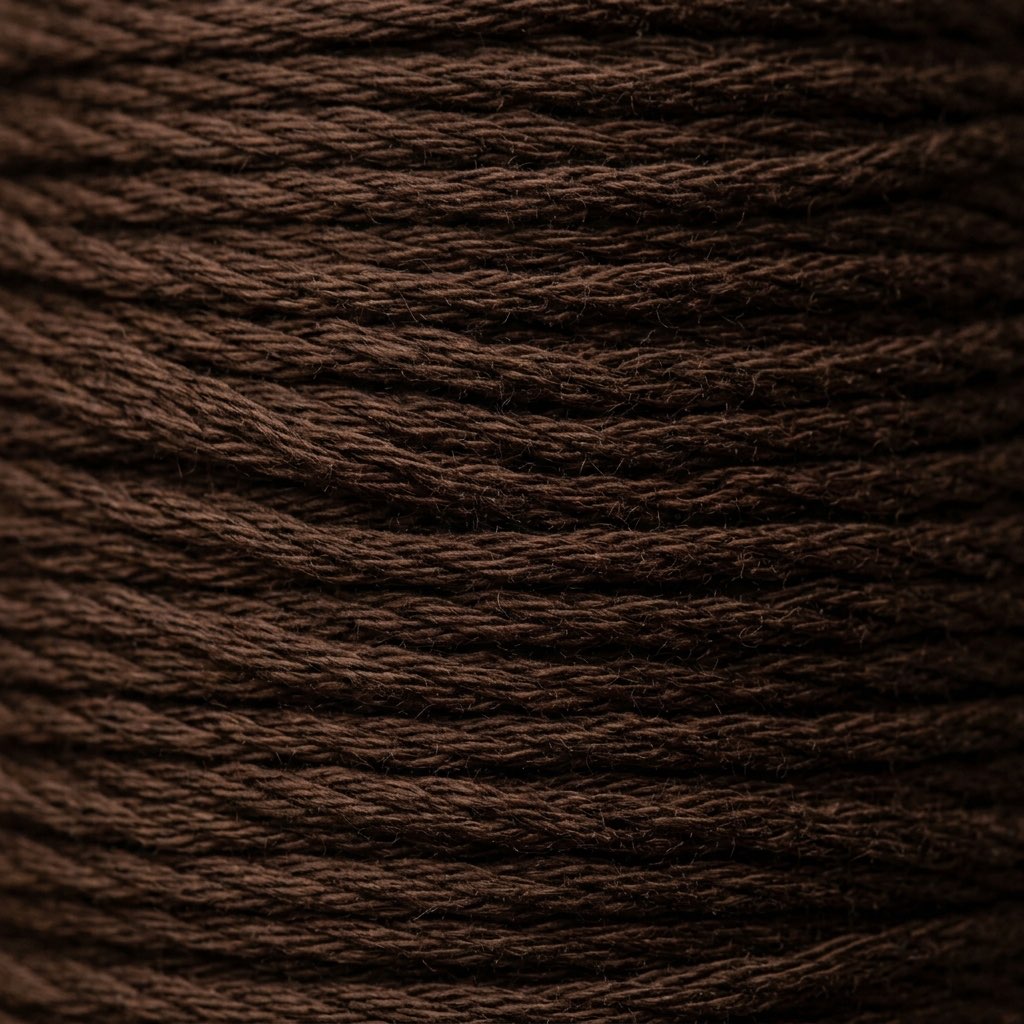
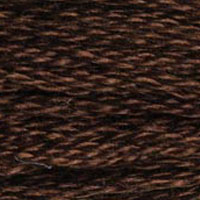
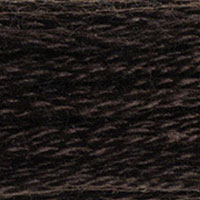
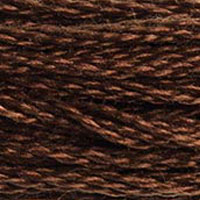
Look at a cross-stitched landscape and find the darkest place in it — the hollow at the base of a tree trunk, the space between stacked firewood, the gap where a stone wall meets damp earth. That's where DMC 3980 lives. This thread is so dark it borders on black, but it isn't black. Hold a strand next to DMC 310 and the difference reveals itself: 3980 carries a deep, warm, almost reddish-brown undertone that 310 simply doesn't have. Black is the absence of light. DMC 3980 is the memory of brown after the light has nearly gone.
That distinction matters more than you might think. In any design where shadow needs to feel organic — connected to the warm, living world of wood and earth and bark — a pure black shadow can look pasted on, like a hole cut in the fabric rather than a darkened version of something real. 3980 gives you depth without that artificial quality. Your shadows stay brown. They stay warm. They stay part of the composition instead of punching through it.
Where 3980 Fits in the Brown Hierarchy
DMC 3980 occupies the absolute floor of the brown family. It's darker than DMC 938 (Ultra Dark Coffee Brown), which itself is already a very deep shade. In practical terms, 3980 is the brown you reach for when 938 isn't dark enough but 310 is too cold. It's niche, but that niche is essential for certain kinds of work.
Steampunk-themed designs are one area where 3980 finds unexpected heavy use. The steampunk aesthetic runs on dark metal, aged leather, and deep shadow — and a thread that reads as near-black with warm brown undertones is exactly what you need for the shadowed recesses of gear mechanisms, the dark interior of a leather satchel, or the space behind iron filigree. Pair it with DMC 975 (Dark Golden Brown) for the polished brass highlights, DMC 801 (Dark Coffee Brown) for mid-tone metal, and DMC 3826 (Golden Brown) for the bright brass edges, and you have a convincing steampunk metalwork palette built entirely on browns and golds.
For tree bark in detailed botanical or landscape work, 3980 handles the deepest fissures — those vertical cracks in old oak bark where light never reaches. Build up through DMC 898 (Very Dark Coffee Brown), then DMC 801, then DMC 434 (Light Brown) for the bark faces catching light. The stump cross-section is another place 3980 shines: it's the color of the oldest rings near the heartwood center, darkened by decades of tannin concentration. That gradient from near-black center through progressively lighter browns to the pale sapwood at the edge tells the story of the tree's entire life, and 3980 is where that story begins.
Lighting and Visibility Considerations
Working with thread this dark comes with practical challenges. On white or cream Aida, 3980 shows up fine — the contrast is enormous. But on darker fabrics like navy, black, or dark green, you might struggle to see your stitches forming, and you'll definitely want a bright task light or a light pad beneath your hoop. Some stitchers find that stitching 3980 on dark fabric under poor lighting leads to tension inconsistencies because they can't see the thread path clearly. A magnifier lamp solves this, but it's worth knowing before you sit down for a late-night stitching session with a dark thread on dark fabric.
Under different lighting conditions, 3980 reveals its character. In bright daylight, the brown undertone is clearly visible — you can see it's not black, especially next to actual black thread. Under warm incandescent light, that reddish-brown base comes forward even more, and the thread can look almost like a very dark burgundy-brown. Under cool LED light, it retreats toward black again, losing some of its warmth. If you're stitching a piece that will hang in a room with warm lighting, 3980's brown identity will be more visible than if the piece goes in a room with cool daylight. Neither is wrong — just know that the thread's personality shifts with the light.
For blended needle work, one strand of 3980 paired with one strand of DMC 838 (Very Dark Beige Brown) creates a shadow tone that's dark but still clearly brown — useful for the underside of mushroom caps, the shadow beneath a bird's wing, or the dark interior of a woven basket where the weave goes under. One strand of 3980 with one strand of DMC 310 pushes you almost to true black but with a subtle warmth that's beautiful for outlining on designs where pure black backstitching would be too harsh.
Finding Alternatives for an Almost-Black Brown
Substituting for a thread this dark might seem easy — how different can near-blacks really be? More different than you'd expect. The whole point of 3980 is that it's not black, and a substitute that crosses the line into true black defeats the purpose. You need to match both the extreme darkness and the warm brown undertone simultaneously.
Anchor 382 and Madeira 2004 are both rated close rather than exact, which tells you something about how specific this color space is. Both brands get you into the right depth of darkness, but check carefully for the warm undertone. Hold your candidate against DMC 310 — if you can't see any difference between them, the substitute has lost the brown character you need. If you can see a slight warmth, you're in the right territory.
Cosmo 2624 is similarly a close match. With Cosmo threads, the slightly different twist and sheen can actually help at this darkness level, since even tiny differences in how light reflects off the thread surface can make the brown undertone more or less visible. Stitch a small test swatch on your project fabric rather than just comparing skeins side by side — the way the thread behaves when stitched tells you more than the skein alone.
If 3980 is unavailable and you're considering a DMC alternative, DMC 938 (Ultra Dark Coffee Brown) is the closest neighbor. It's a step lighter, so your shadows won't be quite as deep, but it maintains the warm brown identity clearly. For most designs, the difference between 938 and 3980 in a shadow area is subtle enough that only someone comparing the original to your version side by side would notice. What you want to avoid is reaching for DMC 310 as a substitute — it solves the darkness but loses the brown entirely, and in a palette of warm browns, a cold black shadow will look like it belongs to a different design.
Reference quality
How We Validate This Color Record
Use this page as a reference card for DMC 3980: the structured data, quick conversions, and long-form copy are all tied back to the same stored color record.
- Methodology
- This page renders DMC 3980, its hex value, and every brand equivalent from the site's source-of-truth color record, then checks long-form body copy against those same stored fields.
- Verification status
- Source-field checked. The page content is audited against the stored DMC number, brand equivalents, and match-quality labels before publishing.
- Last reviewed
- 2026-04-20
- Approximation warning
- Screen hex values, thread photos, and cross-brand conversions are reference aids. Dye lots, thread sheen, and fabric color can still shift the result in hand.
Decision guide
When to use the DMC 3980 reference page
This page should help you decide faster between palette planning, brand substitution, and shade comparison without turning the color record into a thin lookup page.
Best for
- + Palette planning when you want the stored DMC 3980 Very Dark Brown record, hex value #2A1000, and linked brand equivalents in one place.
- + Checking the quickest cross-brand shortlist before you buy floss, compare stash substitutes, or route into a more specific conversion page.
- + Finding nearby shades in the browns family before you commit to accents, shading, or background blends.
Watch for
- ! Screen previews are only reference aids. Very Dark Brown can shift on real fabric because thread sheen, stitch coverage, and room lighting change how the color reads.
- ! A stored equivalent is still a shortlist, not a guarantee that two brands will disappear into each other in the same stitched motif.
- ! Older charts, discontinued kit floss, and dye-lot variation can all introduce small but visible differences that the page cannot detect for you.
Before you commit
- Confirm the role of DMC 3980 Very Dark Brown: decide whether you need an exact hero shade, a forgiving background, or a rough stash substitute.
- Compare on project fabric: view the skein or stitched sample on the same fabric count and color you will actually use.
- Use the linked conversion pages next: open the brand-specific pages when you need match-quality caveats before substituting away from the DMC reference.
DMC 3980 FAQ
These questions appear on the page so the FAQ schema stays aligned with what visitors can actually read.
What is the Anchor equivalent of DMC 3980?+
The closest Anchor equivalent to DMC 3980 (Very Dark Brown) is Anchor 382. This is a close match.
What color is DMC 3980?+
DMC 3980 is called "Very Dark Brown" and has a hex color value of #2A1000. It belongs to the browns color family.
What is the Madeira equivalent of DMC 3980?+
The closest Madeira equivalent to DMC 3980 (Very Dark Brown) is Madeira 2004. This is a close match.
How DMC 3980 Looks on Fabric
The same thread appears different depending on your fabric. Always test on your project fabric.
White Aida
Cream / Ecru
Black Aida
Pairs Well With
DMC colors commonly used alongside 3980 Very Dark Brown.
Suggested Palette
Shading Companions
Detailed Conversions
Where to Buy DMC 3980
This section contains affiliate links. We may earn a small commission at no cost to you.
Related Guides
Free Printable Thread Conversion Chart
Pick a brand, enter your email, and we'll send you a printable chart mapping all 552 DMC colors to that brand's equivalents. Zero spam, one chart.
Thanks! Here's your free chart:
Download Your ChartOpens in a new tab. Use your browser's Print → Save as PDF.
No spam. Your email is stored securely and never shared.