
Quick Conversion Table
| Brand | Equivalent | Match |
|---|---|---|
| Anchor | 363 | exact |
| Madeira | 2011 | close |
| Cosmo ⚠ | 2307 | close |
| Sullivans | 45097 | close |
| J&P Coats | 5347 | close |
| Dimensions | 6096 | close |
| Bucilla | 5943 | close |
| Candamar | 6096 | close |
The Color of Wicker
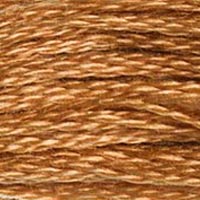
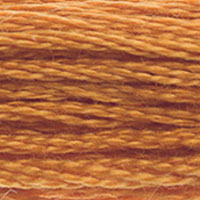
Pick up a wicker basket — a real one, not the painted kind — and look at the individual woven strips. The ones facing the light are a warm, golden tan. That's DMC 436. It's the color of things that start as living plants and become useful objects: willow baskets, rattan chairs, jute twine, hemp rope, bamboo blinds. There's something fundamentally honest about this color. It doesn't try to be anything other than what it is — a clear, warm, medium-light brown that looks like natural fiber in sunlight.
In the DMC system, 436 is simply called "Tan," which is either perfectly accurate or spectacularly unhelpful depending on your perspective. It sits in the upper half of the neutral brown gradient (433-434-435-436-437), lighter than the trio below it but with enough pigment to read as distinctly brown rather than beige. It's the transition point where brown starts to become something else — not yet tan in the pale, sandy sense, but clearly headed that direction.
Basket Weaving in Cross-Stitch
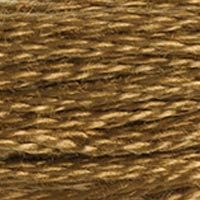
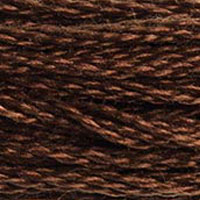
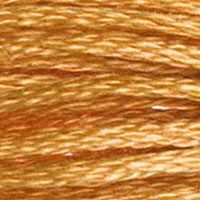
Cross-stitched baskets appear in everything from Easter designs to fruit bowl still lifes to Nantucket lighthouse scenes, and DMC 436 is the primary body color for most of them. The technique for convincing basketwork relies on alternating values to suggest the over-under pattern of the weave. Use 436 for the lit faces of the strips, DMC 434 (Light Brown) for the shadow side, and DMC 437 (Light Tan) for the top highlight where direct light strikes. Where strips cross, drop to DMC 433 (Medium Brown) for the tiny shadow beneath the overlap.
The trick to stitching convincing wicker texture is regularity. Real baskets have a grid-like rhythm — over, under, over, under — and your color placement needs to follow that same regular alternation. A common mistake is trying to add "random" variation for realism, but real basketwork isn't random; it's systematic. Follow the weave pattern faithfully, alternate your values consistently, and the texture emerges naturally from the geometric structure. It's one of those cases where disciplined, pattern-faithful stitching produces a more realistic result than trying to be creative with the color placement.
Landscape Perspective: Foreground to Distance
In landscape cross-stitch, browns play a critical role in establishing spatial depth, and 436 sits at an important boundary. It's warm and saturated enough to read as mid-ground — a path curving through a meadow, a wooden gate at middle distance, the thatched roof of a cottage that's neither close nor far. Push a brown lighter and cooler (DMC 841 or 842) and it recedes into the background. Darken and warm it (DMC 434 or 433) and it pushes forward. 436 occupies the neutral middle distance, and skilled pattern designers exploit this by using it for elements that need to sit at a specific depth in the composition.
For sandy paths — the kind that wind through English cottage gardens or along the edges of wheat fields — 436 is the primary path color in full sun. Shadow areas on the path get DMC 434 or DMC 435. The bright, sun-bleached center of the path uses DMC 437 or DMC 738 (Very Light Tan). The edges where the path meets grass need a transition thread: one strand of 436 blended with one strand of a medium green like DMC 3347 creates a convincing grass-growing-through-the-path effect that's much more natural than a hard color boundary.
On fabric, 436 reads clearly on white Aida with good contrast and warm presence. On cream fabric, it softens and integrates, losing some contrast but gaining a mellow, antiqued quality that suits cottage and country designs. Natural linen is where 436 can become problematic — many linen colors are in the same value range, and you can lose contrast entirely. If you're stitching a path or basket on natural linen and using 436 as the main color, make sure your linen is either noticeably lighter or noticeably darker than the thread. Check by laying a strand across the fabric and squinting — if it disappears, you need a different fabric or a different shade.
Matching the Honest Tan
DMC 436 is straightforward enough that most substitutes in the right value range will work, but "straightforward" doesn't mean "anything goes." The warm, neutral quality — warm but not golden, brown but not dark, tan but not yellow — is a specific balance point.
Anchor 363 is an exact match and a confident recommendation. Madeira 2011 is also exact and blends well with DMC threads if you're mixing brands in a project. Both capture the honest, neutral warmth that defines 436 without drifting toward gold or pink.
Cosmo 2307 is close and generally works. Some stitchers detect a slight warmth difference between Cosmo and DMC at this value, but it's subtle enough that in most contexts — basket fill, path color, background shading — you wouldn't notice. If you're building a precise gradient through the 433-437 sequence and using Cosmo only for the 436 position, verify that the spacing looks even. Sullivans 45097 is in range — test it against your chosen fabric in natural light.
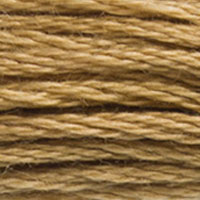
The most common within-DMC substitute situation arises when a pattern calls for both 436 and 437 but you can only find one. These two are close enough that some stitchers have accidentally used one for the other without noticing until the piece was well advanced. If your pattern uses them side by side in a gradient, the one-step difference matters. If they appear in different areas of the design that don't touch, using one for both is a reasonable shortcut when the other is unavailable. Avoid replacing 436 with DMC 422 (Light Hazelnut Brown), which has a more golden character despite being at a similar value — in a neutral brown context, that gold lean will be visible.
Reference quality
How We Validate This Color Record
Use this page as a reference card for DMC 436: the structured data, quick conversions, and long-form copy are all tied back to the same stored color record.
- Methodology
- This page renders DMC 436, its hex value, and every brand equivalent from the site's source-of-truth color record, then checks long-form body copy against those same stored fields.
- Verification status
- Source-field checked. The page content is audited against the stored DMC number, brand equivalents, and match-quality labels before publishing.
- Last reviewed
- 2026-04-20
- Approximation warning
- Screen hex values, thread photos, and cross-brand conversions are reference aids. Dye lots, thread sheen, and fabric color can still shift the result in hand.
Decision guide
When to use the DMC 436 reference page
This page should help you decide faster between palette planning, brand substitution, and shade comparison without turning the color record into a thin lookup page.
Best for
- + Palette planning when you want the stored DMC 436 Tan record, hex value #CB9051, and linked brand equivalents in one place.
- + Checking the quickest cross-brand shortlist before you buy floss, compare stash substitutes, or route into a more specific conversion page.
- + Finding nearby shades in the browns family before you commit to accents, shading, or background blends.
Watch for
- ! Screen previews are only reference aids. Tan can shift on real fabric because thread sheen, stitch coverage, and room lighting change how the color reads.
- ! A stored equivalent is still a shortlist, not a guarantee that two brands will disappear into each other in the same stitched motif.
- ! Older charts, discontinued kit floss, and dye-lot variation can all introduce small but visible differences that the page cannot detect for you.
Before you commit
- Confirm the role of DMC 436 Tan: decide whether you need an exact hero shade, a forgiving background, or a rough stash substitute.
- Compare on project fabric: view the skein or stitched sample on the same fabric count and color you will actually use.
- Use the linked conversion pages next: open the brand-specific pages when you need match-quality caveats before substituting away from the DMC reference.
DMC 436 FAQ
These questions appear on the page so the FAQ schema stays aligned with what visitors can actually read.
What is the Anchor equivalent of DMC 436?+
The closest Anchor equivalent to DMC 436 (Tan) is Anchor 363. This is an exact match.
What color is DMC 436?+
DMC 436 is called "Tan" and has a hex color value of #CB9051. It belongs to the browns color family.
What is the Madeira equivalent of DMC 436?+
The closest Madeira equivalent to DMC 436 (Tan) is Madeira 2011. This is a close match.
How DMC 436 Looks on Fabric
The same thread appears different depending on your fabric. Always test on your project fabric.
White Aida
Cream / Ecru
Black Aida
Pairs Well With
DMC colors commonly used alongside 436 Tan.
Vintage & Antique
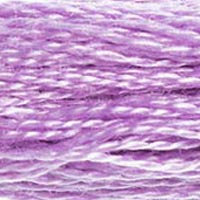
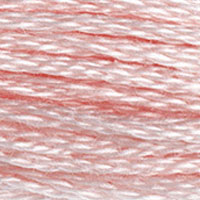
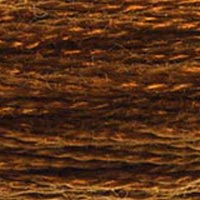
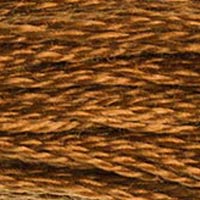
Rustic Country
Shading Companions
Detailed Conversions
Where to Buy DMC 436
This section contains affiliate links. We may earn a small commission at no cost to you.
Related Guides
Free Printable Thread Conversion Chart
Pick a brand, enter your email, and we'll send you a printable chart mapping all 552 DMC colors to that brand's equivalents. Zero spam, one chart.
Thanks! Here's your free chart:
Download Your ChartOpens in a new tab. Use your browser's Print → Save as PDF.
No spam. Your email is stored securely and never shared.