
Quick Conversion Table
| Brand | Equivalent | Match |
|---|---|---|
| Anchor | 186 | close |
| Madeira | 1202 | close |
| Cosmo ⚠ | 844 | close |
| Sullivans | 45449 | close |
| J&P Coats | 6186 | close |
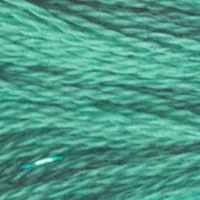
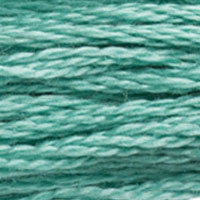
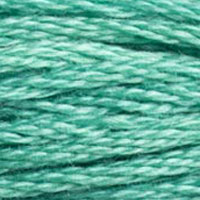
At #49B3A1, DMC 3851 Light Bright Green is a name that undersells the color considerably. Yes, it's lighter than DMC 3850 (Dark Bright Green). But "light" here means medium-bright rather than pale — this is still a vivid, saturated teal-green with noticeable presence. It reads more like the color of a bright tropical leaf in full sun, or the surface of shallow Caribbean water over a sandy bottom, than anything you'd call simply "light green."
The family it belongs to — the bright green duo of 3850 and 3851 — covers a significant value range between its two members. As the lighter stop, 3851 functions as either the highlight in a two-shade teal-green scheme or as the main fill in designs that need a vivid, mid-tone teal-green without going as dark as 3850. Its hexadecimal value places it squarely between green and blue in hue, but visually it reads as more clearly teal-green than its darker sibling, partly because the lighter value allows the green component to read more distinctly.
A Color Worth Knowing for Tropical and Art Deco Work
The particular quality of 3851 — vivid, medium-bright, cleanly teal — suits design styles that call for color that pops without being overwhelming. Art Deco cross-stitch designs frequently use colors in this saturation range and temperature: vivid but controlled, modern but not garish. The geometric, architectural quality of Art Deco aesthetics is well-served by teal-greens in this register, where they can anchor bold geometric patterns alongside gold, black, and cream.
In tropical and botanical designs, 3851 works well for the bright upper surfaces of leaves in direct sunlight — the area that's caught the light and is reflecting it with maximum color intensity. Paired with DMC 3850 for the shadow side and DMC 3849 (Light Teal Green) for transitional areas, it contributes to a convincing three-value botanical shading scheme.
Some stitchers have noted that 3851 and DMC 954 (Nile Green) occupy similar value territory but with different hue identities — 954 being a warmer, more yellow-green, and 3851 being the cooler teal version. For designs that switch between warm and cool greens to represent different plant elements, keeping both in the stash is useful. They're different enough to be distinct, similar enough in value to coexist in a palette without value conflict.
On white fabric, coverage is excellent and the color is vivid and clear. On cream or natural linen, the warm ground softens the teal quality slightly, pushing it toward a slightly warmer aqua — appealing in vintage botanical contexts. Stitching technique matters as usual with saturated colors: railroading and consistent tension keep the fill smooth and prevent streaking.
Light Bright Green has no exact matches across major brands, which is typical for vivid teal-greens in this value range.
Anchor 186 is close. Anchor's brighter greens in the teal zone tend to be reliable in saturation, and 186 is a workable substitute. Like most Anchor teal-greens, it may lean slightly more blue compared to 3851's more balanced green-cyan position.
Madeira 1202 is close. Madeira's bright green family performs well in this color zone, and 1202 is a useful alternative for projects that need to source outside DMC. Some stitchers find Madeira's version slightly more vivid, which may be an advantage in high-energy design contexts.
Cosmo 844 is close. Cosmo's version in the light bright green family is well-regarded for its vibrancy and clean thread behavior. Worth considering for projects where the thread's handling quality matters as much as the color accuracy.
Sullivans 45449 is close and suitable for standalone projects. As always with Sullivans saturated colors, lot consistency should be confirmed for multi-skein purchases.
- For a slightly more blue version at similar value, DMC 3845 (Medium Bright Turquoise) shifts the hue toward cyan-blue while maintaining comparable saturation.
- For a warmer, more conventional bright green at similar value, DMC 913 (Medium Nile Green) adds warmth and moves toward the yellow-green family.
Reference quality
How We Validate This Color Record
Use this page as a reference card for DMC 3851: the structured data, quick conversions, and long-form copy are all tied back to the same stored color record.
- Methodology
- This page renders DMC 3851, its hex value, and every brand equivalent from the site's source-of-truth color record, then checks long-form body copy against those same stored fields.
- Verification status
- Source-field checked. The page content is audited against the stored DMC number, brand equivalents, and match-quality labels before publishing.
- Last reviewed
- 2026-04-20
- Approximation warning
- Screen hex values, thread photos, and cross-brand conversions are reference aids. Dye lots, thread sheen, and fabric color can still shift the result in hand.
Decision guide
When to use the DMC 3851 reference page
This page should help you decide faster between palette planning, brand substitution, and shade comparison without turning the color record into a thin lookup page.
Best for
- + Palette planning when you want the stored DMC 3851 Light Bright Green record, hex value #49B3A1, and linked brand equivalents in one place.
- + Checking the quickest cross-brand shortlist before you buy floss, compare stash substitutes, or route into a more specific conversion page.
- + Finding nearby shades in the greens family before you commit to accents, shading, or background blends.
Watch for
- ! Screen previews are only reference aids. Light Bright Green can shift on real fabric because thread sheen, stitch coverage, and room lighting change how the color reads.
- ! A stored equivalent is still a shortlist, not a guarantee that two brands will disappear into each other in the same stitched motif.
- ! Older charts, discontinued kit floss, and dye-lot variation can all introduce small but visible differences that the page cannot detect for you.
Before you commit
- Confirm the role of DMC 3851 Light Bright Green: decide whether you need an exact hero shade, a forgiving background, or a rough stash substitute.
- Compare on project fabric: view the skein or stitched sample on the same fabric count and color you will actually use.
- Use the linked conversion pages next: open the brand-specific pages when you need match-quality caveats before substituting away from the DMC reference.
DMC 3851 FAQ
These questions appear on the page so the FAQ schema stays aligned with what visitors can actually read.
What is the Anchor equivalent of DMC 3851?+
The closest Anchor equivalent to DMC 3851 (Light Bright Green) is Anchor 186. This is a close match.
What color is DMC 3851?+
DMC 3851 is called "Light Bright Green" and has a hex color value of #49B3A1. It belongs to the greens color family.
What is the Madeira equivalent of DMC 3851?+
The closest Madeira equivalent to DMC 3851 (Light Bright Green) is Madeira 1202. This is a close match.
Where Light Bright Green Does Its Best Work
This is a color with a specific personality — vivid, tropical, modern — and it appears most naturally in projects that embrace those qualities:
- Tropical and rainforest designs: Light Bright Green is an excellent fit for the vivid mid-tones in tropical foliage — the lit surfaces of monstera leaves, the bright upper sections of palm fronds, the intense green of tropical ferns in direct light. It works especially well in designs that aim for a saturated, vacation-poster color palette rather than a naturalistic one.
- Art Deco geometric panels: The saturated, controlled quality of 3851 suits the clean lines and vivid palettes of Art Deco-inspired cross-stitch designs. Alongside cream, black, and geometric gold (DMC 3852 or DMC 781), it creates the characteristic Art Deco color scheme with authenticity.
- Stained glass designs: Cross-stitch patterns that simulate stained glass rely on vivid, saturated thread colors to mimic the effect of colored glass backlit by sunlight. Light Bright Green is an excellent "teal-green glass" color that maintains its vibrancy when viewed against a bright window background in a framed piece.
How DMC 3851 Looks on Fabric
The same thread appears different depending on your fabric. Always test on your project fabric.
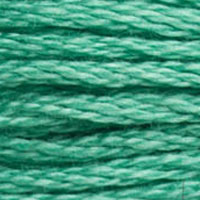
White Aida
Cream / Ecru
Black Aida
Pairs Well With
DMC colors commonly used alongside 3851 Light Bright Green.
Suggested Palette
Shading Companions
Detailed Conversions
Where to Buy DMC 3851
This section contains affiliate links. We may earn a small commission at no cost to you.
Related Guides
Free Printable Thread Conversion Chart
Pick a brand, enter your email, and we'll send you a printable chart mapping all 552 DMC colors to that brand's equivalents. Zero spam, one chart.
Thanks! Here's your free chart:
Download Your ChartOpens in a new tab. Use your browser's Print → Save as PDF.
No spam. Your email is stored securely and never shared.