
Quick Conversion Table
| Brand | Equivalent | Match |
|---|---|---|
| Anchor | 186 | exact |
| Madeira | 1113 | close |
| Cosmo ⚠ | 897 | close |
| Sullivans | 45294 | close |
| J&P Coats | 6185 | close |
| Dimensions | 6158 | close |
| Bucilla | 6089 | close |
| Candamar | 6090 | close |
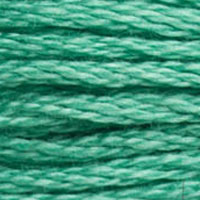
Medium values are the unsung workhorses of any shading progression. The darkest value gets the drama; the lightest value gets the highlight. The medium value does most of the actual coverage — filling the broad mid-lit areas that make up the majority of any surface in normal light conditions. DMC 959 Medium Seagreen is exactly this: the thread you'll use the most skein of in any aquatic design, the one that fills all those areas between the deepest shadows of DMC 958 (Dark Seagreen) and the airy brightness of DMC 964 (Light Seagreen).
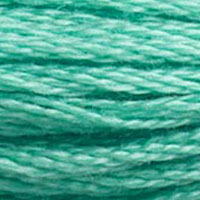
The color itself is a clear, medium-value teal-green — saturated enough to read with vivid color presence, light enough to be clearly distinct from its darker family member. It has the quality of tropical water in the middle-depth zone: not the surface sparkle, not the mysterious dark of deep water, but the reliable visual richness of the sunlit shallow-to-medium zone where most coral life actually lives and most underwater photography happens.
The Bridge in Seagreen Progressions
In any seagreen shading sequence, DMC 959 is the thread that does the bridging work. It makes the transition from DMC 958's depth to DMC 964's lightness possible without a jarring value jump. Without it, underwater designs look banded rather than smoothly graduated. With it, the shading reads as continuous — the eye moves smoothly from dark shadow to bright highlight across the design's surface.
For stitchers who work in the parking method on complex designs, DMC 959 often gets the most parking needles because it covers the largest area. Keeping several needles of it parked at various positions across a seascape or reef design is more efficient than repeatedly re-threading — the medium value simply appears in too many places for a single needle to handle efficiently.
The Versatile Teal: Beyond Ocean Scenes
DMC 959 is usable outside of strictly aquatic contexts anywhere a clear, medium teal-green is needed. Geometric designs with jewel-tone color schemes include it alongside deeper blues, purples, and warm golds. In peacock-themed designs, the full plumage palette requires multiple greens and teals, and 959 fills one of the middle registers of that complex, iridescent palette.
For stitchers attracted to the popular "mermaid scale" and scale-pattern designs, DMC 959 is a primary fill color — bright enough to read as vivid under display lighting, saturated enough to maintain its color character against darker and lighter neighbors in a complex repeated scale motif.
In botanical work, the blue-toned greens like 959 work for succulent varieties with glaucous (blue-green) leaves, for hydrangea leaves, and for some of the more tropical-looking foliage in garden scene designs. The blue component in 959 distinguishes these leaves from the warmer yellow-greens of grass and most deciduous foliage, which is botanically accurate and visually useful.
Anchor 186 is an exact match, and this conversion is reliable in practice. Anchor's medium seagreen reads very similarly to DMC 959, making it one of the more trustworthy cross-brand conversions in the teal-green family. If you're mid-project and run out of DMC 959, Anchor 186 is a safe choice for continuing without visible disruption.
Madeira 1113 is exact and performs well. Madeira's thread quality in this color range is consistently reported as good, with reliable colorfastness — particularly important for a saturated mid-value color that's likely to be used in large amounts.
Cosmo 897 is close. As with other Cosmo conversions in the seagreen range, slight saturation or warmth differences may appear on careful comparison, but for most practical stitching purposes it works well as a substitute.
Sullivans 45294 is close and serviceable for casual projects. For designs where the precise balance of green and blue in the teal is important for distinguishing 959 from adjacent family members 958 and 964, confirming with a test skein is recommended.
- For the most efficient use of the seagreen family in aquatic designs: purchase DMC 958, 959, and 964 together — they form a natural three-value system that handles most ocean and water shading needs.
- If you want to extend the seagreen family into the aquamarine range for more vivid areas, DMC 943 (Medium Aquamarine) integrates naturally and shares the same clear blue-green character.
Reference quality
How We Validate This Color Record
Use this page as a reference card for DMC 959: the structured data, quick conversions, and long-form copy are all tied back to the same stored color record.
- Methodology
- This page renders DMC 959, its hex value, and every brand equivalent from the site's source-of-truth color record, then checks long-form body copy against those same stored fields.
- Verification status
- Source-field checked. The page content is audited against the stored DMC number, brand equivalents, and match-quality labels before publishing.
- Last reviewed
- 2026-04-20
- Approximation warning
- Screen hex values, thread photos, and cross-brand conversions are reference aids. Dye lots, thread sheen, and fabric color can still shift the result in hand.
Decision guide
When to use the DMC 959 reference page
This page should help you decide faster between palette planning, brand substitution, and shade comparison without turning the color record into a thin lookup page.
Best for
- + Palette planning when you want the stored DMC 959 Medium Seagreen record, hex value #59C7B4, and linked brand equivalents in one place.
- + Checking the quickest cross-brand shortlist before you buy floss, compare stash substitutes, or route into a more specific conversion page.
- + Finding nearby shades in the greens family before you commit to accents, shading, or background blends.
Watch for
- ! Screen previews are only reference aids. Medium Seagreen can shift on real fabric because thread sheen, stitch coverage, and room lighting change how the color reads.
- ! A stored equivalent is still a shortlist, not a guarantee that two brands will disappear into each other in the same stitched motif.
- ! Older charts, discontinued kit floss, and dye-lot variation can all introduce small but visible differences that the page cannot detect for you.
Before you commit
- Confirm the role of DMC 959 Medium Seagreen: decide whether you need an exact hero shade, a forgiving background, or a rough stash substitute.
- Compare on project fabric: view the skein or stitched sample on the same fabric count and color you will actually use.
- Use the linked conversion pages next: open the brand-specific pages when you need match-quality caveats before substituting away from the DMC reference.
DMC 959 FAQ
These questions appear on the page so the FAQ schema stays aligned with what visitors can actually read.
What is the Anchor equivalent of DMC 959?+
The closest Anchor equivalent to DMC 959 (Medium Seagreen) is Anchor 186. This is an exact match.
What color is DMC 959?+
DMC 959 is called "Medium Seagreen" and has a hex color value of #59C7B4. It belongs to the greens color family.
What is the Madeira equivalent of DMC 959?+
The closest Madeira equivalent to DMC 959 (Medium Seagreen) is Madeira 1113. This is a close match.
How DMC 959 Looks on Fabric
The same thread appears different depending on your fabric. Always test on your project fabric.
White Aida
Cream / Ecru
Black Aida
Pairs Well With
DMC colors commonly used alongside 959 Medium Seagreen.
Suggested Palette
Shading Companions

Detailed Conversions
Where to Buy DMC 959
This section contains affiliate links. We may earn a small commission at no cost to you.
Related Guides
Free Printable Thread Conversion Chart
Pick a brand, enter your email, and we'll send you a printable chart mapping all 552 DMC colors to that brand's equivalents. Zero spam, one chart.
Thanks! Here's your free chart:
Download Your ChartOpens in a new tab. Use your browser's Print → Save as PDF.
No spam. Your email is stored securely and never shared.