
Quick Conversion Table
| Brand | Equivalent | Match |
|---|---|---|
| Anchor | 271 | exact |
| Madeira | 0501 | close |
| Cosmo ⚠ | 101 | close |
| Sullivans | 45221 | close |
| J&P Coats | 3280 | close |
| Dimensions | 6819 | close |
| Bucilla | 6819 | close |
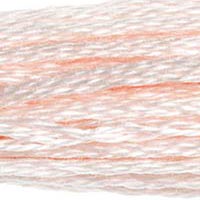
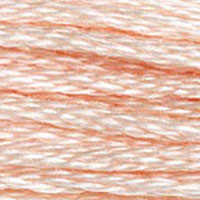
There's a specific problem that DMC 819 exists to solve, and once you understand it, you'll stop wondering why this color seems almost invisible on the skein. Needle painting and realistic floral cross-stitch need highlights — not white, because white kills the illusion, but something that reads as light-catching pink at the very edge of a petal where it would catch the most sun. That's Light Baby Pink. At hex #FFEEEB, it's so close to white that new stitchers sometimes question whether it's worth buying. It absolutely is.
The Highlight Problem in Floral Work
When you're building a realistic rose or peony from dark center out to lit edge, your journey runs something like DMC 326 (Very Dark Rose) through DMC 335 (Rose), DMC 899 (Medium Rose), DMC 818 (Baby Pink), and finally 819 as your palest note. Skip 819 and use white instead, and the petal loses its pink cast at the edges — it looks bleached rather than illuminated. Use 819 and the highlight retains a whisper of warmth that the eye reads as the same color viewed in stronger light rather than a different color entirely.
The same principle applies in any design that uses pale pink as a highlight rather than a base color. Ribbons on gift-wrap motifs, baby animal fur highlights, the light side of a sphere or balloon — all of these benefit from 819's barely-there pinkness over the flatness of pure white.
Where 819 Disappears (and Why That's Sometimes Useful)
On white 18-count Aida, 819 is very difficult to see while you're stitching. The thread virtually disappears against the fabric. This is a genuine challenge — many stitchers have made the frustrating mistake of leaving a section thinking it was unstitched only to discover later that it was already done in 819. A few strategies help: use a light box or work near a window where the dimensional quality of stitched versus unstitched fabric becomes more apparent, and consider temporarily placing a piece of gray paper behind your fabric while stitching 819 sections.
That same near-invisibility is genuinely useful in certain applications. Stitchers who add subtle texture or sheen to an otherwise white area — snow highlights, soap bubble effects, white fabric folds in a still-life piece — use 819 to add dimensionality without changing the apparent color of the white area. The finished piece reads as white but has a subtle depth that a pure white section lacks.
Companions and Palette Context
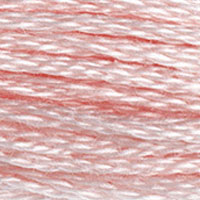
819 pairs naturally with DMC 818 (Baby Pink) as a family pair — the two are frequently used together in the same design, with 819 reserved for the lightest moments. Together with DMC 963 (Ultra Very Light Dusty Rose), 819, and 818, you have a complete pale-pink highlight system for soft, feminine, vintage-inspired work. Adding DMC 3716 (Very Light Dusty Rose) extends the range slightly warmer and more saturated without leaving the delicate register.
For evenweave and linen stitchers, 819 over-two on 28-count natural linen picks up the warm undertone of the fabric and reads as the palest antique rose — a genuinely beautiful effect in period-style pieces, herbal samplers, and botanical designs. The same thread that seems to almost vanish on white Aida becomes a soft, warm presence on linen, which is part of why stitching fabric choice matters as much as thread color choice.
Both Anchor 271 and Madeira 0501 earn exact match ratings, which makes 819 one of the better-supported colors across brands at this delicate value level. The fact that all three major manufacturers agree this closely on a near-white pink is actually quite useful — it means any of the three is a reliable choice if your usual brand is unavailable.
The caveat with exact matches at this pale end of the spectrum is that "exact" means exact in color, but thread sheen and texture still vary by brand. Cosmo thread tends to have a slightly silkier finish than DMC, which at this pale value can read as slightly different in person even when the color is matched. If you're mixing Cosmo 101 with DMC 819 in the same piece, check the two together before committing — the sheen difference may be visible in your specific fabric and lighting combination.
Sullivans 45221 is listed as close — a slight color shift rather than exact. For most applications at this pale range, the difference is likely imperceptible in finished work, but as always with substitutions, testing against your fabric before stitching is the safest approach.
Within DMC, if 819 is unavailable and you need something paler than DMC 818 (Baby Pink), your options are limited — you're very close to white, and the jump from 818 to white is larger than you'd hope. One option some stitchers use is blending a strand of 818 with a strand of white (DMC B5200 or Blanc) in a blended needle, which approximates 819's value without requiring the exact color.
Reference quality
How We Validate This Color Record
Use this page as a reference card for DMC 819: the structured data, quick conversions, and long-form copy are all tied back to the same stored color record.
- Methodology
- This page renders DMC 819, its hex value, and every brand equivalent from the site's source-of-truth color record, then checks long-form body copy against those same stored fields.
- Verification status
- Source-field checked. The page content is audited against the stored DMC number, brand equivalents, and match-quality labels before publishing.
- Last reviewed
- 2026-04-20
- Approximation warning
- Screen hex values, thread photos, and cross-brand conversions are reference aids. Dye lots, thread sheen, and fabric color can still shift the result in hand.
Decision guide
When to use the DMC 819 reference page
This page should help you decide faster between palette planning, brand substitution, and shade comparison without turning the color record into a thin lookup page.
Best for
- + Palette planning when you want the stored DMC 819 Light Baby Pink record, hex value #FFEEEB, and linked brand equivalents in one place.
- + Checking the quickest cross-brand shortlist before you buy floss, compare stash substitutes, or route into a more specific conversion page.
- + Finding nearby shades in the pinks family before you commit to accents, shading, or background blends.
Watch for
- ! Screen previews are only reference aids. Light Baby Pink can shift on real fabric because thread sheen, stitch coverage, and room lighting change how the color reads.
- ! A stored equivalent is still a shortlist, not a guarantee that two brands will disappear into each other in the same stitched motif.
- ! Older charts, discontinued kit floss, and dye-lot variation can all introduce small but visible differences that the page cannot detect for you.
Before you commit
- Confirm the role of DMC 819 Light Baby Pink: decide whether you need an exact hero shade, a forgiving background, or a rough stash substitute.
- Compare on project fabric: view the skein or stitched sample on the same fabric count and color you will actually use.
- Use the linked conversion pages next: open the brand-specific pages when you need match-quality caveats before substituting away from the DMC reference.
DMC 819 FAQ
These questions appear on the page so the FAQ schema stays aligned with what visitors can actually read.
What is the Anchor equivalent of DMC 819?+
The closest Anchor equivalent to DMC 819 (Light Baby Pink) is Anchor 271. This is an exact match.
What color is DMC 819?+
DMC 819 is called "Light Baby Pink" and has a hex color value of #FFEEEB. It belongs to the pinks color family.
What is the Madeira equivalent of DMC 819?+
The closest Madeira equivalent to DMC 819 (Light Baby Pink) is Madeira 0501. This is a close match.
How DMC 819 Looks on Fabric
The same thread appears different depending on your fabric. Always test on your project fabric.
White Aida
Cream / Ecru
Black Aida
Pairs Well With
DMC colors commonly used alongside 819 Light Baby Pink.


Detailed Conversions
Where to Buy DMC 819
This section contains affiliate links. We may earn a small commission at no cost to you.
Related Guides
Free Printable Thread Conversion Chart
Pick a brand, enter your email, and we'll send you a printable chart mapping all 552 DMC colors to that brand's equivalents. Zero spam, one chart.
Thanks! Here's your free chart:
Download Your ChartOpens in a new tab. Use your browser's Print → Save as PDF.
No spam. Your email is stored securely and never shared.