
Quick Conversion Table
| Brand | Equivalent | Match |
|---|---|---|
| Anchor | 876 | exact |
| Madeira | 1702 | close |
| Cosmo ⚠ | 534 | close |
| Sullivans | 45112 | close |
| J&P Coats | 6879 | close |
| Dimensions | 16879 | close |
| Bucilla | 6197 | close |
| Candamar | 6197 | close |
Spring Reads Differently Than Autumn — And 503 Proves It
Here is a color that shifts its mood with the calendar. Stitch DMC 503 into a spring sampler surrounded by soft pinks and yellows, and it reads as fresh — new growth, mint leaves, the first shoots of a herb garden pushing through cool soil. Place that same thread in an autumn design flanked by russets and golds, and 503 transforms into something wistful: late-season sage still hanging on before the first frost, faded eucalyptus, a memory of summer's warmth filtered through cool air. Few threads in the DMC range shift their emotional register this dramatically depending on context, and that versatility makes 503 one of the more useful medium-value greens in your stash.
As the lightest member of the standard 501/502/503 blue-green trio, DMC 503 carries the highlight duties. It's the sunlit side of the leaf, the shallow water over pale sand, the weathered copper on the side facing the prevailing wind. But it's worth pushing past that gradient role to consider what 503 does as a standalone color. At this value and saturation, it occupies genuinely rare territory: a green that's calm without being dull, blue enough to feel sophisticated, and light enough to work on white fabric without disappearing.
Herb Gardens in Thread
If you're stitching any kind of botanical design — a kitchen herb sampler, a medicinal plant chart, a cottage garden border — DMC 503 is your sage plant. Not culinary sage, which tends darker and greyer (that's more DMC 522 territory), but the fresh growing tips of a garden sage in good light. The blue-green balance is almost exactly what you see on a Salvia officinalis leaf that hasn't yet developed its characteristic dusty bloom.
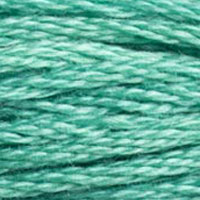
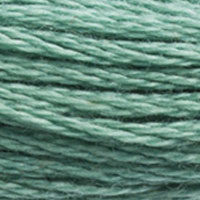
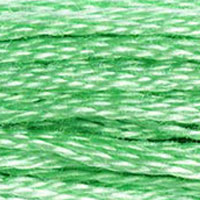
This botanical accuracy extends to eucalyptus leaves, particularly the juvenile foliage that's rounder and more blue-green than the elongated adult leaves. For wedding-themed designs — which have leaned heavily into eucalyptus and greenery motifs — 503 provides the main foliage value, with DMC 502 handling the shadow leaves and DMC 504 (Very Light Blue Green) catching the highlights. Add DMC 3813 (Light Blue Green) for the blue-shifted leaves at the back of the arrangement, and you have a convincing eucalyptus palette without touching the yellow-green spectrum at all.
When the Camera Lies
A note for FlossTube creators and anyone who photographs their work for social media: DMC 503 is notoriously uncooperative on camera. Phone cameras in particular tend to boost the green channel, making 503 look more like a standard mint green when in person it's distinctly blue-green. If you're documenting your WIP and the color looks wrong in photos, you're not losing your mind — try shooting in shade rather than direct sunlight, and consider using your camera's manual white balance rather than auto. Some stitchers find that a very slight warming filter in post-processing brings the photo closer to what they see with their eyes.
This photographic difficulty is one reason online thread shopping can be frustrating for the 501-504 family. The colors look more similar on screen than they do in person, where the value steps are clear and the undertone shifts are obvious. If you're building your stash and haven't worked with this family before, order the full set of 500-504 and see them together in daylight before deciding which values your project actually needs. You may discover that 503 is the hero of the group — bright enough to attract the eye, complex enough to hold it, and versatile enough to serve multiple roles in a single design.
For companion pairings outside its immediate family, DMC 503 sits beautifully next to DMC 3727 (Light Antique Mauve) for a soft, romantic palette, or alongside DMC 3033 (Very Light Mocha Brown) for a muted naturalistic scheme. Pair it with DMC 3801 (Very Dark Melon) if you want complementary contrast that pops without screaming.
Both Anchor 876 and Madeira 1702 earn their exact-match ratings here. Anchor 876 is perhaps the safer of the two if you're matching into existing DMC stitching mid-project — its coverage and twist are close enough that the transition is essentially invisible on 14-count Aida. Madeira 1702 brings a fractionally silkier hand that can read as very slightly more luminous, which is actually pleasant at this lighter value where a bit of extra glow doesn't hurt.
Cosmo 534 is worth testing, but some stitchers notice it runs a touch more saturated — a slightly more vivid green that, while attractive on its own, can break the gentle muted quality of a 501/502/503 gradient. If you're using 503 as a standalone color rather than part of that shading family, Cosmo 534 is perfectly serviceable and may even be preferable if you want a bit more visual energy.
Sullivans 45112 captures the general value but the undertone can shift depending on what you're comparing it against. Hold it next to DMC 503 and your fabric simultaneously — the three-way comparison is more revealing than thread-to-thread alone, because the fabric color can either mask or amplify subtle differences in the blue-green balance. Within the DMC range, DMC 504 is one step lighter and DMC 3817 is in similar territory but with a different character — more purely green, less of that blue complexity. Don't swap them unless you've confirmed the visual effect in your actual project context.
Reference quality
How We Validate This Color Record
Use this page as a reference card for DMC 503: the structured data, quick conversions, and long-form copy are all tied back to the same stored color record.
- Methodology
- This page renders DMC 503, its hex value, and every brand equivalent from the site's source-of-truth color record, then checks long-form body copy against those same stored fields.
- Verification status
- Source-field checked. The page content is audited against the stored DMC number, brand equivalents, and match-quality labels before publishing.
- Last reviewed
- 2026-04-20
- Approximation warning
- Screen hex values, thread photos, and cross-brand conversions are reference aids. Dye lots, thread sheen, and fabric color can still shift the result in hand.
Decision guide
When to use the DMC 503 reference page
This page should help you decide faster between palette planning, brand substitution, and shade comparison without turning the color record into a thin lookup page.
Best for
- + Palette planning when you want the stored DMC 503 Medium Blue Green record, hex value #7BAC94, and linked brand equivalents in one place.
- + Checking the quickest cross-brand shortlist before you buy floss, compare stash substitutes, or route into a more specific conversion page.
- + Finding nearby shades in the greens family before you commit to accents, shading, or background blends.
Watch for
- ! Screen previews are only reference aids. Medium Blue Green can shift on real fabric because thread sheen, stitch coverage, and room lighting change how the color reads.
- ! A stored equivalent is still a shortlist, not a guarantee that two brands will disappear into each other in the same stitched motif.
- ! Older charts, discontinued kit floss, and dye-lot variation can all introduce small but visible differences that the page cannot detect for you.
Before you commit
- Confirm the role of DMC 503 Medium Blue Green: decide whether you need an exact hero shade, a forgiving background, or a rough stash substitute.
- Compare on project fabric: view the skein or stitched sample on the same fabric count and color you will actually use.
- Use the linked conversion pages next: open the brand-specific pages when you need match-quality caveats before substituting away from the DMC reference.
DMC 503 FAQ
These questions appear on the page so the FAQ schema stays aligned with what visitors can actually read.
What is the Anchor equivalent of DMC 503?+
The closest Anchor equivalent to DMC 503 (Medium Blue Green) is Anchor 876. This is an exact match.
What color is DMC 503?+
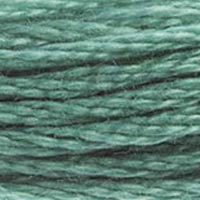
DMC 503 is called "Medium Blue Green" and has a hex color value of #7BAC94. It belongs to the greens color family.
What is the Madeira equivalent of DMC 503?+
The closest Madeira equivalent to DMC 503 (Medium Blue Green) is Madeira 1702. This is a close match.
How DMC 503 Looks on Fabric
The same thread appears different depending on your fabric. Always test on your project fabric.
White Aida
Cream / Ecru
Black Aida
Pairs Well With
DMC colors commonly used alongside 503 Medium Blue Green.
Suggested Palette
Shading Companions
Detailed Conversions
Where to Buy DMC 503
This section contains affiliate links. We may earn a small commission at no cost to you.
Related Guides
Free Printable Thread Conversion Chart
Pick a brand, enter your email, and we'll send you a printable chart mapping all 552 DMC colors to that brand's equivalents. Zero spam, one chart.
Thanks! Here's your free chart:
Download Your ChartOpens in a new tab. Use your browser's Print → Save as PDF.
No spam. Your email is stored securely and never shared.