
Quick Conversion Table
| Brand | Equivalent | Match |
|---|---|---|
| Anchor | 187 | exact |
| Madeira | 1114 | close |
| Cosmo ⚠ | 899 | close |
| Sullivans | 45293 | close |
| J&P Coats | 6186 | close |
| Dimensions | 16186 | close |
| Bucilla | 958 | close |
| Candamar | 6158 | close |
Seagreen at Its Darkest: Depth Without Murkiness
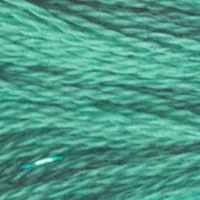
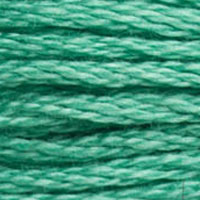
Stand at the edge of a dock over clear tropical water and look straight down. Not the reflective bright aqua near the surface, not the deep teal of open water — the water directly beneath you, where the color has both saturation and depth. That's the territory DMC 958 Dark Seagreen occupies. It's a genuinely rich green-teal with enough blue in it to feel aquatic but enough green to keep it from being classified as simply blue. And importantly, it's dark enough to do real work in shading — to provide a genuine shadow value rather than just being a midtone.
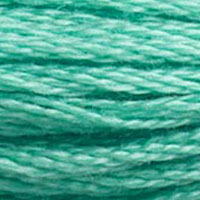
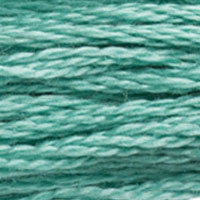
In the seagreen family, DMC 958 is the anchor (pun only slightly intended) of the four-value progression. DMC 959 (Medium Seagreen) sits above it, DMC 964 (Light Seagreen) is the lightest, and the transition across all three creates a convincing range for anything that needs aquatic depth. DMC 943 (Medium Aquamarine) is a nearby color with a slightly different character — more purely saturated — that pairs well with 958 in designs that need both vivid aqua and deep shadow.
Ocean and Water Design Workload
Any cross-stitch design featuring ocean, reef, river, or aquatic elements will use DMC 958 heavily. It's the shadow value in wave designs, the deeper water behind a reef shelf, the shade under lily pads in a pond scene. Mermaid and underwater fantasy compositions rely on 958 as the darkest component in their water palettes — deep enough to feel mysterious without becoming so dark that it loses its color character.
Tropical fish require this color for their darker body areas and fin details. Sea turtles, whose shells have complex green-teal-brown patterns, typically need 958 for some of their darker scute panels. Peacock feathers — a perennially popular cross-stitch subject — use this color for the dark rings that surround the eye spots.
The Unexpectedly Useful Kitchen and Garden Applications
Some stitchers are surprised to find DMC 958 in their hands for non-aquatic subjects, but the color genuinely earns its place in vegetable garden designs. Kale leaves, dark broccoli, deep-green spinach, and the inner leaves of a Savoy cabbage all fall in this saturated deep-green-teal range. For these subjects, 958 provides a realistic shadow value without the more neutral, muted quality of forest greens like DMC 987 or DMC 988 that might feel less alive.
For geometric and abstract designs where a vivid, deep teal-green is part of the palette — Aztec-inspired patterns, geometric florals, or stained glass effects — DMC 958 delivers real color impact while still being dark enough to create contrast against lighter values. It pairs beautifully with DMC 816 (Garnet), DMC 972 (Deep Canary), and DMC 792 (Dark Cornflower Blue) for jewel-tone palettes that feel rich and cohesive.
On evenweave or linen stitched over-two, DMC 958 has the coverage to read clearly even on a warm ground fabric. The green component is dominant enough that the warm tone of natural linen doesn't significantly muddy the color — a practical advantage over some more purely blue-toned colors that can shift surprisingly on cream or natural backgrounds.
Anchor 187 is an exact match for DMC 958, and this is a very well-supported conversion. Anchor's interpretation of this dark seagreen is reliably close in hue, which matters significantly because this color's specific blue-green balance is what makes it work in aquatic palettes. A substitute that tips too blue or too green would disrupt the seagreen family's internal logic.
Madeira 1114 is also exact. Madeira's slightly higher sheen gives this already-vivid dark color an additional richness that works particularly well in jewel-tone design palettes or in any design where the teal-green needs maximum visual impact.
Cosmo 899 is close but falls in a color range where Cosmo's slightly different saturation profile is most visible. Some stitchers report Cosmo's version as slightly more purely green than DMC 958's blue-green balance. In ocean and aquatic designs where the teal quality of 958 is specifically what you need, test before substituting.
Sullivans 45293 is listed as close. Works for projects where the general color family is more important than exact hue matching.
- For the complete seagreen shading progression: pair DMC 958 (dark) with DMC 959 (medium) and DMC 964 (light) — these three share enough character to work seamlessly together in any aquatic design.
- If DMC 958 reads too blue in a design context, DMC 991 (Dark Aquamarine) provides a nearby alternative with a slightly different green-blue balance that may integrate better with your palette.
Reference quality
How We Validate This Color Record
Use this page as a reference card for DMC 958: the structured data, quick conversions, and long-form copy are all tied back to the same stored color record.
- Methodology
- This page renders DMC 958, its hex value, and every brand equivalent from the site's source-of-truth color record, then checks long-form body copy against those same stored fields.
- Verification status
- Source-field checked. The page content is audited against the stored DMC number, brand equivalents, and match-quality labels before publishing.
- Last reviewed
- 2026-04-20
- Approximation warning
- Screen hex values, thread photos, and cross-brand conversions are reference aids. Dye lots, thread sheen, and fabric color can still shift the result in hand.
Decision guide
When to use the DMC 958 reference page
This page should help you decide faster between palette planning, brand substitution, and shade comparison without turning the color record into a thin lookup page.
Best for
- + Palette planning when you want the stored DMC 958 Dark Seagreen record, hex value #3EB6A1, and linked brand equivalents in one place.
- + Checking the quickest cross-brand shortlist before you buy floss, compare stash substitutes, or route into a more specific conversion page.
- + Finding nearby shades in the greens family before you commit to accents, shading, or background blends.
Watch for
- ! Screen previews are only reference aids. Dark Seagreen can shift on real fabric because thread sheen, stitch coverage, and room lighting change how the color reads.
- ! A stored equivalent is still a shortlist, not a guarantee that two brands will disappear into each other in the same stitched motif.
- ! Older charts, discontinued kit floss, and dye-lot variation can all introduce small but visible differences that the page cannot detect for you.
Before you commit
- Confirm the role of DMC 958 Dark Seagreen: decide whether you need an exact hero shade, a forgiving background, or a rough stash substitute.
- Compare on project fabric: view the skein or stitched sample on the same fabric count and color you will actually use.
- Use the linked conversion pages next: open the brand-specific pages when you need match-quality caveats before substituting away from the DMC reference.
DMC 958 FAQ
These questions appear on the page so the FAQ schema stays aligned with what visitors can actually read.
What is the Anchor equivalent of DMC 958?+
The closest Anchor equivalent to DMC 958 (Dark Seagreen) is Anchor 187. This is an exact match.
What color is DMC 958?+
DMC 958 is called "Dark Seagreen" and has a hex color value of #3EB6A1. It belongs to the greens color family.
What is the Madeira equivalent of DMC 958?+
The closest Madeira equivalent to DMC 958 (Dark Seagreen) is Madeira 1114. This is a close match.
How DMC 958 Looks on Fabric
The same thread appears different depending on your fabric. Always test on your project fabric.
White Aida
Cream / Ecru
Black Aida
Pairs Well With
DMC colors commonly used alongside 958 Dark Seagreen.
Suggested Palette
Shading Companions
Detailed Conversions
Where to Buy DMC 958
This section contains affiliate links. We may earn a small commission at no cost to you.
Related Guides
Free Printable Thread Conversion Chart
Pick a brand, enter your email, and we'll send you a printable chart mapping all 552 DMC colors to that brand's equivalents. Zero spam, one chart.
Thanks! Here's your free chart:
Download Your ChartOpens in a new tab. Use your browser's Print → Save as PDF.
No spam. Your email is stored securely and never shared.