
DMC 543 — Ultra Very Light Beige Brown
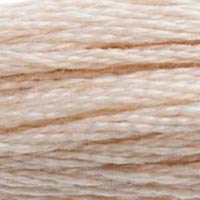
Browns family · Hex #F2E3CE
Quick Conversion Table
| Brand | Equivalent | Match |
|---|---|---|
| Anchor | 933 | exact |
| Madeira | 1909 | close |
| Cosmo ⚠ | 1000 | close |
| Sullivans | 45122 | close |
| J&P Coats | 2275 | close |
| Dimensions | 15533 | close |
The Ghost of Brown
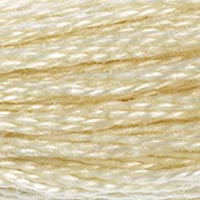
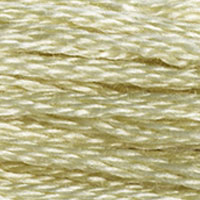
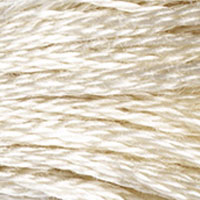
DMC 543 barely qualifies as brown. It's more of a memory — the faintest possible whisper of warm color against a pale background, like tea-stained paper or the inside of a seashell that's been bleached by years of sun. At this end of the beige brown family, you're working with color so subtle that it can disappear entirely on cream fabric, yet on white Aida it provides a warmth and softness that no grey or white can match. This is brown reduced to its atmospheric essence: not a color that names itself, but a color that changes the temperature of everything around it.
That subtlety is exactly what makes 543 valuable. In a full-coverage design on white fabric, stitching the background in 543 instead of Blanc or Ecru creates a warm, aged quality — like the design was stitched decades ago and has mellowed with time. It's the cross-stitch equivalent of "old paper" in graphic design: not white, not tan, but that barely-there warmth that signals age, warmth, and authenticity. Reproduction sampler stitchers love this trick. Instead of stitching a modern piece that looks modern and then waiting thirty years for it to age, use 543 for your background fill and it looks like a family heirloom from day one.
Primitive and Folk Art Sampler Traditions
The primitive sampler revival has brought threads like DMC 543 into the spotlight. Traditional samplers — the real antiques from the 1700s and 1800s — weren't stitched on white fabric. They were stitched on linen that started as a natural off-white and has since aged to various shades of warm beige. The "aged linen" look is foundational to the primitive sampler aesthetic, and when modern stitchers work these designs on white or cream Aida (because not everyone wants to stitch on linen), they use background fills in 543 or similar ultra-light beiges to recreate that mellowed quality.
Beyond backgrounds, 543 shows up in primitive samplers as the lightest value in motifs that would have been stitched in lighter silk or linen thread. Faded flowers, ghost-like alphabet letters that have nearly vanished with age, the lightest parts of house motifs where the original thread has all but disintegrated — 543 captures that poignant, time-worn quality. Pair it with DMC 3781 (Dark Mocha Brown), DMC 3787 (Dark Brown Grey), and DMC 407 (Medium Cocoa) for a palette that looks like it was extracted directly from a two-hundred-year-old sampler behind glass in a museum.
Brown Under Different Lighting: The Chameleon Value
Ultra-light colors like 543 are uniquely sensitive to their lighting environment. In bright, cool daylight, 543 reads as a warm off-white — you can see the beige tint clearly against white fabric. Under warm incandescent or warm-white LED light, the warmth amplifies and the thread looks more distinctly tan, almost like a very pale caramel. Under cool white fluorescent light, the warmth can drain almost entirely, leaving what looks like a slightly dirty white. This chameleonic quality means your piece will genuinely look different depending on where it hangs.
For background fills, this isn't usually a problem — the effect is always "warmer than white" regardless of the light source. But if you're using 543 as a motif color that needs to be visible, be aware that in some lighting conditions it may nearly disappear against cream fabric. Test a small area, stand back, squint, and decide whether you have enough contrast. On white Aida, 543 maintains visibility across all normal lighting conditions. On cream, you're on the edge. On natural linen, you're probably over the edge — the thread and fabric will merge.
Two strands on 14-count give you smooth, even coverage that creates a unified warm tone rather than individual stitches. This is one of those threads where you want your technique to be as invisible as possible — the goal is a field of warm color, not a grid of crosses. Railroad carefully, keep tension even, and work for flat, light-catching stitches. Any unevenness in thread lay is more visible in pale colors because the shadows cast by twisted or bunched strands create contrast that wouldn't be noticeable in a darker thread.
Substituting at the Edge of Color
When a color is this subtle, substitution becomes both easier and harder simultaneously. Easier, because the differences between candidates are tiny — we're talking about variations in an already barely-there beige. Harder, because those tiny differences can matter enormously in context: a substitute that's slightly too grey will read as cool and clinical instead of warm and aged, and a substitute that's slightly too yellow will look jaundiced against white fabric.
Anchor 933 is rated exact and captures the warm off-white quality faithfully. Madeira 1909, also exact, works well — at this paleness, Madeira's sheen is essentially invisible, so the difference in thread finish between brands doesn't affect the color impression. Both are safe, reliable choices.
Cosmo 1000 is close, and at this value level, "close" usually means "functionally identical in most contexts." The variation you'll find between dye lots of the same brand is likely as large as the variation between DMC 543 and Cosmo 1000. Sullivans 45122 is similarly close — if it looks right when held against your fabric in daylight, it is right.
Within DMC, the closest neighbors are DMC 842 (Very Light Beige Brown), which is distinctly darker — a clear step down rather than a substitute — and Ecru, which is similarly pale and warm but slightly more yellow. For background fill applications where 543 is creating an "aged" base, Ecru can work as an alternative, though the slightly different warmth may shift the overall mood. DMC 3033 (Very Light Mocha Brown) is another near-neighbor worth considering, slightly more grey-brown than 543's pure warm beige. Avoid DMC Blanc as a substitute — it completely lacks the warmth that makes 543 useful in the first place.
Reference quality
How We Validate This Color Record
Use this page as a reference card for DMC 543: the structured data, quick conversions, and long-form copy are all tied back to the same stored color record.
- Methodology
- This page renders DMC 543, its hex value, and every brand equivalent from the site's source-of-truth color record, then checks long-form body copy against those same stored fields.
- Verification status
- Source-field checked. The page content is audited against the stored DMC number, brand equivalents, and match-quality labels before publishing.
- Last reviewed
- 2026-04-20
- Approximation warning
- Screen hex values, thread photos, and cross-brand conversions are reference aids. Dye lots, thread sheen, and fabric color can still shift the result in hand.
Decision guide
When to use the DMC 543 reference page
This page should help you decide faster between palette planning, brand substitution, and shade comparison without turning the color record into a thin lookup page.
Best for
- + Palette planning when you want the stored DMC 543 Ultra Very Light Beige Brown record, hex value #F2E3CE, and linked brand equivalents in one place.
- + Checking the quickest cross-brand shortlist before you buy floss, compare stash substitutes, or route into a more specific conversion page.
- + Finding nearby shades in the browns family before you commit to accents, shading, or background blends.
Watch for
- ! Screen previews are only reference aids. Ultra Very Light Beige Brown can shift on real fabric because thread sheen, stitch coverage, and room lighting change how the color reads.
- ! A stored equivalent is still a shortlist, not a guarantee that two brands will disappear into each other in the same stitched motif.
- ! Older charts, discontinued kit floss, and dye-lot variation can all introduce small but visible differences that the page cannot detect for you.
Before you commit
- Confirm the role of DMC 543 Ultra Very Light Beige Brown: decide whether you need an exact hero shade, a forgiving background, or a rough stash substitute.
- Compare on project fabric: view the skein or stitched sample on the same fabric count and color you will actually use.
- Use the linked conversion pages next: open the brand-specific pages when you need match-quality caveats before substituting away from the DMC reference.
DMC 543 FAQ
These questions appear on the page so the FAQ schema stays aligned with what visitors can actually read.
What is the Anchor equivalent of DMC 543?+
The closest Anchor equivalent to DMC 543 (Ultra Very Light Beige Brown) is Anchor 933. This is an exact match.
What color is DMC 543?+
DMC 543 is called "Ultra Very Light Beige Brown" and has a hex color value of #F2E3CE. It belongs to the browns color family.
What is the Madeira equivalent of DMC 543?+
The closest Madeira equivalent to DMC 543 (Ultra Very Light Beige Brown) is Madeira 1909. This is a close match.
How DMC 543 Looks on Fabric
The same thread appears different depending on your fabric. Always test on your project fabric.
White Aida
Cream / Ecru
Black Aida
Pairs Well With
DMC colors commonly used alongside 543 Ultra Very Light Beige Brown.
Suggested Palette
Shading Companions
Detailed Conversions
Where to Buy DMC 543
This section contains affiliate links. We may earn a small commission at no cost to you.
Related Guides
Free Printable Thread Conversion Chart
Pick a brand, enter your email, and we'll send you a printable chart mapping all 552 DMC colors to that brand's equivalents. Zero spam, one chart.
Thanks! Here's your free chart:
Download Your ChartOpens in a new tab. Use your browser's Print → Save as PDF.
No spam. Your email is stored securely and never shared.