
Quick Conversion Table
| Brand | Equivalent | Match |
|---|---|---|
| Anchor | 390 | exact |
| Madeira | 1908 | close |
| Cosmo ⚠ | 365 | close |
| Sullivans | 45223 | close |
| J&P Coats | 5933 | close |
| Dimensions | 15830 | close |
| Bucilla | 822 | close |
| Candamar | 6255 | close |
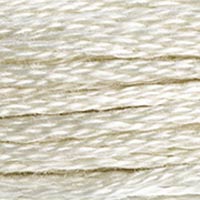
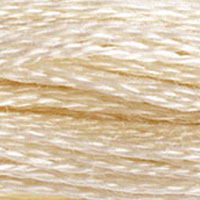
Some colors are invisible until you try to do without them. DMC 822 — Light Beige Gray at hex #E7E2D3 — falls squarely into that category. It's not a color that attracts attention in the skein, and new stitchers sometimes skip it in favor of something that looks more exciting. Then they attempt a stone wall, a sandy beach scene, an old wood texture, a concrete surface, animal fur, or a natural linen background fill, and discover that nothing in their stash produces the right quiet, weathered quality. That's when 822 gets purchased, and it rarely leaves the stash after that.
The Neutral That's Not Quite Any Other Neutral
Understanding 822's position in the neutral family helps explain its utility. It's warmer than a true cool gray — the beige undertone places it in the warm neutral zone rather than the cool. But it's cooler than a tan or sand color, with enough gray to prevent it from reading as beige. This warm-cool balance is precisely what makes it so versatile for natural textures, which are rarely purely warm or purely cool.
Compared to DMC 644 (Medium Beige Gray), 822 is the lighter value in the same family, and the two together make a functional pair for any surface that needs a subtle light-shadow distinction without strong color. Paired with DMC 644 for shadow and DMC 3866 (Ultra Very Light Mocha Brown) for the lightest highlight, you have a three-tone neutral system that can convincingly render stone, concrete, driftwood, or aged canvas.
Where Designers Actually Reach for 822
Architectural cross-stitch — buildings, castles, stone bridges, cobblestone streets — is the most obvious home for 822. The warm-gray cast reads naturally as aged stone without looking too yellow (sand-like) or too cool (clinical and metallic). European village scenes, medieval castle designs, and any piece that needs realistic masonry will lean on 822 heavily.
Animal fur rendering is another natural application. Rabbits, deer, some cat breeds, and many bird species have a warm gray-brown quality that 822 captures at the lighter end of their coat. Paired with DMC 640 (Very Dark Beige Gray) and DMC 642 (Dark Beige Gray) for the darker fur zones, 822 provides the highlight tones that make animal textures read as three-dimensional rather than flat.
Sampler backgrounds are a subtler use. Some stitchers use a very light coverage of 822 in evenweave background areas to unify a complex sampler — not filling fully, but using fractional stitches or strategic placement to warm up what would otherwise be an unfinished linen-colored negative space. The warmth of 822 bridges the gap between warm linen fabric and cooler design colors.
Technique Considerations
Light neutrals like 822 have a property that makes them particularly useful in blended needle work: they reduce the saturation of any color they're blended with while adding warmth. Two strands of DMC 3765 (Very Dark Peacock Blue) blended with one strand of 822 creates a muted teal that reads as naturally faded or aged. This technique is useful in antique-style and vintage-inspired designs where saturated modern colors look out of period.
On natural linen evenweave, 822 sometimes reads as nearly invisible — the fabric and thread are close enough in value and temperature that the stitching blends into the ground. If this is the effect you want, perfect. If not, move to 14-count or 18-count white Aida where the contrast is more readable, or consider going one value darker to DMC 644.
Anchor 390 and Madeira 1908 both earn exact match ratings — relatively unusual for warm neutrals, where undertone variations tend to be more noticeable than in saturated colors. The agreement across three major manufacturers suggests this is a well-calibrated and consistent shade.
Cosmo 365 is listed as close, and the difference tends to be in the gray-beige balance. Cosmo's version may read slightly cooler or slightly warmer depending on dye lot, but in most design contexts the difference is minor enough to be acceptable.
Sullivans 45223 is also a close match. As with most warm neutrals, the difference between close and exact is most visible when mixing brands within a single piece — if you're using Sullivans throughout a design, their equivalent will read correctly in context even if it doesn't match DMC skein-to-skein.
Within DMC, the obvious neighbors are DMC 644 (Medium Beige Gray), which is one value darker in the same family, and DMC 3866 (Ultra Very Light Mocha Brown), which is warmer and lighter. If 822 reads too light for your purpose, 644 is the natural step up. If it reads too gray and you need something warmer, DMC 3033 (Very Light Mocha Brown) shifts toward more beige warmth at a similar value.
One practical note: light neutrals occasionally develop a slight color cast from handling — oils from your hands, artificial light sources, even the color of your lap fabric. Keep your hands especially clean when working with 822 on white or pale Aida, and store completed sections away from direct light to prevent any unintended yellowing of the thread.
Reference quality
How We Validate This Color Record
Use this page as a reference card for DMC 822: the structured data, quick conversions, and long-form copy are all tied back to the same stored color record.
- Methodology
- This page renders DMC 822, its hex value, and every brand equivalent from the site's source-of-truth color record, then checks long-form body copy against those same stored fields.
- Verification status
- Source-field checked. The page content is audited against the stored DMC number, brand equivalents, and match-quality labels before publishing.
- Last reviewed
- 2026-04-20
- Approximation warning
- Screen hex values, thread photos, and cross-brand conversions are reference aids. Dye lots, thread sheen, and fabric color can still shift the result in hand.
Decision guide
When to use the DMC 822 reference page
This page should help you decide faster between palette planning, brand substitution, and shade comparison without turning the color record into a thin lookup page.
Best for
- + Palette planning when you want the stored DMC 822 Light Beige Gray record, hex value #E7E2D3, and linked brand equivalents in one place.
- + Checking the quickest cross-brand shortlist before you buy floss, compare stash substitutes, or route into a more specific conversion page.
- + Finding nearby shades in the neutrals family before you commit to accents, shading, or background blends.
Watch for
- ! Screen previews are only reference aids. Light Beige Gray can shift on real fabric because thread sheen, stitch coverage, and room lighting change how the color reads.
- ! A stored equivalent is still a shortlist, not a guarantee that two brands will disappear into each other in the same stitched motif.
- ! Older charts, discontinued kit floss, and dye-lot variation can all introduce small but visible differences that the page cannot detect for you.
Before you commit
- Confirm the role of DMC 822 Light Beige Gray: decide whether you need an exact hero shade, a forgiving background, or a rough stash substitute.
- Compare on project fabric: view the skein or stitched sample on the same fabric count and color you will actually use.
- Use the linked conversion pages next: open the brand-specific pages when you need match-quality caveats before substituting away from the DMC reference.
DMC 822 FAQ
These questions appear on the page so the FAQ schema stays aligned with what visitors can actually read.
What is the Anchor equivalent of DMC 822?+
The closest Anchor equivalent to DMC 822 (Light Beige Gray) is Anchor 390. This is an exact match.
What color is DMC 822?+
DMC 822 is called "Light Beige Gray" and has a hex color value of #E7E2D3. It belongs to the neutrals color family.
What is the Madeira equivalent of DMC 822?+
The closest Madeira equivalent to DMC 822 (Light Beige Gray) is Madeira 1908. This is a close match.
How DMC 822 Looks on Fabric
The same thread appears different depending on your fabric. Always test on your project fabric.
White Aida
Cream / Ecru
Black Aida
Pairs Well With
DMC colors commonly used alongside 822 Light Beige Gray.
Suggested Palette
Shading Companions
Detailed Conversions
Where to Buy DMC 822
This section contains affiliate links. We may earn a small commission at no cost to you.
Related Guides
Free Printable Thread Conversion Chart
Pick a brand, enter your email, and we'll send you a printable chart mapping all 552 DMC colors to that brand's equivalents. Zero spam, one chart.
Thanks! Here's your free chart:
Download Your ChartOpens in a new tab. Use your browser's Print → Save as PDF.
No spam. Your email is stored securely and never shared.