
Quick Conversion Table
| Brand | Equivalent | Match |
|---|---|---|
| Anchor | 274 | exact |
| Madeira | 1709 | close |
| Cosmo ⚠ | 981 | close |
| Sullivans | 45272 | close |
| J&P Coats | 6005 | close |
| Candamar | 6184 | close |
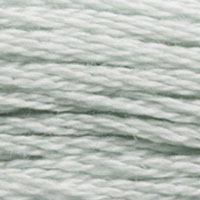
At the faint end of the Gray Green family, DMC 928 Very Light Gray Green solves a problem that many designs encounter: you need a pale near-white that isn't actually white, something that suggests air and light while carrying just enough color to prevent it from reading as blank. At #DDE3E3, it's clearly pale — genuinely light, functioning as a near-white in many contexts — but it has a blue-gray-green cast that gives it character. Placed on white Aida it's visibly colored; placed on linen or antique white it all but disappears into the ground. That behavior is often exactly what you want.
In the Gray Green family as a whole (924 through 928), 928 represents the ceiling — the lightest value, the place gradients end when they're building toward light. It's used when the surface in question needs to look almost washed out with brightness but with a color quality that maintains the cool, muted character of the Gray Green family. In realistic representations of glass, water reflections, pale ice, or very light-colored architectural stone, 928 occupies the bright highlight zone.
Working With Very Pale Colors
Very light threads like 928 present a consistent set of practical challenges. On white or near-white fabric, they can disappear into the ground — which is either a problem or a feature, depending on what you're trying to achieve. On 14-count Aida, working 928 on white fabric produces stitches that are clearly visible only in certain lighting conditions; on natural linen or antique white, there's more contrast between thread and ground, and the color reads more definitively.
Because pale threads are less forgiving of messy back-of-work management, knots and bulk on the reverse can show through to the front when working 928 in large areas. The loop start method and maintaining a tidy back are more important with pale colors than with darks, where any bleedthrough tends to be invisible.
Railroading is also more critical with very light threads. The visual difference between a well-laid, full stitch and a twisted one is most apparent in pale, lightly pigmented threads — the slight color shift from twist is more noticeable when there's less pigment to absorb the variation. Taking a few extra seconds to lay 928 stitches carefully in large fill areas pays off in the finished surface quality.
The Near-White Problem and Its Solutions
Experienced stitchers know that pure white (DMC Blanc or DMC B5200) can feel harsh or clinical in many design contexts — it reads as a gap rather than as a color. DMC 3865 (Winter White) is the standard solution, but 928 fills a different need: when the design calls for a pale near-white with a cool, slightly green-gray cast rather than a warm, clean white, 928 is the answer that 3865 isn't.
This makes 928 particularly useful in ocean and coastal designs (where pale highlights suggest sea foam or the sky reflected in water), architectural cross-stitch (where it reads as the color of old white-painted wood, or aged limestone in certain lights), and winter landscape pieces (where it suggests the cold color of snow in shadow, which is never actually white but a very pale blue-gray).
Paired with DMC 924 at the dark end and DMC 927 between them, a three-stop Gray Green gradient using just 924, 927, and 928 produces surprisingly effective shading in subjects where the full four-stop range would be overkill — small ornaments, bookmarks, and simpler botanical motifs where you need gray-green shading without committing to four separate thread colors.
Anchor 274 and Madeira 1709 both carry exact ratings, completing the full Gray Green family's reliable brand conversion record. Both are trustworthy substitutes for DMC 928. At this very light value, exact-rated equivalents are particularly reassuring — pale colors where a slight saturation or hue shift would affect how the color reads against adjacent pale tones or white fabric benefit from the additional precision that an exact rating suggests.
Anchor 274 reads comparably in most applications, though the exact chromatic character may be very subtly different. For designs where 928 appears as the lightest step in a gradient that's otherwise well-matched in Anchor, completing the gradient with Anchor 274 should produce consistent results.
Cosmo 981 and Sullivans 45272 carry close ratings. At very light values, close ratings warrant more careful attention than they do at mid-tones — the slight saturation difference that separates close from exact is relatively more visible when both colors are pale and the eye is working hard to distinguish them. Test against your specific fabric and the adjacent colors in your design before committing.
Within DMC, if 928 is unavailable, DMC 927 (Light Gray Green, one step darker) is the obvious family substitute. For applications where 928 functions as a pale near-white accent, DMC 3753 (Ultra Very Light Antique Blue) or DMC 747 (Very Light Sky Blue) cover adjacent pale cool territory, though with different color character. DMC 3865 (Winter White) is worth considering if you need pale and cool but the gray-green cast of 928 isn't specifically required.
Reference quality
How We Validate This Color Record
Use this page as a reference card for DMC 928: the structured data, quick conversions, and long-form copy are all tied back to the same stored color record.
- Methodology
- This page renders DMC 928, its hex value, and every brand equivalent from the site's source-of-truth color record, then checks long-form body copy against those same stored fields.
- Verification status
- Source-field checked. The page content is audited against the stored DMC number, brand equivalents, and match-quality labels before publishing.
- Last reviewed
- 2026-04-20
- Approximation warning
- Screen hex values, thread photos, and cross-brand conversions are reference aids. Dye lots, thread sheen, and fabric color can still shift the result in hand.
Decision guide
When to use the DMC 928 reference page
This page should help you decide faster between palette planning, brand substitution, and shade comparison without turning the color record into a thin lookup page.
Best for
- + Palette planning when you want the stored DMC 928 Very Light Gray Green record, hex value #DDE3E3, and linked brand equivalents in one place.
- + Checking the quickest cross-brand shortlist before you buy floss, compare stash substitutes, or route into a more specific conversion page.
- + Finding nearby shades in the greens family before you commit to accents, shading, or background blends.
Watch for
- ! Screen previews are only reference aids. Very Light Gray Green can shift on real fabric because thread sheen, stitch coverage, and room lighting change how the color reads.
- ! A stored equivalent is still a shortlist, not a guarantee that two brands will disappear into each other in the same stitched motif.
- ! Older charts, discontinued kit floss, and dye-lot variation can all introduce small but visible differences that the page cannot detect for you.
Before you commit
- Confirm the role of DMC 928 Very Light Gray Green: decide whether you need an exact hero shade, a forgiving background, or a rough stash substitute.
- Compare on project fabric: view the skein or stitched sample on the same fabric count and color you will actually use.
- Use the linked conversion pages next: open the brand-specific pages when you need match-quality caveats before substituting away from the DMC reference.
DMC 928 FAQ
These questions appear on the page so the FAQ schema stays aligned with what visitors can actually read.
What is the Anchor equivalent of DMC 928?+
The closest Anchor equivalent to DMC 928 (Very Light Gray Green) is Anchor 274. This is an exact match.
What color is DMC 928?+
DMC 928 is called "Very Light Gray Green" and has a hex color value of #DDE3E3. It belongs to the greens color family.
What is the Madeira equivalent of DMC 928?+
The closest Madeira equivalent to DMC 928 (Very Light Gray Green) is Madeira 1709. This is a close match.
How DMC 928 Looks on Fabric
The same thread appears different depending on your fabric. Always test on your project fabric.
White Aida
Cream / Ecru
Black Aida
Pairs Well With
DMC colors commonly used alongside 928 Very Light Gray Green.
Suggested Palette
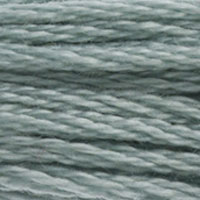
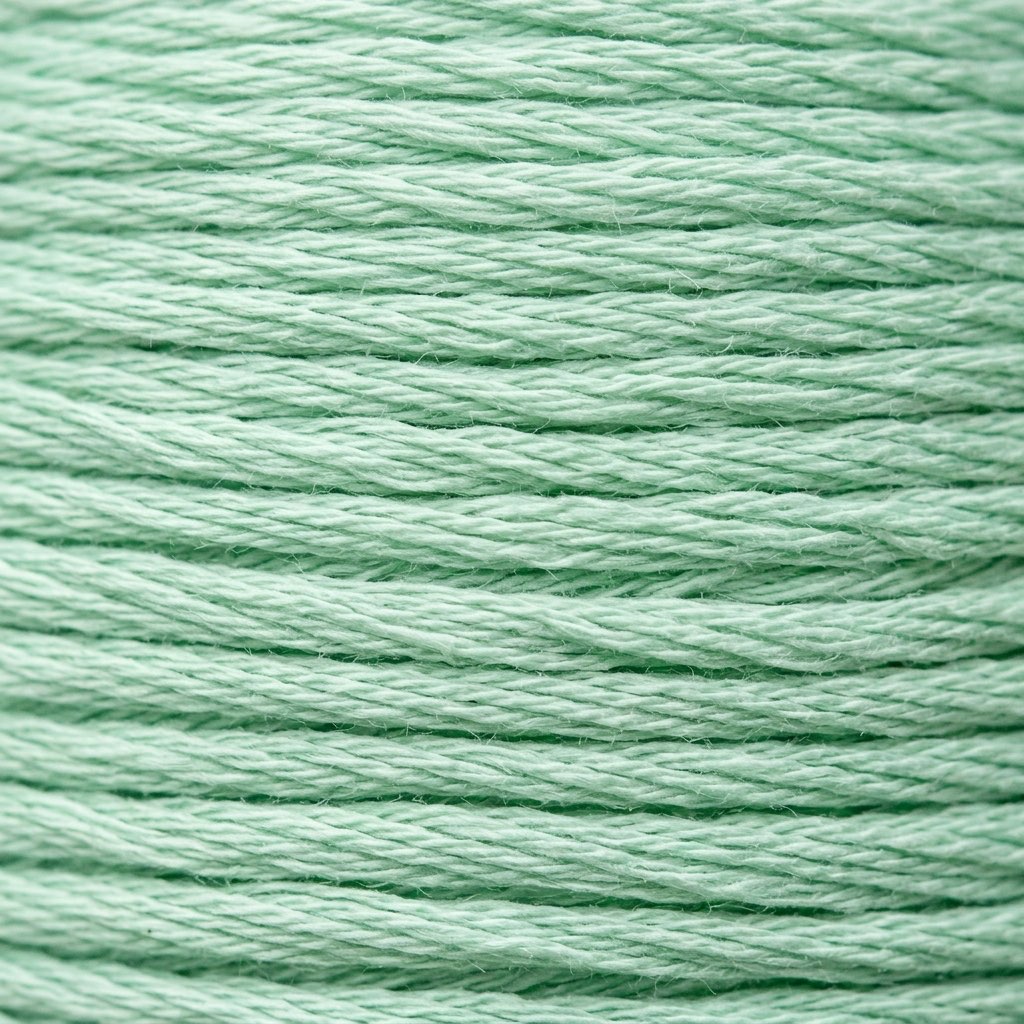
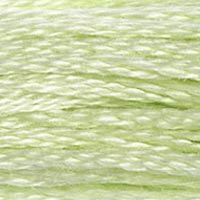
Shading Companions
Detailed Conversions
Where to Buy DMC 928
This section contains affiliate links. We may earn a small commission at no cost to you.
Related Guides
Free Printable Thread Conversion Chart
Pick a brand, enter your email, and we'll send you a printable chart mapping all 552 DMC colors to that brand's equivalents. Zero spam, one chart.
Thanks! Here's your free chart:
Download Your ChartOpens in a new tab. Use your browser's Print → Save as PDF.
No spam. Your email is stored securely and never shared.