
Quick Conversion Table
| Brand | Equivalent | Match |
|---|---|---|
| Anchor | 858 | exact |
| Madeira | 1511 | close |
| Cosmo ⚠ | 922 | close |
| Sullivans | 45120 | close |
| J&P Coats | 6015 | close |
| Bucilla | 524 | close |
The Lightest Whisper in the Fern Family
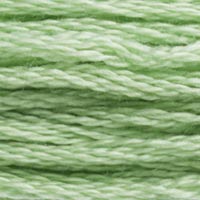
At the palest end of any green family, you reach a point where the color is more suggestion than statement. DMC 524 lives right at that threshold. It's the highlight value of the fern greens (520/522/523/524), and its job is to catch light — to represent the spot on a frond or leaf where sunshine washes out most of the pigment, leaving behind just enough green to signal "this is still foliage" before tipping into cream or white.
What keeps 524 from reading as simply pale yellow-green is a subtle grey quality inherited from its family. Even at this light value, there's a muted, chalky character that distinguishes it from the cleaner, brighter pale greens like DMC 369 (Very Light Pistachio Green) or DMC 772 (Very Light Yellow Green). The difference is subtle on a color card but significant in a design: 524 recedes where those brighter shades advance, making it ideal for backgrounds, fills, and large expanses of sky-lit foliage where you want coverage without competition.
Backgrounds That Breathe
Full-coverage background stitching in a pale thread tests both your patience and your technique. On 14-count white Aida, DMC 524 provides barely-there color that softens the starkness of blank white canvas without imposing itself. The effect is like a tinted ground — your design appears to float on a gentle wash of green-grey rather than sitting on clinical white. This is a technique borrowed from oil painting, where toned canvases change the entire mood of the work, and it translates beautifully to cross stitch.
For this background application, consistency matters enormously. Two strands, railroaded, with even tension throughout. Any variation in coverage will be visible because the color is so light — a thin spot or a gap shows the white Aida beneath and creates a distracting blotch. Consider using a laying tool if you don't already; at this pale value, perfectly flat stitches read as smoother and more uniform than twisted ones, and the uniformity is what makes a pale background work.
On cream or natural linen, 524 behaves differently. The warmth of the fabric absorbs some of the thread's already-minimal contrast, and 524 can start to blend into the fabric rather than sitting atop it. This can be lovely for a soft, aged sampler effect — the stitching and fabric become a single textured surface rather than distinct layers. But if you need clear stitch definition on warm fabric, step down to 523 instead.
Meadow Light and Open Spaces
Landscape designs use 524 for distance. In aerial perspective — the artistic principle that objects appear lighter, less saturated, and cooler as they recede — 524 represents the farthest green hills, the meadow at the horizon, the treeline that's more atmosphere than detail. This role makes it a crucial thread in any multi-plane landscape, where the depth of the scene depends on clear value separation between foreground, middle ground, and background.
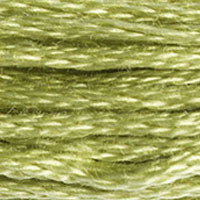
Pair 524 with DMC 3348 (Light Yellow Green) for sunlit meadow highlights, or with DMC 928 (Very Light Gray Green) if you're working a misty, overcast scene where the greens need to merge gradually with grey sky. For a complete distance gradient, work from DMC 520 in the foreground shadow through 522 and 523 in the middle ground, and let 524 handle the far hills before they dissolve into sky. It's a four-thread gradient that handles remarkable depth, all from a single well-designed color family.
Pale greens are where substitution precision matters most and matters least simultaneously. Most — because at light values, small hue shifts that would be invisible in a dark thread become quite apparent. Least — because the color is so subtle that the overall impact on a finished piece is gentle regardless.
Anchor 858 is your cleanest swap. It maintains the grey-green muting that defines the fern family even at this whisper-light value, and the coverage is equivalent strand for strand. Madeira 1511 matches well and brings a marginally smoother finish that can help with the uniformity challenges of large pale-fill areas.
Cosmo 922 is close but may read a touch more purely green — losing the grey overtone that keeps 524 in its specific lane. If you're using 524 for a tinted background effect, this slightly cleaner green quality could actually be desirable, reading as fresher and more spring-like. If you're using it as the highlight in a fern green gradient, maintaining the grey muting matters more for family coherence.
Within DMC, the closest neighbor is DMC 3348 (Light Yellow Green), which shares the light value but has a warmer, more yellow character without the grey. DMC 772 (Very Light Yellow Green) is even lighter and brighter. Neither is a true substitute — they're different threads for different purposes — but knowing where they sit relative to 524 helps you choose intentionally when building a pale green palette.
Reference quality
How We Validate This Color Record
Use this page as a reference card for DMC 524: the structured data, quick conversions, and long-form copy are all tied back to the same stored color record.
- Methodology
- This page renders DMC 524, its hex value, and every brand equivalent from the site's source-of-truth color record, then checks long-form body copy against those same stored fields.
- Verification status
- Source-field checked. The page content is audited against the stored DMC number, brand equivalents, and match-quality labels before publishing.
- Last reviewed
- 2026-04-20
- Approximation warning
- Screen hex values, thread photos, and cross-brand conversions are reference aids. Dye lots, thread sheen, and fabric color can still shift the result in hand.
Decision guide
When to use the DMC 524 reference page
This page should help you decide faster between palette planning, brand substitution, and shade comparison without turning the color record into a thin lookup page.
Best for
- + Palette planning when you want the stored DMC 524 Very Light Fern Green record, hex value #C4CDAC, and linked brand equivalents in one place.
- + Checking the quickest cross-brand shortlist before you buy floss, compare stash substitutes, or route into a more specific conversion page.
- + Finding nearby shades in the greens family before you commit to accents, shading, or background blends.
Watch for
- ! Screen previews are only reference aids. Very Light Fern Green can shift on real fabric because thread sheen, stitch coverage, and room lighting change how the color reads.
- ! A stored equivalent is still a shortlist, not a guarantee that two brands will disappear into each other in the same stitched motif.
- ! Older charts, discontinued kit floss, and dye-lot variation can all introduce small but visible differences that the page cannot detect for you.
Before you commit
- Confirm the role of DMC 524 Very Light Fern Green: decide whether you need an exact hero shade, a forgiving background, or a rough stash substitute.
- Compare on project fabric: view the skein or stitched sample on the same fabric count and color you will actually use.
- Use the linked conversion pages next: open the brand-specific pages when you need match-quality caveats before substituting away from the DMC reference.
DMC 524 FAQ
These questions appear on the page so the FAQ schema stays aligned with what visitors can actually read.
What is the Anchor equivalent of DMC 524?+
The closest Anchor equivalent to DMC 524 (Very Light Fern Green) is Anchor 858. This is an exact match.
What color is DMC 524?+
DMC 524 is called "Very Light Fern Green" and has a hex color value of #C4CDAC. It belongs to the greens color family.
What is the Madeira equivalent of DMC 524?+
The closest Madeira equivalent to DMC 524 (Very Light Fern Green) is Madeira 1511. This is a close match.
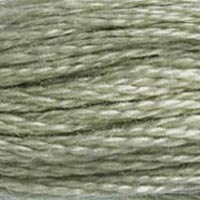
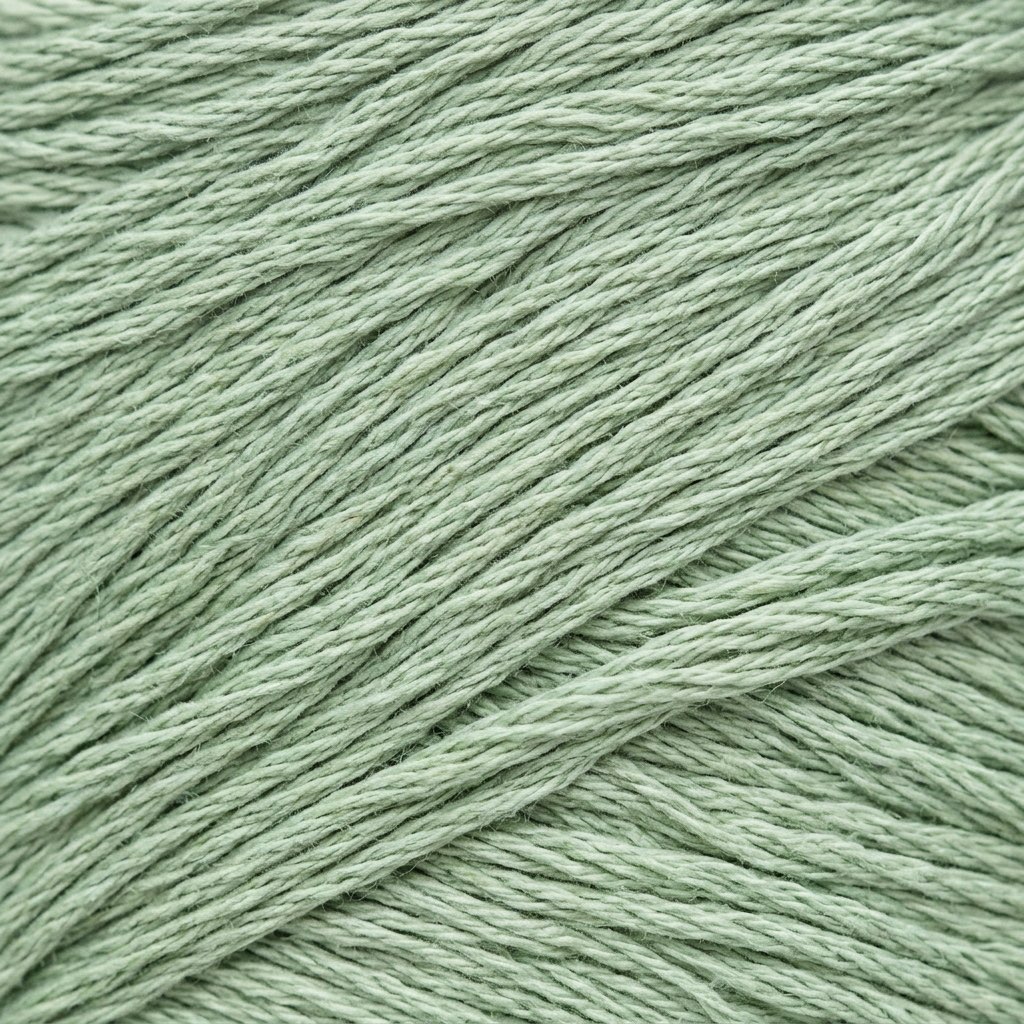
How DMC 524 Looks on Fabric
The same thread appears different depending on your fabric. Always test on your project fabric.
White Aida
Cream / Ecru
Black Aida
Pairs Well With
DMC colors commonly used alongside 524 Very Light Fern Green.
Suggested Palette
Shading Companions
Detailed Conversions
Where to Buy DMC 524
This section contains affiliate links. We may earn a small commission at no cost to you.
Related Guides
Free Printable Thread Conversion Chart
Pick a brand, enter your email, and we'll send you a printable chart mapping all 552 DMC colors to that brand's equivalents. Zero spam, one chart.
Thanks! Here's your free chart:
Download Your ChartOpens in a new tab. Use your browser's Print → Save as PDF.
No spam. Your email is stored securely and never shared.