
Quick Conversion Table
| Brand | Equivalent | Match |
|---|---|---|
| Anchor | 240 | close |
| Madeira | 1209 | close |
| Cosmo ⚠ | 970 | close |
| Sullivans | 45479 | close |
| J&P Coats | 6016 | close |
Spring's First Real Green
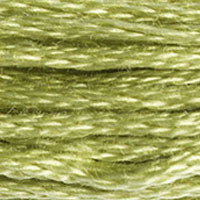
There's a specific week in spring — maybe early April in temperate climates, later further north — when the trees that have been bare all winter suddenly push out their first leaves. Not the deep, settled greens of summer. Not the acid-yellow of the very earliest buds. Something in between: soft, bright, full of light, unmistakably alive. That's DMC 164. It's the green of a forest that's just waking up, and it carries that same feeling of relief and possibility that the actual season does.
Technically, 164 is a light-value green with a warm, slightly yellowish undertone — not aggressively yellow like the chartreuse shades, but enough warmth to separate it clearly from the cool mint and celadon families. It's the kind of green that works beautifully in dappled light areas of a design, where tree canopy thins and sunlight filters through young leaves. It says "new growth" in a way that darker greens simply can't.
Where 164 Earns Its Place on the Thread List
In landscape and nature designs, 164 shows up most often as the highlight green — the lightest value in a canopy gradient, or the sunlit tops of hedgerows, or new grass pushing up through darker established lawn. It pairs naturally downward with DMC 3363 (Medium Pine Green) and DMC 3362 (Dark Pine Green) for a three-step forest canopy that moves from shadow to light convincingly. Add DMC 3364 (Pine Green) as an intermediate step and you have one of the most-used four-shade gradients in the entire green family.
But landscape work isn't the only place 164 shines. This is a remarkably popular thread for floral cross-stitch, where it serves as the go-to leaf color for spring bouquet designs. It's light enough that it doesn't compete with the flowers — the actual focal point — while still reading unmistakably as foliage. Pair it with DMC 3689 (Light Mauve) and DMC 3354 (Light Dusty Rose) for a cottage garden feel that's become practically a cliche in the SAL community, but became a cliche because it genuinely works.
On fabric choice: 164 is light enough that fabric color significantly impacts how it reads. On white Aida, it's fresh and crisp — perfect for modern, clean designs. On cream or antique white, it warms up and softens, picking up an almost sage quality that suits vintage-inspired samplers. On oatmeal linen, it practically melts into the background in a way that can be beautiful for subtle texture work but frustrating if you need the color to carry a design element. If you're stitching 164 on linen, make sure your design doesn't rely on it for contrast — at this value, the line between "subtle" and "invisible" gets thin.
Coverage note: two strands on 14-count Aida give full, plush coverage. On 18-count, two strands still work but you'll want to watch your tension — light greens show fabric peeking through more visibly than darks, and any gaps read as white spots rather than gentle texture. Railroad your stitches on 18-count and higher to keep the coverage even and the color consistent.
Madeira 1209 is rated an exact match here, which is notable — exact matches at this specific light-warm-green intersection aren't common. If you can source Madeira 1209, it should slot in seamlessly. The slightly silkier Madeira finish is almost imperceptible at this light value, where the thread surface reflects plenty of light regardless of brand.
Anchor 240 gets you close, though some stitchers find it pulls very slightly cooler than DMC 164. In a mixed-brand project where 164 is surrounded by other DMC greens, this minor temperature shift can sometimes create an odd-one-out effect. Hold them side by side on your chosen fabric in daylight before committing — if you can see the difference off the needle, you'll see it on the fabric.
Cosmo 970 and Sullivans 45479 both land in the general neighborhood. The key thing to watch for with any substitute at this light value is whether the yellow-green warmth is preserved. Cool light greens exist in abundance across all thread brands, but DMC 164's specific charm is that gentle warmth. A substitute that skews minty or celadon will change the entire mood of a spring-themed piece.
Within the DMC range, DMC 3348 (Light Yellow Green) is a near neighbor that some stitchers accidentally swap for 164. They're similar but not identical: 3348 pushes slightly more yellow and reads a touch brighter. In a design that calls for both, they create a lovely one-step gradation. But they're not interchangeable — 164 reads more definitively as "green" while 3348 starts flirting with chartreuse territory.
Reference quality
How We Validate This Color Record
Use this page as a reference card for DMC 164: the structured data, quick conversions, and long-form copy are all tied back to the same stored color record.
- Methodology
- This page renders DMC 164, its hex value, and every brand equivalent from the site's source-of-truth color record, then checks long-form body copy against those same stored fields.
- Verification status
- Source-field checked. The page content is audited against the stored DMC number, brand equivalents, and match-quality labels before publishing.
- Last reviewed
- 2026-04-20
- Approximation warning
- Screen hex values, thread photos, and cross-brand conversions are reference aids. Dye lots, thread sheen, and fabric color can still shift the result in hand.
Decision guide
When to use the DMC 164 reference page
This page should help you decide faster between palette planning, brand substitution, and shade comparison without turning the color record into a thin lookup page.
Best for
- + Palette planning when you want the stored DMC 164 Light Forest Green record, hex value #C8D8B8, and linked brand equivalents in one place.
- + Checking the quickest cross-brand shortlist before you buy floss, compare stash substitutes, or route into a more specific conversion page.
- + Finding nearby shades in the greens family before you commit to accents, shading, or background blends.
Watch for
- ! Screen previews are only reference aids. Light Forest Green can shift on real fabric because thread sheen, stitch coverage, and room lighting change how the color reads.
- ! A stored equivalent is still a shortlist, not a guarantee that two brands will disappear into each other in the same stitched motif.
- ! Older charts, discontinued kit floss, and dye-lot variation can all introduce small but visible differences that the page cannot detect for you.
Before you commit
- Confirm the role of DMC 164 Light Forest Green: decide whether you need an exact hero shade, a forgiving background, or a rough stash substitute.
- Compare on project fabric: view the skein or stitched sample on the same fabric count and color you will actually use.
- Use the linked conversion pages next: open the brand-specific pages when you need match-quality caveats before substituting away from the DMC reference.
DMC 164 FAQ
These questions appear on the page so the FAQ schema stays aligned with what visitors can actually read.
What is the Anchor equivalent of DMC 164?+
The closest Anchor equivalent to DMC 164 (Light Forest Green) is Anchor 240. This is a close match.
What color is DMC 164?+
DMC 164 is called "Light Forest Green" and has a hex color value of #C8D8B8. It belongs to the greens color family.
What is the Madeira equivalent of DMC 164?+
The closest Madeira equivalent to DMC 164 (Light Forest Green) is Madeira 1209. This is a close match.
How DMC 164 Looks on Fabric
The same thread appears different depending on your fabric. Always test on your project fabric.
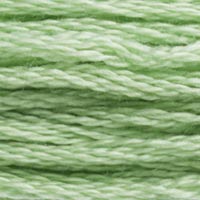
White Aida
Cream / Ecru
Black Aida
Pairs Well With
DMC colors commonly used alongside 164 Light Forest Green.
Suggested Palette
Shading Companions
Detailed Conversions
Where to Buy DMC 164
This section contains affiliate links. We may earn a small commission at no cost to you.
Related Guides
Free Printable Thread Conversion Chart
Pick a brand, enter your email, and we'll send you a printable chart mapping all 552 DMC colors to that brand's equivalents. Zero spam, one chart.
Thanks! Here's your free chart:
Download Your ChartOpens in a new tab. Use your browser's Print → Save as PDF.
No spam. Your email is stored securely and never shared.