
Quick Conversion Table
| Brand | Equivalent | Match |
|---|---|---|
| Anchor | 859 | exact |
| Madeira | 1512 | close |
| Cosmo ⚠ | 923 | close |
| Sullivans | 45119 | close |
| J&P Coats | 6015 | close |
| Bucilla | 6078 | close |
Pistachio Shells and Painted Shutters
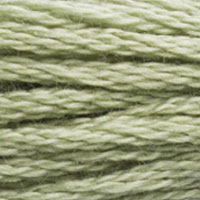
Some greens announce themselves. DMC 523 doesn't. It's the color of pistachio shells — not the nut inside, which is a deeper, more vivid green, but the pale, sun-bleached exterior of the shell itself. It's also the exact shade of those painted wooden shutters you see on farmhouses in Provence and Tuscany, the ones that started as a brighter green a decade ago and have faded to something soft, chalky, and completely beautiful. This is a green that has lived a little, and it shows.
Within the fern green family (520/522/523/524), DMC 523 occupies the light-medium position — bright enough to catch light but muted enough to sit comfortably next to the paler 524 without creating a jarring value jump. Its yellow undertone is more evident at this lighter value than in the darker 520 or 522, giving it a warmth that reads as sunlit and natural. This is not a cool green, and treating it like one in a design will create problems. Pair it with warm companions — golds, tans, warm pinks — and it sings. Put it next to icy blues or pure whites and it can look oddly yellow.
The Dye Lot Question
If there's one shade in the fern green family where dye lot variation is most noticeable, it's 523. At this mid-light value, the balance between the green and yellow pigment components is delicate, and small shifts in dye concentration can produce visible differences between skeins purchased years apart. This is generally not a problem if you buy enough skeins at once for your project, but it becomes an issue if you run out mid-piece and order a replacement.
The practical advice: buy one extra skein of 523 when you start any project that uses it heavily. If your project calls for two skeins, buy three. The cost is minimal compared to the frustration of getting a replacement skein from a different dye lot and seeing a visible line where old meets new in a large fill area. Some stitchers mitigate dye lot risk by alternating between skeins throughout a project — stitch a few rows with skein A, switch to skein B, alternate throughout — so that any variation distributes evenly rather than concentrating in one area.
Samplers, Seasons, and Context-Shifting
Light Fern Green is one of those threads that shifts meaning depending on what's around it. In a spring design — surrounded by DMC 3716 (Very Light Dusty Rose) and DMC 745 (Light Pale Yellow) — it reads as new growth, fresh and tender. In an autumn design alongside DMC 3826 (Golden Brown) and DMC 3776 (Light Mahogany), the same thread becomes aging foliage, still green but leaning toward the yellow that precedes a leaf's final turn.
This seasonal flexibility makes 523 particularly valuable in year-round sampler designs and seasonal rotation projects. For a four-seasons sampler, you can use 523 in both the spring and autumn panels with completely different emotional results, reducing your total thread count without sacrificing seasonal accuracy. It also works beautifully in wedding samplers where a soft, natural green is needed for wreaths and garlands — less vivid than the emerald greens, less grey than the celadons, with a warmth that harmonizes with the ivory and gold tones typical of wedding color palettes.
On fabric, 523 is light enough that it can start to lose contrast on white Aida, particularly under artificial light. On cream evenweave or natural linen, it has better presence and reads as more distinctly green. If you're working on white fabric and finding that 523 looks washed out, check your lighting before changing your thread — this shade looks significantly better in natural daylight than under most LED lamps.
Anchor 859 is a clean, reliable match — hue, value, and undertone all align without surprises. If you're mid-project and your local shop is out of DMC 523, Anchor 859 is the one I'd walk out with confidently. Madeira 1512 is equally matched, and its slightly smoother finish can actually enhance the soft, chalky quality that makes 523 appealing in the first place.
Where substitution gets tricky is with Cosmo 923 It's a close match in the general sense — similar value, similar green family — but some batches skew marginally more saturated, which at this light value can be the difference between "muted and organic" and "clean and leafy." If your design depends on the muted quality (historical reproductions, primitive samplers, autumn scenes), audition Cosmo 897 against your actual fabric first.
Sullivans 45119 is another close-enough option that benefits from in-person comparison before committing. The general territory is right, but thread finish and twist can affect how the color reads at this light value more than at darker values, where the depth of pigment overwhelms subtle surface differences.
Within DMC, resist swapping 523 for DMC 3013 (Light Khaki Green). Despite surface similarity, 3013 is warmer and more yellow — explicitly khaki where 523 is still clearly green with yellow warmth. The distinction matters in botanical contexts where the eye is sensitive to the green-versus-yellow balance in foliage.
Reference quality
How We Validate This Color Record
Use this page as a reference card for DMC 523: the structured data, quick conversions, and long-form copy are all tied back to the same stored color record.
- Methodology
- This page renders DMC 523, its hex value, and every brand equivalent from the site's source-of-truth color record, then checks long-form body copy against those same stored fields.
- Verification status
- Source-field checked. The page content is audited against the stored DMC number, brand equivalents, and match-quality labels before publishing.
- Last reviewed
- 2026-04-20
- Approximation warning
- Screen hex values, thread photos, and cross-brand conversions are reference aids. Dye lots, thread sheen, and fabric color can still shift the result in hand.
Decision guide
When to use the DMC 523 reference page
This page should help you decide faster between palette planning, brand substitution, and shade comparison without turning the color record into a thin lookup page.
Best for
- + Palette planning when you want the stored DMC 523 Light Fern Green record, hex value #ABB197, and linked brand equivalents in one place.
- + Checking the quickest cross-brand shortlist before you buy floss, compare stash substitutes, or route into a more specific conversion page.
- + Finding nearby shades in the greens family before you commit to accents, shading, or background blends.
Watch for
- ! Screen previews are only reference aids. Light Fern Green can shift on real fabric because thread sheen, stitch coverage, and room lighting change how the color reads.
- ! A stored equivalent is still a shortlist, not a guarantee that two brands will disappear into each other in the same stitched motif.
- ! Older charts, discontinued kit floss, and dye-lot variation can all introduce small but visible differences that the page cannot detect for you.
Before you commit
- Confirm the role of DMC 523 Light Fern Green: decide whether you need an exact hero shade, a forgiving background, or a rough stash substitute.
- Compare on project fabric: view the skein or stitched sample on the same fabric count and color you will actually use.
- Use the linked conversion pages next: open the brand-specific pages when you need match-quality caveats before substituting away from the DMC reference.
DMC 523 FAQ
These questions appear on the page so the FAQ schema stays aligned with what visitors can actually read.
What is the Anchor equivalent of DMC 523?+
The closest Anchor equivalent to DMC 523 (Light Fern Green) is Anchor 859. This is an exact match.
What color is DMC 523?+
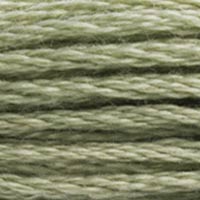
DMC 523 is called "Light Fern Green" and has a hex color value of #ABB197. It belongs to the greens color family.
What is the Madeira equivalent of DMC 523?+
The closest Madeira equivalent to DMC 523 (Light Fern Green) is Madeira 1512. This is a close match.
How DMC 523 Looks on Fabric
The same thread appears different depending on your fabric. Always test on your project fabric.
White Aida
Cream / Ecru
Black Aida
Pairs Well With
DMC colors commonly used alongside 523 Light Fern Green.
Suggested Palette
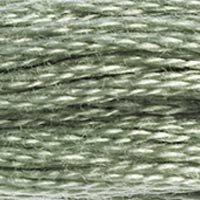
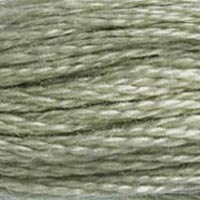
Shading Companions
Detailed Conversions
Where to Buy DMC 523
This section contains affiliate links. We may earn a small commission at no cost to you.
Related Guides
Free Printable Thread Conversion Chart
Pick a brand, enter your email, and we'll send you a printable chart mapping all 552 DMC colors to that brand's equivalents. Zero spam, one chart.
Thanks! Here's your free chart:
Download Your ChartOpens in a new tab. Use your browser's Print → Save as PDF.
No spam. Your email is stored securely and never shared.