
Quick Conversion Table
| Brand | Equivalent | Match |
|---|---|---|
| Anchor | 1020 | exact |
| Madeira | 0502 | close |
| Cosmo ⚠ | 851 | close |
| Sullivans | 45363 | close |
| J&P Coats | 3067 | close |
| Dimensions | 13067 | close |
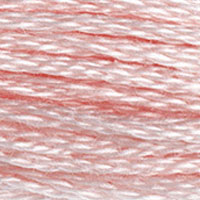
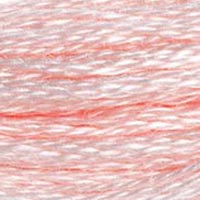
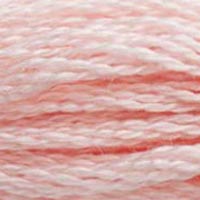
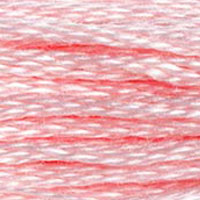
Very Light Salmon is one of those colors that earns its keep by being almost invisible. It appears in designs as the lightest skin tone, the palest blush on a white rose, the faintest warm glow at the edge of a highlight — areas where the thread must be present but must not announce itself. DMC 3713 at #FFE2E2 accomplishes this: it's warm and peachy-pink without the saturation to call attention. It does its job quietly, which is sometimes exactly the job.
Skin Tone Foundation
In realistic cross-stitch — portraiture, figure work, character designs — 3713 frequently serves as the lightest skin value for warm complexions. Its peachy warmth prevents it from reading as chalky or cool, which pale pinks and near-whites often do. When you're building a skin tone sequence from shadow to highlight, 3713 at the lightest end signals that the highlight is warm rather than neutral — a subtlety that separates convincing skin rendering from the flat, cardboard-figure look that bothers experienced stitchers.
The specific palette that many needle painters use for light, warm complexions works something like this: DMC 3712 (Medium Salmon) for mid-tones, DMC 3700 (Light Salmon) for slightly deeper shadows, DMC 3713 for the palest highlights, with perhaps a touch of blanc for the absolute brightest catch light. This sequence produces warm, living skin tones that stand up to close examination — important in portrait pieces that invite scrutiny.
Floral Highlight Work
Beyond skin tones, Very Light Salmon serves as the extreme highlight in warm pink and peach floral sequences. In flowers that are naturally warm-pink — blush roses, peach dahlias, certain peonies — the petal tips and sun-catching edges need to be almost white but warm rather than cool. Using 3713 rather than blanc or very pale neutral pinks in these positions keeps the flower's warmth character intact all the way into the highlight register.
For sampler borders and decorative elements where a warm, very pale pink is needed as background or secondary fill, 3713 provides coverage that reads as presence without dominating. On cream or ecru fabric, it nearly disappears against the background unless the design relies on the contrast — this can be either a problem (if you want the color to show clearly) or a feature (if you want a subtle, tone-on-tone quality).
Very Light Salmon pairs naturally with DMC 3756 (Ultra Very Light Baby Blue) for very soft, warm-cool combinations in birth samplers and nursery designs, with DMC 3747 (Very Light Blue Violet) for gentle complementary contrast, and with DMC 3689 (Light Mauve) for quiet multi-hue pale palettes that feel gentle rather than bland. The key is keeping everything in the pale range — mixing 3713 with strongly saturated colors just makes the pale thread disappear.
Anchor 1020 is an exact match and is the most reliable substitute available. For very pale colors like 3713, the exact match rating genuinely matters — at this value level, even small hue differences are visible because there's no depth of color to absorb and mask them. Anchor 1020 can be used with confidence for all project types.
Madeira 0502 is listed as close rather than exact, suggesting it lands slightly differently in value or hue — worth swatching for sensitive applications like skin tone work. Cosmo 851 and Sullivans 45363 are close matches. For pale colors, the Sullivans sheen advantage can make 3713 equivalents read brighter than the matte DMC original, which may be a consideration if highlight brightness needs to be calibrated precisely.
Within DMC, DMC 3706 (Medium Melon) and DMC 3708 (Light Melon) are both warmer and more orange; DMC 819 (Light Baby Pink) goes cooler and more cleanly pink. DMC 948 (Very Light Peach) occupies nearby pale warm territory and can substitute in some applications, particularly skin tone work, where a less pink and more neutral-peach quality is acceptable. Test any pale substitution in context — pale colors interact with fabric color and neighboring threads in ways that are hard to predict without a physical swatch.
Reference quality
How We Validate This Color Record
Use this page as a reference card for DMC 3713: the structured data, quick conversions, and long-form copy are all tied back to the same stored color record.
- Methodology
- This page renders DMC 3713, its hex value, and every brand equivalent from the site's source-of-truth color record, then checks long-form body copy against those same stored fields.
- Verification status
- Source-field checked. The page content is audited against the stored DMC number, brand equivalents, and match-quality labels before publishing.
- Last reviewed
- 2026-04-20
- Approximation warning
- Screen hex values, thread photos, and cross-brand conversions are reference aids. Dye lots, thread sheen, and fabric color can still shift the result in hand.
Decision guide
When to use the DMC 3713 reference page
This page should help you decide faster between palette planning, brand substitution, and shade comparison without turning the color record into a thin lookup page.
Best for
- + Palette planning when you want the stored DMC 3713 Very Light Salmon record, hex value #FFE2E2, and linked brand equivalents in one place.
- + Checking the quickest cross-brand shortlist before you buy floss, compare stash substitutes, or route into a more specific conversion page.
- + Finding nearby shades in the pinks family before you commit to accents, shading, or background blends.
Watch for
- ! Screen previews are only reference aids. Very Light Salmon can shift on real fabric because thread sheen, stitch coverage, and room lighting change how the color reads.
- ! A stored equivalent is still a shortlist, not a guarantee that two brands will disappear into each other in the same stitched motif.
- ! Older charts, discontinued kit floss, and dye-lot variation can all introduce small but visible differences that the page cannot detect for you.
Before you commit
- Confirm the role of DMC 3713 Very Light Salmon: decide whether you need an exact hero shade, a forgiving background, or a rough stash substitute.
- Compare on project fabric: view the skein or stitched sample on the same fabric count and color you will actually use.
- Use the linked conversion pages next: open the brand-specific pages when you need match-quality caveats before substituting away from the DMC reference.
DMC 3713 FAQ
These questions appear on the page so the FAQ schema stays aligned with what visitors can actually read.
What is the Anchor equivalent of DMC 3713?+
The closest Anchor equivalent to DMC 3713 (Very Light Salmon) is Anchor 1020. This is an exact match.
What color is DMC 3713?+
DMC 3713 is called "Very Light Salmon" and has a hex color value of #FFE2E2. It belongs to the pinks color family.
What is the Madeira equivalent of DMC 3713?+
The closest Madeira equivalent to DMC 3713 (Very Light Salmon) is Madeira 0502. This is a close match.
How DMC 3713 Looks on Fabric
The same thread appears different depending on your fabric. Always test on your project fabric.
White Aida
Cream / Ecru
Black Aida
Pairs Well With
DMC colors commonly used alongside 3713 Very Light Salmon.
Vintage & Antique
Detailed Conversions
Where to Buy DMC 3713
This section contains affiliate links. We may earn a small commission at no cost to you.
Related Guides
Free Printable Thread Conversion Chart
Pick a brand, enter your email, and we'll send you a printable chart mapping all 552 DMC colors to that brand's equivalents. Zero spam, one chart.
Thanks! Here's your free chart:
Download Your ChartOpens in a new tab. Use your browser's Print → Save as PDF.
No spam. Your email is stored securely and never shared.