
Quick Conversion Table
| Brand | Equivalent | Match |
|---|---|---|
| Anchor | 905 | exact |
| Madeira | 1904 | close |
| Cosmo ⚠ | 477 | close |
| Sullivans | 45428 | close |
| J&P Coats | 5381 | close |
| Dimensions | 15395 | close |
The Outlining Thread That Isn't Black
Every stitcher eventually confronts the same question: does this design really need black outlining? DMC 310 is the default, the go-to, the thread that shows up on every backstitch line in every pattern from every designer. But experienced stitchers know that black outlining can be too harsh, too stark, too modern-looking for certain designs. It can flatten a piece that should have depth, cage colors that should breathe, and impose a graphic-novel crispness on subjects that call for softness. DMC 3021 is one of the best answers to the 310 problem.
Very Dark Brown Gray sits in a fascinating color space — dark enough to define edges and create contrast, warm enough to relate to surrounding colors, and complex enough (that gray modifier is doing real work) to read differently depending on context. Against warm browns, 3021 reads as a deep shadow. Against greens, it reads as dark bark. Against creams and beiges, it reads as a firm but gentle outline. Against actual black, it reads as a dark brown. This chameleon quality is exactly what makes it so useful for outlining work.
The community has strong feelings about this. Browse any FlossTube channel that covers historical sampler reproduction or realistic nature scenes, and you'll hear stitchers praising threads like 3021 as their 310 replacement. The argument isn't that 310 is bad — it's that 310 is absolute. It creates a definitive boundary that says "this shape ends here." 3021 creates a boundary that says "this shape transitions here," which is more forgiving and more natural-looking.
Sepia Photography and Monochromatic Work
If you're stitching a sepia-toned piece — an old photograph reproduction, a vintage landscape, a memorial sampler with that deliberately aged aesthetic — DMC 3021 is your black. Not DMC 310, not DMC 3371 (Black Brown), but 3021. The gray-brown character sits perfectly at the darkest end of a sepia palette without introducing true black's coldness. Everything stays warm, everything stays connected, and the finished piece has that cohesive, time-worn quality that sepia work demands.
Build a sepia palette around 3021 as the anchor dark: pair it with DMC 3781 (Dark Mocha Brown) as a dark mid-tone, DMC 3862 (Dark Mocha Beige) for the medium range, DMC 3863 (Medium Mocha Beige) for lighter mid-tones, DMC 3864 (Light Mocha Beige) for light areas, and DMC 3866 (Ultra Very Light Mocha Brown) for the brightest highlights. This six-thread gradient covers the full tonal range of a sepia photograph with remarkable fidelity, and 3021's gray-brown darkness grounds the entire composition without ever reading as harsh.
For old map reproduction — another popular niche — 3021 handles the printed text lines, compass rose outlines, and cartouche borders. The slightly warm gray-brown reads as aged ink on parchment, exactly the right character for a document that's supposed to look centuries old.
The Temperature Debate: Cool Brown or Warm Gray?
Is DMC 3021 a cool brown or a warm gray? Stitchers argue about this with genuine passion, and honestly, the answer depends on context. Against a warm palette (the mahogany family, the golden browns), 3021 reads as the cool member of the group — the shadow that has lost its warmth. Against a cool palette (the blue-grays, the slate tones), 3021 reads as the warm interloper — the thread that still remembers the earth. This is what makes it such a valuable bridge thread.
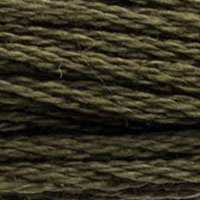
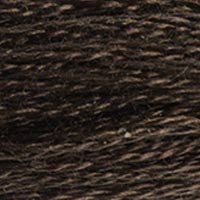
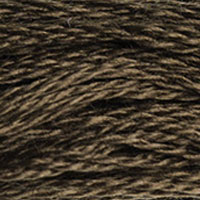
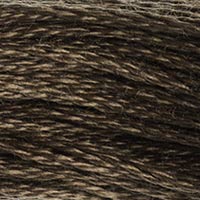
The hex value (#4F4B41) tells the story: there's more brown than gray, but the gray pulls the saturation down from what a pure dark brown would be. You're getting a muted, complex neutral that refuses to be categorized neatly. On white Aida, the brown component is most visible. On cream or ecru, the gray comes forward. On colored fabric — particularly sage green or dusty blue grounds — 3021 seems to shift character entirely, reading as a warm neutral that harmonizes rather than contrasts.
For nature scenes and landscape work, this temperature ambiguity is a feature. Use 3021 for shadows under trees, the dark side of stone walls, the depth of a stream bed, the outline of distant mountain ridges. In all these contexts, the color should be dark but not definitive, present but not dominant — exactly what 3021 delivers. Add DMC 3032 (Medium Mocha Brown) and DMC 3033 (Very Light Mocha Brown) above it for a nature-friendly neutral gradient that handles shadows and highlights without introducing any strong color bias.
Preserving the Gray-Brown Balance
The critical quality in any 3021 substitute is that gray-brown duality. A pure dark brown — even at the exact same darkness — will read warmer and more saturated than 3021, which defeats the purpose if you're using it specifically for its muted, neutral character. A pure dark gray will go too cool and lose the earthy warmth that keeps 3021 connected to brown-family palettes.
Anchor 905 is an exact match and performs admirably. The gray-brown balance holds, and the thread's behavior under different lighting conditions mirrors DMC 3021 well. Madeira 1904 is also exact and worth using with confidence. Both brands maintain this color's essential character — that dark, complex, neither-fully-brown-nor-fully-gray quality that makes it special.
Cosmo 477 is close and may drift slightly in either direction depending on the dye lot. Before substituting Cosmo into a sepia palette where 3021 anchors the dark end, stitch a test column next to your other palette threads. The eye is extremely sensitive to temperature shifts in monochromatic or limited-palette work, and a substitute that's even slightly too warm or too cool can throw off the whole progression.
Within DMC's range, don't confuse 3021 with DMC 3371 (Black Brown), which is significantly darker and warmer — closer to actual black with a brown tint. And don't reach for DMC 844 (Ultra Dark Beaver Grey), which is similar in value but pulls decidedly cool-gray without the brown warmth. The thread that's closest to 3021's unique personality is probably DMC 3787 (Dark Brown Grey), which shares the gray-brown character but sits slightly lighter. If 3021 is unavailable and you're using it for outlining, 3787 with slightly denser stitching can approximate the effect.
Reference quality
How We Validate This Color Record
Use this page as a reference card for DMC 3021: the structured data, quick conversions, and long-form copy are all tied back to the same stored color record.
- Methodology
- This page renders DMC 3021, its hex value, and every brand equivalent from the site's source-of-truth color record, then checks long-form body copy against those same stored fields.
- Verification status
- Source-field checked. The page content is audited against the stored DMC number, brand equivalents, and match-quality labels before publishing.
- Last reviewed
- 2026-04-20
- Approximation warning
- Screen hex values, thread photos, and cross-brand conversions are reference aids. Dye lots, thread sheen, and fabric color can still shift the result in hand.
Decision guide
When to use the DMC 3021 reference page
This page should help you decide faster between palette planning, brand substitution, and shade comparison without turning the color record into a thin lookup page.
Best for
- + Palette planning when you want the stored DMC 3021 Very Dark Brown Gray record, hex value #4F4B41, and linked brand equivalents in one place.
- + Checking the quickest cross-brand shortlist before you buy floss, compare stash substitutes, or route into a more specific conversion page.
- + Finding nearby shades in the browns family before you commit to accents, shading, or background blends.
Watch for
- ! Screen previews are only reference aids. Very Dark Brown Gray can shift on real fabric because thread sheen, stitch coverage, and room lighting change how the color reads.
- ! A stored equivalent is still a shortlist, not a guarantee that two brands will disappear into each other in the same stitched motif.
- ! Older charts, discontinued kit floss, and dye-lot variation can all introduce small but visible differences that the page cannot detect for you.
Before you commit
- Confirm the role of DMC 3021 Very Dark Brown Gray: decide whether you need an exact hero shade, a forgiving background, or a rough stash substitute.
- Compare on project fabric: view the skein or stitched sample on the same fabric count and color you will actually use.
- Use the linked conversion pages next: open the brand-specific pages when you need match-quality caveats before substituting away from the DMC reference.
DMC 3021 FAQ
These questions appear on the page so the FAQ schema stays aligned with what visitors can actually read.
What is the Anchor equivalent of DMC 3021?+
The closest Anchor equivalent to DMC 3021 (Very Dark Brown Gray) is Anchor 905. This is an exact match.
What color is DMC 3021?+
DMC 3021 is called "Very Dark Brown Gray" and has a hex color value of #4F4B41. It belongs to the browns color family.
What is the Madeira equivalent of DMC 3021?+
The closest Madeira equivalent to DMC 3021 (Very Dark Brown Gray) is Madeira 1904. This is a close match.
How DMC 3021 Looks on Fabric
The same thread appears different depending on your fabric. Always test on your project fabric.
White Aida
Cream / Ecru
Black Aida
Pairs Well With
DMC colors commonly used alongside 3021 Very Dark Brown Gray.
Suggested Palette
Shading Companions
Detailed Conversions
Where to Buy DMC 3021
This section contains affiliate links. We may earn a small commission at no cost to you.
Related Guides
Free Printable Thread Conversion Chart
Pick a brand, enter your email, and we'll send you a printable chart mapping all 552 DMC colors to that brand's equivalents. Zero spam, one chart.
Thanks! Here's your free chart:
Download Your ChartOpens in a new tab. Use your browser's Print → Save as PDF.
No spam. Your email is stored securely and never shared.