
Quick Conversion Table
| Brand | Equivalent | Match |
|---|---|---|
| Anchor | 845 | close |
| Madeira | 1508 | close |
| Cosmo ⚠ | 925 | close |
| Sullivans | 45331 | close |
| J&P Coats | 6269 | close |
| Bucilla | 6181 | close |
| Candamar | 6181 | close |
Recovery decision for DMC 3051
Keep this color page focused on the decision a visitor actually needs to make: where DMC 3051 belongs in a real palette, and when a muted green-gray is the right answer instead of a brighter olive or forest green.
Where this shade fails first: DMC 3051 fails first when the design really needs a cooler shadow green or a truer military olive and the gray cast starts to flatten the motif.
This is the muted-green checkpoint for batch 1. It is strongest when you need restraint, not when you need the deepest possible shadow color.
A common debate resurfaces among cross stitchers: what's the best dark green for shadow areas in botanical designs? The primary options typically include DMC 3051 (Dark Green Gray), DMC 3345 (Dark Hunter Green), and DMC 500 (Very Dark Blue Green). Each has dedicated advocates, and their arguments reveal what different stitchers prioritize. DMC 3051's case rests on its gray component — that brownish-gray influence that mutes the green just enough to read as genuinely shadowed vegetation rather than simply a darker green.
The Gray That Makes It Work
Green shadows in nature are not simply darker greens. Real shadow on foliage is complicated: it involves the absence of direct light (which means less green wavelength reflected), ambient cool light from the sky (which adds blue-gray), and the color of adjacent surfaces (which influences the shadow's hue). The result is that shadowed vegetation tends to look grayish, brownish, or bluish compared to the same foliage in direct light — never simply a deeper version of the sunlit green.
DMC 3051's gray-green character captures this accurately. When you place it alongside lighter green-grays like DMC 3052 (Medium Green Gray) and DMC 3053 (Green Gray), you get shadow relationships that feel botanically true. The transition from 3053 (the lightest, most yellow-influenced green-gray) through 3052 (mid-value) to 3051 (dark, gray-dominant) mirrors the way light falls on leaves and stems in realistic botanical illustration.
Where DMC 3051 Earns Its Keep
Substantial botanical and floral patterns — the kind with detailed, multi-value foliage that takes dozens of hours to complete — provide the perfect canvas for DMC 3051. It handles the darkest shadow areas of leaves, the undersides of foliage that never receive direct light, the deep recesses where two leaves overlap and the lower one goes dark. Without this kind of dark anchor in a botanical palette, the foliage can look flat and one-dimensional regardless of how many lighter greens are used.
Landscape and garden patterns utilize DMC 3051 similarly: for the shadowed areas of hedgerows, the dark spaces between clumps of grass, the deep interior of a tree canopy. It also appears in wildlife designs for dark markings on birds and animals — the dark green-gray banding on some feathers, the shadowed fur on woodland animals that live in green-shaded environments.
Traditional samplers and classic designs sometimes incorporate DMC 3051 as a deep foliage anchor in borders. Historic samplers often include a dark, muted green in vine and leaf motifs, and 3051 serves this role authentically. It connects visually to the kind of colors produced by early natural dyes — mossy, earthy, and aged in character.
Practical Stitching Notes
Working with dark threads on dark fabric presents challenges, and DMC 3051 is dark enough that on any ground darker than off-white, distinguishing your stitches from the background during stitching becomes an exercise in patience. On white 14-count or 18-count Aida this isn't an issue, but if you're working a specialty project on darker fabric, be aware of this ahead of time.
DMC 3051's dark value also means it shows tension inconsistency clearly — any stitch that's tighter or looser than its neighbors will catch the light differently and pop visually. Maintaining consistent tension (the sewing method or stab method, not rushing through large fill areas) pays off in a smooth, professional-looking finished surface.
Best Uses for Dark Green Gray (DMC 3051)
Cross stitch projects featuring DMC 3051 benefit from its unique tonal qualities. When selecting the ideal cross stitch floss for your design, keep Dark Green Gray in mind as a versatile choice that blends perfectly with other shades.
Madeira 1508 is a precise alternative for DMC 3051 — the only exact-rated equivalent among the four listed brands. If Madeira is your preferred brand or you're in a region where it's more available than DMC, this is a reliable one-for-one swap. Anchor 845 is listed as close; Anchor's equivalent in this range sits in the right general territory but may have slightly more brown warmth or slightly different gray balance.
Cosmo 925 and Sullivans 45331 are close. As with other dark, complex colors, in-person comparison is more reliable than online floss charts for this thread. The gray component that defines DMC 3051's character doesn't always translate cleanly across brands.
Within the DMC range, if you need a substitute from stash, DMC 3363 (Medium Pine Green) is darker and less gray but serves a similar function as a mid-dark botanical green. DMC 520 (Dark Fern Green) is comparable in value but more olive-warm. None of these exactly replicates the specific gray-greenness of 3051, but for less color-critical applications they can substitute. If you're working a design where the entire green-gray family is specified (3051, 3052, 3053), it's worth sourcing the DMC originals — the family works as a system, and substituting only one value disrupts the relationships between the colors.
Reference quality
How We Validate This Color Record
Use this page as a reference card for DMC 3051: the structured data, quick conversions, and long-form copy are all tied back to the same stored color record.
- Methodology
- This page renders DMC 3051, its hex value, and every brand equivalent from the site's source-of-truth color record, then checks long-form body copy against those same stored fields.
- Verification status
- Source-field checked. The page content is audited against the stored DMC number, brand equivalents, and match-quality labels before publishing.
- Last reviewed
- 2026-04-20
- Approximation warning
- Screen hex values, thread photos, and cross-brand conversions are reference aids. Dye lots, thread sheen, and fabric color can still shift the result in hand.
Decision guide
When to use the DMC 3051 reference page
This page should help you decide faster between palette planning, brand substitution, and shade comparison without turning the color record into a thin lookup page.
Best for
- + Muted foliage, military-adjacent accents, and antique palettes that need green without full saturation.
- + Palette planning when you want the stored DMC 3051 Dark Green Gray record, hex value #5F6648, and linked brand equivalents in one place.
- + Checking the quickest cross-brand shortlist before you buy floss, compare stash substitutes, or route into a more specific conversion page.
- + Finding nearby shades in the greens family before you commit to accents, shading, or background blends.
Watch for
- ! DMC 3051 fails first when the design really needs a cooler shadow green or a truer military olive and the gray cast starts to flatten the motif.
- ! If the surrounding section already includes blue-greens or deep teals, compare this page against the darker recovery routes before you lock the palette.
- ! Screen previews are only reference aids. Dark Green Gray can shift on real fabric because thread sheen, stitch coverage, and room lighting change how the color reads.
- ! A stored equivalent is still a shortlist, not a guarantee that two brands will disappear into each other in the same stitched motif.
- ! Older charts, discontinued kit floss, and dye-lot variation can all introduce small but visible differences that the page cannot detect for you.
Before you commit
- Check DMC 3051 beside the darkest green or blue-green in the project so the gray cast stays intentional.
- Confirm the role of DMC 3051 Dark Green Gray: decide whether you need an exact hero shade, a forgiving background, or a rough stash substitute.
- Compare on project fabric: view the skein or stitched sample on the same fabric count and color you will actually use.
- Use the linked conversion pages next: open the brand-specific pages when you need match-quality caveats before substituting away from the DMC reference.
DMC 3051 FAQ
These questions appear on the page so the FAQ schema stays aligned with what visitors can actually read.
What is the Anchor equivalent of DMC 3051?+
The closest Anchor equivalent to DMC 3051 (Dark Green Gray) is Anchor 845. This is a close match.
What color is DMC 3051?+
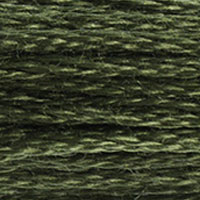
DMC 3051 is called "Dark Green Gray" and has a hex color value of #5F6648. It belongs to the greens color family.
What is the Madeira equivalent of DMC 3051?+
The closest Madeira equivalent to DMC 3051 (Dark Green Gray) is Madeira 1508. This is a close match.
Dark Green Gray serves as a highly reliable choice in realistic botanical and woodland designs. It performs exceptionally well when rendering the deep, cool shadows found in dense foliage, the undersides of fern fronds, and the mossy textures of forest floor scenes. Its ability to convey depth without reading as a stark black or an overly saturated green makes it invaluable for creating convincing, three-dimensional plant life.
For historical and reproduction samplers, 3051 frequently appears in borders, vines, and architectural motifs. Its muted, aged character accurately reflects the faded appearance of natural green dyes used in centuries past, making it a critical component for stitchers looking to recreate the authentic look and feel of antique textiles. It provides a grounding presence that ties a reproduction palette together.
This thread remains highly popular with designers of fantasy and primitive-style patterns. The slightly murky, mysterious quality of the gray-green is perfect for depicting old stone walls covered in lichen, shadowed castle gardens, and the muted, earthy tones of primitive folk art. Its versatility across such diverse design styles cements its status as a staple in many stitchers' regular thread rotations.
How DMC 3051 Looks on Fabric
The same thread appears different depending on your fabric. Always test on your project fabric.
White Aida
Cream / Ecru
Black Aida
Pairs Well With
DMC colors commonly used alongside 3051 Dark Green Gray.
Suggested Palette
Shading Companions
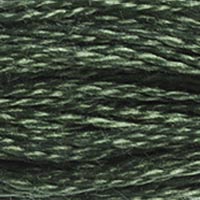
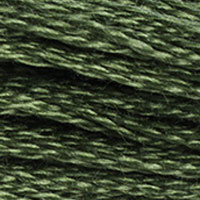
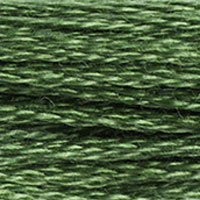
Detailed Conversions
Where to Buy DMC 3051
This section contains affiliate links. We may earn a small commission at no cost to you.
Related Guides
Free Printable Thread Conversion Chart
Pick a brand, enter your email, and we'll send you a printable chart mapping all 552 DMC colors to that brand's equivalents. Zero spam, one chart.
Thanks! Here's your free chart:
Download Your ChartOpens in a new tab. Use your browser's Print → Save as PDF.
No spam. Your email is stored securely and never shared.