
Quick Conversion Table
| Brand | Equivalent | Match |
|---|---|---|
| Anchor | 1088 | exact |
| Madeira | 1914 | close |
| Cosmo ⚠ | 3386 | close |
| Sullivans | 45236 | close |
| J&P Coats | 5476 | close |
| Dimensions | 15381 | close |
| Bucilla | 838 | close |
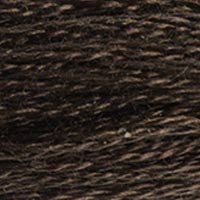
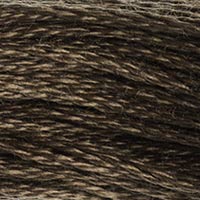
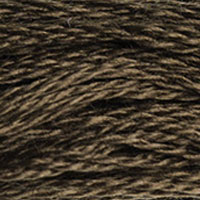
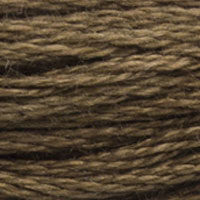
Dark chocolate, walnut shell, strong black tea, the bark of a weathered oak — there is a whole family of deep, warm brown-blacks that exist in the world, and DMC 838 inhabits that space. Very Dark Beige Brown at hex #594937 is dark enough to function almost as an outlining color for brown-family designs, yet retains the unmistakable warmth of brown rather than the neutrality of charcoal or black. It's the color that makes everything around it look richer.
The Deep Anchor of the Beige Brown Family
The beige brown family runs across five values from 838 through 842, and 838 is the darkest. In the logic of the family, 838 is called upon whenever another member needs to cast a shadow — when 839 (Dark Beige Brown) needs a deeper accent behind it, when the eye needs to track into a corner or crevice of a three-dimensional rendering. Without 838, the family sits in the middle-dark-to-light range and lacks the deepest shadow note that creates a convincing sense of depth.
Brown families in cross-stitch are the workhorses of realistic design, and the beige brown sub-family occupies a specific niche: warm browns with a yellowish undertone, related to the color of sand, oat, and dry earth rather than the redder mahogany and chestnut families. 838's depth within that warm, sandy-earthen tradition gives it a specific utility in natural landscape and architectural design that pure dark brown (like DMC 3371, Black Brown) doesn't cover.
Animal Subjects and Wildlife
Many animal fur colors live in the beige brown family, and 838 anchors the darkest tones in that rendering. Deer, certain rabbit breeds, many bird species, and dogs with wheaten or fawn coloring all have their deepest shadow fur tones in this range. A realistic whitetail deer rendered with the full beige brown family uses 838 for the deeply shadowed areas where legs meet body, under the chin, and in the deepest fold shadows of the coat. Without this dark anchor, the deer looks uniformly light and flat rather than three-dimensional and real.
Owl cross-stitch — a perennially popular wildlife subject — frequently uses the beige brown family for the earthy-toned species like barn owls, great horned owls, and tawny owls. 838 handles the darkest spots in the feather pattern and the deep shadow areas of the facial disc. Pairing it with DMC 840 (Medium Beige Brown) for main feather body and DMC 842 (Very Light Beige Brown) for pale belly feathers creates a naturalistic owl palette that reads as authentic to birders and non-birders alike.
Wood Textures and Architectural Elements
Wooden objects in cross-stitch — log cabins, rustic furniture, wooden signs, antique frames — need believable wood grain texture, and 838 provides the darkest grain lines and knot shadows. The deep dark of a wood knot center, the shadow in a deep wood grain groove, and the contrast-defining darkest tone of any painted-wood surface all benefit from 838's combination of darkness and warmth. Purely dark grays or blacks for wood grain look metallic rather than organic; 838's brown warmth reads as authentically wooden.
Stone and rock subjects sometimes use 838 as well, particularly for sandstone or warm-toned stone where the warmth of beige brown is more appropriate than a cool neutral gray. Terracotta roof tiles, brick shadows, and warm clay soil in landscape designs also reach for this deep warm brown.
Anchor 1088 and Madeira 1914 both earn exact match ratings for 838, making it one of the better-supported dark browns across brands. This level of agreement is particularly useful for dark shadow colors, where minor variations would normally be less visible — the confirmation of exact matches means you can be especially confident in these alternatives.
Cosmo 3386 and Sullivans 45236 are close matches. Dark browns are usually among the easier colors to approximate across brands because the high pigment density makes minor undertone differences less obvious. At 838's very dark value, the difference between "close" and "exact" is likely imperceptible in finished work for most designs.
Within DMC, 838's immediate neighbor is DMC 839 (Dark Beige Brown), which is one noticeably visible value lighter. For designs that need 838 and you're out of stock, 839 can substitute in areas where 838 functions as the darkest shadow — you lose some depth, but the color family character is preserved. Going the other direction, DMC 3371 (Black Brown) is darker and cooler, approaching near-black in character. It can substitute for 838 in designs where extreme depth is more important than warm undertone, but it will shift the palette toward cooler, more neutral territory.
One practical note: very dark threads in the beige brown family can occasionally develop a slight chalky residue from manufacturing wax or sizing that affects how they stitch. If 838 feels slightly stiff or looks slightly cloudy when first used, washing the finished piece gently will typically resolve this.
Reference quality
How We Validate This Color Record
Use this page as a reference card for DMC 838: the structured data, quick conversions, and long-form copy are all tied back to the same stored color record.
- Methodology
- This page renders DMC 838, its hex value, and every brand equivalent from the site's source-of-truth color record, then checks long-form body copy against those same stored fields.
- Verification status
- Source-field checked. The page content is audited against the stored DMC number, brand equivalents, and match-quality labels before publishing.
- Last reviewed
- 2026-04-20
- Approximation warning
- Screen hex values, thread photos, and cross-brand conversions are reference aids. Dye lots, thread sheen, and fabric color can still shift the result in hand.
Decision guide
When to use the DMC 838 reference page
This page should help you decide faster between palette planning, brand substitution, and shade comparison without turning the color record into a thin lookup page.
Best for
- + Palette planning when you want the stored DMC 838 Very Dark Beige Brown record, hex value #594937, and linked brand equivalents in one place.
- + Checking the quickest cross-brand shortlist before you buy floss, compare stash substitutes, or route into a more specific conversion page.
- + Finding nearby shades in the browns family before you commit to accents, shading, or background blends.
Watch for
- ! Screen previews are only reference aids. Very Dark Beige Brown can shift on real fabric because thread sheen, stitch coverage, and room lighting change how the color reads.
- ! A stored equivalent is still a shortlist, not a guarantee that two brands will disappear into each other in the same stitched motif.
- ! Older charts, discontinued kit floss, and dye-lot variation can all introduce small but visible differences that the page cannot detect for you.
Before you commit
- Confirm the role of DMC 838 Very Dark Beige Brown: decide whether you need an exact hero shade, a forgiving background, or a rough stash substitute.
- Compare on project fabric: view the skein or stitched sample on the same fabric count and color you will actually use.
- Use the linked conversion pages next: open the brand-specific pages when you need match-quality caveats before substituting away from the DMC reference.
DMC 838 FAQ
These questions appear on the page so the FAQ schema stays aligned with what visitors can actually read.
What is the Anchor equivalent of DMC 838?+
The closest Anchor equivalent to DMC 838 (Very Dark Beige Brown) is Anchor 1088. This is an exact match.
What color is DMC 838?+
DMC 838 is called "Very Dark Beige Brown" and has a hex color value of #594937. It belongs to the browns color family.
What is the Madeira equivalent of DMC 838?+
The closest Madeira equivalent to DMC 838 (Very Dark Beige Brown) is Madeira 1914. This is a close match.
How DMC 838 Looks on Fabric
The same thread appears different depending on your fabric. Always test on your project fabric.
White Aida
Cream / Ecru
Black Aida
Pairs Well With
DMC colors commonly used alongside 838 Very Dark Beige Brown.
Suggested Palette
Shading Companions
Detailed Conversions
Where to Buy DMC 838
This section contains affiliate links. We may earn a small commission at no cost to you.
Related Guides
Free Printable Thread Conversion Chart
Pick a brand, enter your email, and we'll send you a printable chart mapping all 552 DMC colors to that brand's equivalents. Zero spam, one chart.
Thanks! Here's your free chart:
Download Your ChartOpens in a new tab. Use your browser's Print → Save as PDF.
No spam. Your email is stored securely and never shared.