
Quick Conversion Table
| Brand | Equivalent | Match |
|---|---|---|
| Anchor | 330 | exact |
| Madeira | 0205 | exact |
| Cosmo ⚠ | 754 | close |
| Sullivans | 45285 | close |
| J&P Coats | 2330 | close |
| Dimensions | 6117 | close |
| Bucilla | 2665 | close |
| Candamar | 6117 | close |
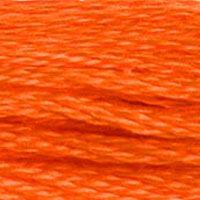
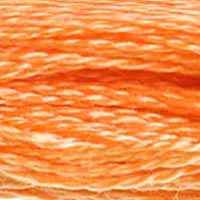
There's a reason certain sports teams have made burnt orange their signature color: it's impossible to ignore. DMC 947 Burnt Orange is that specific warm, vivid orange that sits just below pure orange on the saturation scale — bright enough to demand attention, darkened just enough to feel substantial rather than garish. It is, in the best possible way, a color that has opinions about itself.
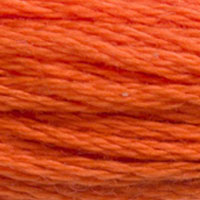
In the DMC orange family, 947 occupies the lighter, more vividly orange end of the burnt range. DMC 946 (Medium Burnt Orange) is its darker neighbor, adding more of the brownish-russet quality that gives the "burnt" name its justification. DMC 947 itself still reads as clearly and vibrantly orange, which makes it useful in a wider range of contexts than its darker sibling — it's the orange you'd use for autumn highlights, while 946 handles the deeper shadows.
The Seasonal Warkhorse
Ask any stitcher with a decent seasonal stash what they associate with DMC 947, and the answer almost always comes back: pumpkins and autumn leaves. This color was practically made for October. Full pumpkin designs typically use 947 as the primary body fill, with DMC 971 (Pumpkin) providing the sunlit highlights and DMC 946 (Medium Burnt Orange) deepening the shadows. The three-color shading sequence produces remarkably convincing roundness in a pumpkin motif.
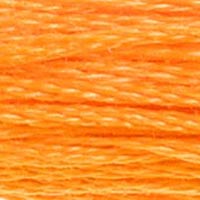
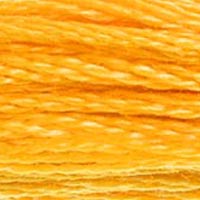
Autumn foliage, marigolds, tiger lilies, and harvest scenes all rely on 947's particular brand of vivid warmth. It's also the color of a glowing fire in autumn-themed hearth designs, though for actual flames you'd typically blend it with DMC 740 (Tangerine) and DMC 972 (Deep Canary) to get the full fire palette.
Animals, Food, and Other Applications
Beyond seasonal work, DMC 947 turns up in some unexpected places. Tropical fish — particularly clownfish and certain wrasse species — use this exact orange for their primary body color. Monarch butterfly wings require 947 as a foundation, with black DMC 310 for the distinctive veining pattern. Red pandas, who aren't quite fox-orange but aren't rust-brown either, often require 947 as part of their fur palette.
In food-themed stitching, this is the orange of fresh carrots, ripe persimmons, and the particular orange of a well-charred pizza crust edge. Whimsical kitchen samplers and food-themed designs consume DMC 947 reliably.
For backstitching applications, 947 can serve as a warm outlining color in designs where black would feel too harsh — folksy floral designs and Scandinavian-influenced motifs sometimes use a dark orange backstitch that keeps the piece feeling warm and handcrafted rather than sharply commercial.
One technique note: on 14-count Aida with two full strands, DMC 947 covers beautifully and the color reads cleanly at normal viewing distance. On finer counts like 18 or 28, a single strand is usually sufficient, and the color remains vivid even at that reduced coverage — a sign of a well-dyed, deeply saturated thread that doesn't rely on thickness to carry its hue.
Both Anchor 330 and Madeira 0205 are rated as exact matches, which makes DMC 947 one of the more reliably substitutable colors in the orange range. Anchor 330 in particular is very widely available in shops that stock Anchor threads, and stitchers who have worked both side-by-side report the color match as very close in natural light. Anchor's thread has a slightly looser twist, which some stitchers find easier to separate and work with for blended needle applications.
Madeira 0205 also matches well. Madeira's thread has a slightly higher sheen that amplifies the vividness of this already-saturated orange, which in autumn foliage or flame designs can actually enhance the visual effect. The color holds well over time with Madeira's colorfastness reputation.
Cosmo 754 is close but has been reported to run slightly more red-toned by some stitchers. In a standalone project this is unlikely to matter; in a carefully calibrated autumn palette where the distinction between orange and rust is important, test against your other colors first.
Sullivans 45285 is a close match. As with most Sullivans equivalents in the saturated color ranges, the hue is in the right family but saturation can vary between batches.
- For pumpkin shading: pair 947 with DMC 971 (Pumpkin) for highlights and DMC 946 (Medium Burnt Orange) for shadows — a three-value progression that works on any fabric count.
- Monarch butterfly designs almost universally combine DMC 947 with DMC 310 (Black) for the wing pattern — one of the most iconic two-color design combinations in the hobby.
Reference quality
How We Validate This Color Record
Use this page as a reference card for DMC 947: the structured data, quick conversions, and long-form copy are all tied back to the same stored color record.
- Methodology
- This page renders DMC 947, its hex value, and every brand equivalent from the site's source-of-truth color record, then checks long-form body copy against those same stored fields.
- Verification status
- Source-field checked. The page content is audited against the stored DMC number, brand equivalents, and match-quality labels before publishing.
- Last reviewed
- 2026-04-20
- Approximation warning
- Screen hex values, thread photos, and cross-brand conversions are reference aids. Dye lots, thread sheen, and fabric color can still shift the result in hand.
Decision guide
When to use the DMC 947 reference page
This page should help you decide faster between palette planning, brand substitution, and shade comparison without turning the color record into a thin lookup page.
Best for
- + Palette planning when you want the stored DMC 947 Burnt Orange record, hex value #FF7B4D, and linked brand equivalents in one place.
- + Checking the quickest cross-brand shortlist before you buy floss, compare stash substitutes, or route into a more specific conversion page.
- + Finding nearby shades in the oranges family before you commit to accents, shading, or background blends.
Watch for
- ! Screen previews are only reference aids. Burnt Orange can shift on real fabric because thread sheen, stitch coverage, and room lighting change how the color reads.
- ! A stored equivalent is still a shortlist, not a guarantee that two brands will disappear into each other in the same stitched motif.
- ! Older charts, discontinued kit floss, and dye-lot variation can all introduce small but visible differences that the page cannot detect for you.
Before you commit
- Confirm the role of DMC 947 Burnt Orange: decide whether you need an exact hero shade, a forgiving background, or a rough stash substitute.
- Compare on project fabric: view the skein or stitched sample on the same fabric count and color you will actually use.
- Use the linked conversion pages next: open the brand-specific pages when you need match-quality caveats before substituting away from the DMC reference.
DMC 947 FAQ
These questions appear on the page so the FAQ schema stays aligned with what visitors can actually read.
What is the Anchor equivalent of DMC 947?+
The closest Anchor equivalent to DMC 947 (Burnt Orange) is Anchor 330. This is an exact match.
What color is DMC 947?+
DMC 947 is called "Burnt Orange" and has a hex color value of #FF7B4D. It belongs to the oranges color family.
What is the Madeira equivalent of DMC 947?+
The closest Madeira equivalent to DMC 947 (Burnt Orange) is Madeira 0205. This is an exact match.
Classic Projects for DMC 947 Burnt Orange
A few project types genuinely revolve around this color, making it worth having extra skeins on hand:
- Pumpkin and harvest designs: Any full-coverage pumpkin design will use 947 as its primary fill color, typically consuming two or more skeins on larger pieces. Autumn wreath designs, harvest baskets, and Thanksgiving-themed samplers call for it reliably.
- Monarch butterfly projects: One of the most popular wildlife cross-stitch subjects, monarchs need a large amount of DMC 947 for their wing areas alongside DMC 310 for the distinctive black patterning. Large format monarch designs can use three or more skeins.
- Fire and flame motifs: Whether it's a candle flame on a holiday design, a fireplace in a cozy autumn scene, or a stylized flame element in fantasy work, 947 forms the middle value of most flame palettes.
- Autumn SAL projects: Year-long seasonal SALs invariably have an October installment that reaches for the orange family. DMC 947 appears in more autumn SAL palettes than almost any other single orange thread.
How DMC 947 Looks on Fabric
The same thread appears different depending on your fabric. Always test on your project fabric.
White Aida
Cream / Ecru
Black Aida
Pairs Well With
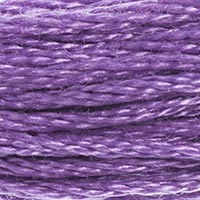
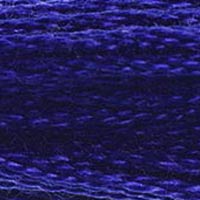
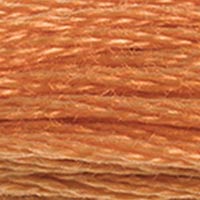
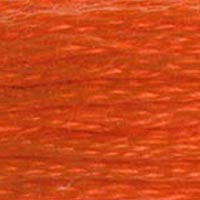
DMC colors commonly used alongside 947 Burnt Orange.
Detailed Conversions
Where to Buy DMC 947
This section contains affiliate links. We may earn a small commission at no cost to you.
Related Guides
Free Printable Thread Conversion Chart
Pick a brand, enter your email, and we'll send you a printable chart mapping all 552 DMC colors to that brand's equivalents. Zero spam, one chart.
Thanks! Here's your free chart:
Download Your ChartOpens in a new tab. Use your browser's Print → Save as PDF.
No spam. Your email is stored securely and never shared.