
Quick Conversion Table
| Brand | Equivalent | Match |
|---|---|---|
| Anchor | 330 | exact |
| Madeira | 0206 | exact |
| Cosmo ⚠ | 757 | close |
| Sullivans | 45142 | close |
| J&P Coats | 2332 | close |
| Dimensions | 12332 | close |
Orange Deserves Better — And DMC 608 Proves It
Orange gets no respect in the cross-stitch world. Flip through any pattern collection or stitch-along announcement, and you will see blues, greens, pinks, and reds dominating the palette. Orange sits in the corner, pulled out for the occasional autumn leaf or Halloween motif and then shoved back in the drawer. It is the most underappreciated color family in the entire DMC range, and that is a genuine loss for stitchers who have not explored what it can do.
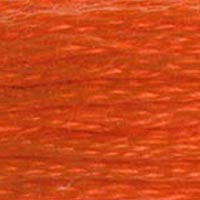
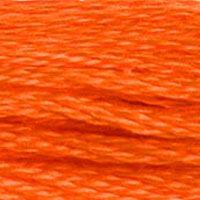
DMC 608 Bright Orange is the thread that should change your mind. This is not a timid, muddy, or ambiguous orange that hides among the browns. The hex value (#FD5D35) tells the story plainly: dominant red channel, a strong green component pushing toward warmth, and almost no blue. The result is a bold, slightly red-leaning orange with genuine fire behind it. It demands attention on fabric the way a ripe habanero demands attention in a salsa — you cannot ignore it, and the dish is better for it.
What makes 608 particularly interesting is its position in the orange spectrum. It sits between the truly warm red-oranges (like DMC 606, which is practically a red wearing an orange costume) and the cooler yellow-oranges (like DMC 740 Tangerine, which veers toward pure spectral orange). 608 holds the middle ground with a red warmth that gives it depth without losing its identity as an orange. This positioning makes it more versatile than you might expect from a color labeled "bright."
How 608 Reads on Different Fabrics
Fabric color dramatically changes how this thread performs. On white Aida or white evenweave, 608 reads hot and vivid — almost neon under certain lighting. The full contrast lets every bit of that red-orange saturation come through, and it can actually feel overpowering in large filled areas. If you are stitching a design with significant blocks of 608 on white, consider railroading your stitches carefully to keep the coverage smooth, because uneven coverage at this saturation level creates a patchy, distracting effect.
On natural or cream linen, the fabric warmth absorbs some of 608's intensity and brings it into a more organic range. This is where it starts to look like actual fire, actual autumn foliage, actual sunset color rather than a highlighter. For nature-themed designs, cream evenweave is hands down the better choice. Over-two on 28-count linen with two strands gives 608 a rich, slightly textured appearance that photographs beautifully.
On black fabric, 608 absolutely glows. The contrast creates an almost luminous effect, which is why so many Halloween cross-stitch designs specify black Aida. A jack-o'-lantern face stitched in 608 and 740 on 18-count black Aida looks like it is genuinely lit from within. If you have never stitched orange on black, try a small ornament — the effect is startling.
Building Palettes with 608
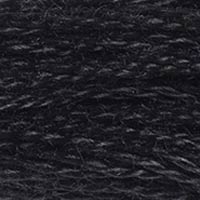
The obvious pairing is DMC 310 (Black) for Halloween work, and it is obvious because it works perfectly. But 608 has range beyond October. Pair it with DMC 3371 (Black Brown) and DMC 920 (Medium Copper) for a more sophisticated autumn palette that avoids the cartoonish quality of pure black-and-orange. Add DMC 3853 (Dark Autumn Gold) and DMC 3855 (Light Autumn Gold) to build a complete leaf gradient from deep fire through golden amber.
For koi fish designs, 608 is essential. Real koi display an orange that is exactly this hue — not yellow, not red, but this specific warm orange. Pair it with DMC blanc, DMC 310, and DMC 946 (Medium Burnt Orange) for a classic koi palette. The white-orange-black combination captures the hi utsuri and kohaku patterns that make koi such popular cross-stitch subjects.
Citrus motifs lean heavily on 608 as well. Blood oranges, clementines, and navel oranges all use this shade for the flesh or rind, depending on the fruit variety. Combined with DMC 972 (Deep Canary) and DMC 3340 (Medium Apricot), you can build a fruit bowl sampler that looks good enough to eat.
One tip that took me years to figure out: 608 blends beautifully with DMC 351 (Coral) when you need a transition between orange and pink. That coral bridge shade prevents the jarring jump that happens when you go directly from bright orange to a pink or rose. In sunset scenes or floral work, that single intermediate shade makes a noticeable difference in how natural the gradient reads.
Substituting DMC 608 Bright Orange
Anchor 330 is an exact match and the safest substitute you will find for 608. The hue, saturation, and value all line up well. In a side-by-side comparison on white Aida, the two are difficult to distinguish even under daylight-balanced lighting. You can confidently mix Anchor 330 and DMC 608 in the same project without visible inconsistency, which matters for those large Halloween or autumn pieces where you might run short mid-project.
Madeira 0206 is also an exact match. Madeira's version handles similarly to DMC in terms of strand separation and coverage. At two strands on 14-count, the coverage density is comparable. One thing to watch for with Madeira in the orange range: their threads can have a very slightly more matte finish than DMC, which at this brightness level can actually be an advantage. Extremely bright oranges with too much sheen can look plasticky under certain lighting, and Madeira's finish tempers that slightly.
Cosmo 757 is rated as a close match rather than exact, and the difference is worth understanding. Cosmo's version may carry a touch more red, nudging it fractionally toward the red-orange end of the spectrum. In isolation, you would not notice. When stitched directly adjacent to DMC 608 in a gradient or blended area, the shift may become apparent. For standalone blocks of color or projects using only one brand, Cosmo 757 does the job well. Cosmo thread has a lovely soft hand that many stitchers prefer.
Sullivans 45142 is also a close match. Sullivans threads tend to be slightly thinner than DMC, so coverage on open-weave fabrics may require an extra strand or more attentive railroading to prevent fabric show-through. On 14-count Aida this is rarely a problem, but on 28-count evenweave over two, test your coverage before committing to a large fill area. The color itself is a reasonable approximation of 608's particular red-orange warmth.
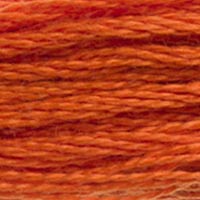
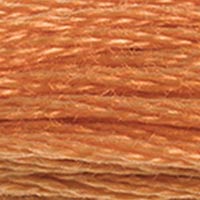
If you need to substitute within the DMC line itself, DMC 946 (Medium Burnt Orange) is the closest neighbor, but it is noticeably darker and more muted. DMC 947 (Burnt Orange) is lighter and more vivid. Neither is a true substitute — they are gradient companions, not replacements. For an exact match, stick with the cross-brand options above.
Reference quality
How We Validate This Color Record
Use this page as a reference card for DMC 608: the structured data, quick conversions, and long-form copy are all tied back to the same stored color record.
- Methodology
- This page renders DMC 608, its hex value, and every brand equivalent from the site's source-of-truth color record, then checks long-form body copy against those same stored fields.
- Verification status
- Source-field checked. The page content is audited against the stored DMC number, brand equivalents, and match-quality labels before publishing.
- Last reviewed
- 2026-04-20
- Approximation warning
- Screen hex values, thread photos, and cross-brand conversions are reference aids. Dye lots, thread sheen, and fabric color can still shift the result in hand.
Decision guide
When to use the DMC 608 reference page
This page should help you decide faster between palette planning, brand substitution, and shade comparison without turning the color record into a thin lookup page.
Best for
- + Palette planning when you want the stored DMC 608 Bright Orange record, hex value #FD5D35, and linked brand equivalents in one place.
- + Checking the quickest cross-brand shortlist before you buy floss, compare stash substitutes, or route into a more specific conversion page.
- + Finding nearby shades in the oranges family before you commit to accents, shading, or background blends.
Watch for
- ! Screen previews are only reference aids. Bright Orange can shift on real fabric because thread sheen, stitch coverage, and room lighting change how the color reads.
- ! A stored equivalent is still a shortlist, not a guarantee that two brands will disappear into each other in the same stitched motif.
- ! Older charts, discontinued kit floss, and dye-lot variation can all introduce small but visible differences that the page cannot detect for you.
Before you commit
- Confirm the role of DMC 608 Bright Orange: decide whether you need an exact hero shade, a forgiving background, or a rough stash substitute.
- Compare on project fabric: view the skein or stitched sample on the same fabric count and color you will actually use.
- Use the linked conversion pages next: open the brand-specific pages when you need match-quality caveats before substituting away from the DMC reference.
DMC 608 FAQ
These questions appear on the page so the FAQ schema stays aligned with what visitors can actually read.
What is the Anchor equivalent of DMC 608?+
The closest Anchor equivalent to DMC 608 (Bright Orange) is Anchor 330. This is an exact match.
What color is DMC 608?+
DMC 608 is called "Bright Orange" and has a hex color value of #FD5D35. It belongs to the oranges color family.
What is the Madeira equivalent of DMC 608?+
The closest Madeira equivalent to DMC 608 (Bright Orange) is Madeira 0206. This is an exact match.
Project Ideas for DMC 608 Bright Orange
Halloween ornaments are the most popular home for 608, and for good reason. Small ornaments on 18-count black Aida stitch up fast and look spectacular. A set of six to eight Halloween ornaments — jack-o'-lanterns, candy corn, black cats with orange collars, haunted houses with glowing windows — makes a satisfying weekend project and a great gift set. Two strands on 18-count gives clean, full coverage, and the small scale means you will not get tired of the color before the project is done. Finish them with orange ribbon hangers and you have a complete decorating set.
Autumn samplers are another natural fit. The traditional sampler format — alphabet, border, motifs, date — translates beautifully into a fall palette. Use 608 for the central motifs (pumpkins, leaves, acorns) and pair it with DMC 3371 (Black Brown), DMC 3031 (Very Dark Mocha Brown), and DMC 3855 (Light Autumn Gold) for a sophisticated seasonal piece that does not read as juvenile or overly "crafty." Add some quarter stitches for the leaf edges to give them a more organic, less blocky appearance.
Citrus motifs deserve more attention from the stitching community. A series of citrus fruit cross-sections — orange, blood orange, grapefruit, lemon, lime — stitched as small matching pieces makes a cheerful kitchen display. 608 handles the orange and blood orange flesh, with DMC 740 for the rind and DMC 972 for the membrane lines. These designs work well on 16-count or 18-count Aida and finish quickly, making them solid candidates for craft fair inventory if you sell your work.
Finally, do not overlook 608 for small accent details in larger pieces. A bird's breast, a single autumn tree in a landscape, a stripe on a fish, a ribbon on a wreath — sometimes you only need a few stitches of bright orange, but those stitches carry visual weight far beyond their count. Keep a skein of 608 in your stash even if you do not have an immediate project for it. The right orange at the right moment can elevate a WIP from good to genuinely eye-catching.
How DMC 608 Looks on Fabric
The same thread appears different depending on your fabric. Always test on your project fabric.
White Aida
Cream / Ecru
Black Aida
Pairs Well With
DMC colors commonly used alongside 608 Bright Orange.
Suggested Palette
Shading Companions
Detailed Conversions
Where to Buy DMC 608
This section contains affiliate links. We may earn a small commission at no cost to you.
Related Guides
Free Printable Thread Conversion Chart
Pick a brand, enter your email, and we'll send you a printable chart mapping all 552 DMC colors to that brand's equivalents. Zero spam, one chart.
Thanks! Here's your free chart:
Download Your ChartOpens in a new tab. Use your browser's Print → Save as PDF.
No spam. Your email is stored securely and never shared.