
Quick Conversion Table
| Brand | Equivalent | Match |
|---|---|---|
| Anchor | 323 | exact |
| Madeira | 0307 | close |
| Cosmo ⚠ | 2402 | close |
| Sullivans | 45169 | close |
| J&P Coats | 2323 | close |
| Dimensions | 6722 | close |
| Bucilla | 3722 | close |
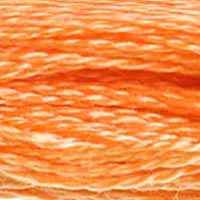
Light colors within a saturated family often suffer from an identity problem — they're expected to represent the same hue as their darker companions but at lower volume. DMC 722 Light Orange Spice avoids this trap by retaining the spice family's essential warmth at a considerably lighter value. Its hex #F7976F is still fully orange — no pale-out toward peach or salmon — just orange with more light in it. That integrity at the light end is what makes it genuinely useful as a highlight rather than a compromise.
The Highlight Role Done Well
In the Orange Spice shading sequence (720 dark, 721 medium, 722 light), each value has a distinct function in creating three-dimensional form. DMC 722 carries the highlighted areas where light strikes curved orange surfaces — the rounded upper curve of a pumpkin, the lit side of a tiger lily petal, the bright edge of an autumn leaf. Because 722 holds its orange saturation rather than fading toward peach or salmon, the highlighted area reads as the same orange material in direct light rather than as a different-colored surface.
This distinction matters for visual realism. When highlight colors lose saturation as they gain lightness (the usual behavior of paints), they can create a blown-out, overexposed look in embroidery. By maintaining saturation while gaining lightness, 722 creates highlights that glow rather than bleach — a quality that experienced needlepainters particularly appreciate when building orange forms.
Beyond Orange — Warm Skin Tones
One of DMC 722's less-obvious applications is in warm, olive-toned skin highlighting. At this warm light orange, it sits in territory useful for sun-bronzed skin highlights, the highlighted areas of tan or olive complexions, and the warm reflected light that hits darker skin from warm light sources. This application requires a light touch — one strand rather than two, often blended in a needle with DMC 676 Light Old Gold — but it adds the kind of warmth to skin tone highlights that cooler options can't provide.
Stitchers working portrait pieces where the light source is warm (candlelight, firelight, sunset) find 722 useful for exactly this reflected-warm-light effect. Alongside DMC 721 for mid-tones, DMC 720 for shadows, and a touch of DMC 3340 Medium Apricot for the pink-warm blush areas, 722 helps build firelit portraits with genuine warmth.
Seasonal and Thematic Use
Autumn pieces deploy the full Orange Spice family, and 722 appears wherever pumpkins, maple leaves, or squash catch direct light. The three values together — 720, 721, 722 — create convincing three-dimensional orange forms that are among the most satisfying to stitch in seasonal work. Cat portraits with golden-orange tabby coats use the same sequence, with 722 highlighting the back, brow ridge, and shoulder areas where the fur catches light. Halloween and harvest pieces — among the most popular seasonal cross stitch categories — rely heavily on this family, and 722's specific position at the bright end makes it one of the more frequently needed threads in autumn project planning.
Tabby cat portraits deserve a special mention: the golden-orange tabby is one of the most popular cat subjects in cross stitch, and the Orange Spice family is the backbone of the palette. In a well-designed tabby cat piece, 720 shadows the areas under the chin, beneath the belly, and between fur stripes. 721 fills the primary warm coat. 722 catches the shoulder, brow, and back highlights. The sequence can be supplemented with DMC 3826 Golden Brown for the deepest reddish-brown tones. Getting 722 right — keeping it warm and orange rather than drifting toward peach — is what makes the cat look like a tabby rather than a generic sandy-colored cat.
Anchor 323 and Madeira 0307 are both exact matches for DMC 722. This cross-brand consistency is useful since the Orange Spice family is frequently used as a complete shading sequence, and having reliable equivalents for all three values (720, 721, 722) means you can work across brands if needed.
Cosmo 2402 and Sullivans 45169 are close. Cosmo 2402 can shift slightly toward peach — the saturation holds but the temperature nudges pinkward at this lighter value. Sullivans 45169 is a reasonable match in most daylight conditions. For designs where 722's color character at the light end is critical (the highlight on a pumpkin, the edge of a tiger lily petal), a swatch comparison is worthwhile.
Within the DMC range, DMC 3340 Medium Apricot and DMC 3341 Apricot both sit in nearby territory but with a distinctly peachy-pink character that DMC 722 doesn't have. They're not substitutes for the Orange Spice family but represent a different color direction entirely. For an emergency replacement that stays in the warm-light-orange zone, DMC 741 Medium Tangerine at reduced strand count (one strand instead of two) gives a brighter, more yellow-orange option that reads light and warm without the peachy shift. It's not identical but serves in a pinch for small highlight areas.
Reference quality
How We Validate This Color Record
Use this page as a reference card for DMC 722: the structured data, quick conversions, and long-form copy are all tied back to the same stored color record.
- Methodology
- This page renders DMC 722, its hex value, and every brand equivalent from the site's source-of-truth color record, then checks long-form body copy against those same stored fields.
- Verification status
- Source-field checked. The page content is audited against the stored DMC number, brand equivalents, and match-quality labels before publishing.
- Last reviewed
- 2026-04-20
- Approximation warning
- Screen hex values, thread photos, and cross-brand conversions are reference aids. Dye lots, thread sheen, and fabric color can still shift the result in hand.
Decision guide
When to use the DMC 722 reference page
This page should help you decide faster between palette planning, brand substitution, and shade comparison without turning the color record into a thin lookup page.
Best for
- + Palette planning when you want the stored DMC 722 Light Orange Spice record, hex value #F7976F, and linked brand equivalents in one place.
- + Checking the quickest cross-brand shortlist before you buy floss, compare stash substitutes, or route into a more specific conversion page.
- + Finding nearby shades in the oranges family before you commit to accents, shading, or background blends.
Watch for
- ! Screen previews are only reference aids. Light Orange Spice can shift on real fabric because thread sheen, stitch coverage, and room lighting change how the color reads.
- ! A stored equivalent is still a shortlist, not a guarantee that two brands will disappear into each other in the same stitched motif.
- ! Older charts, discontinued kit floss, and dye-lot variation can all introduce small but visible differences that the page cannot detect for you.
Before you commit
- Confirm the role of DMC 722 Light Orange Spice: decide whether you need an exact hero shade, a forgiving background, or a rough stash substitute.
- Compare on project fabric: view the skein or stitched sample on the same fabric count and color you will actually use.
- Use the linked conversion pages next: open the brand-specific pages when you need match-quality caveats before substituting away from the DMC reference.
DMC 722 FAQ
These questions appear on the page so the FAQ schema stays aligned with what visitors can actually read.
What is the Anchor equivalent of DMC 722?+
The closest Anchor equivalent to DMC 722 (Light Orange Spice) is Anchor 323. This is an exact match.
What color is DMC 722?+
DMC 722 is called "Light Orange Spice" and has a hex color value of #F7976F. It belongs to the oranges color family.
What is the Madeira equivalent of DMC 722?+
The closest Madeira equivalent to DMC 722 (Light Orange Spice) is Madeira 0307. This is a close match.
How DMC 722 Looks on Fabric
The same thread appears different depending on your fabric. Always test on your project fabric.
White Aida
Cream / Ecru
Black Aida
Pairs Well With
DMC colors commonly used alongside 722 Light Orange Spice.
Suggested Palette
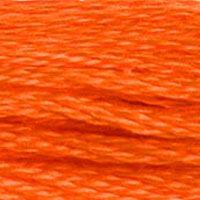
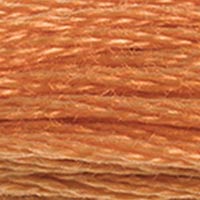
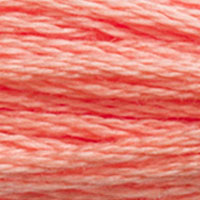
Shading Companions
Detailed Conversions
Where to Buy DMC 722
This section contains affiliate links. We may earn a small commission at no cost to you.
Related Guides
Free Printable Thread Conversion Chart
Pick a brand, enter your email, and we'll send you a printable chart mapping all 552 DMC colors to that brand's equivalents. Zero spam, one chart.
Thanks! Here's your free chart:
Download Your ChartOpens in a new tab. Use your browser's Print → Save as PDF.
No spam. Your email is stored securely and never shared.