
Quick Conversion Table
| Brand | Equivalent | Match |
|---|---|---|
| Anchor | 1035 | exact |
| Madeira | 1712 | close |
| Cosmo ⚠ | 734 | close |
| Sullivans | 45273 | close |
| J&P Coats | 7052 | close |
| Dimensions | 6163 | close |
| Bucilla | 3930 | close |
| Candamar | 6163 | close |
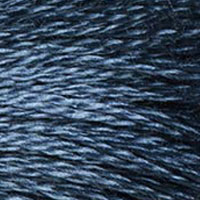
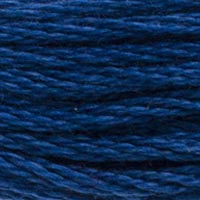
"Antique" in color naming usually means grayed, softened, aged — the chromatic equivalent of something that was once brighter having developed the patina of time. DMC 930 Dark Antique Blue earns its name. At #455C71, this is a blue that reads as having lived somewhere: not quite navy, not quite slate, not quite teal, but the kind of blue you'd find in old painted furniture, faded indigo textiles, or the sky in an overcast 18th-century landscape painting. It carries a formality and depth that modern clean blues lack.
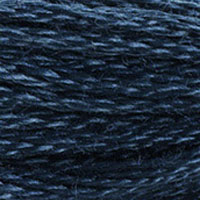
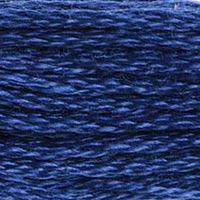
In the three-step Antique Blue family — 930 (Dark), DMC 931 (Medium Antique Blue), and DMC 932 (Light Antique Blue) — 930 anchors the shadow end with the most presence and depth. It's dark enough to function as a near-neutral in muted palettes while maintaining enough blue character to read clearly in context. The muted quality that comes from the gray component makes it far more versatile than a saturated navy or cobalt — it cooperates with adjacent colors rather than competing with them.
Historical and Period Associations
The Antique Blue family resonates strongly with several historical textile traditions. Indigo dye, historically one of the most important and commercially significant dyes in the world, produced blues in exactly this slightly desaturated, gray-blue range when used on natural fibers and aged with light. The DMC 930 hue is close to what you'd see in a piece of old indigo-dyed linen that's been washed and exposed to light over decades — the characteristic quality of aged indigo that historians call "indigo fade."
18th and 19th century American and European folk embroidery traditions used indigo-dyed threads extensively, and reproduction patterns from these traditions specify 930 or its family regularly. Redwork and bluework pieces (the tradition of single-color embroidery on white fabric, either red or blue) use antique blues rather than bright cobalt specifically to achieve the historical quality of period pieces. A bluework design stitched in DMC 930 has a completely different visual quality than the same design in a bright DMC 798 (Dark Delft Blue) — more period-appropriate, softer, less graphic.
Contemporary Applications
The muted Scandinavian and Nordic aesthetic that's been influential in design for years depends on colors like DMC 930. Swedish folk textiles in particular often feature this kind of grayed blue-gray as a primary element, and cross-stitch interpretations of Swedish folk art reach for 930 and 931 frequently. The farmhouse and cottagecore aesthetic movements in cross-stitch are full of patterns that specify antique blue as their primary color family.
In more contemporary design contexts, the pairing of 930 with DMC 926 (Medium Gray Green) and DMC 927 (Light Gray Green) creates the kind of sophisticated, muted palette that appeals to stitchers who want their finished pieces to complement modern home décor rather than read as traditional craft objects. The mutual mutedness of both color families makes them natural companions.
Anchor 1035 and Madeira 1712 both carry exact ratings for DMC 930, providing solid brand substitution support. The full Anchor Antique Blue sequence (1035, 1034, 1033) maps reliably to the DMC 930, 931, 932 family, allowing complete gradient work in either brand.
Anchor 1035 is a dependable substitute that reads comparably in most contexts. The muted quality of 930 — the gray component that gives it its "antique" character — is preserved in the Anchor equivalent. Madeira 1712 is similarly reliable and offers Madeira's consistent colorfastness in the blue range.
Cosmo 734 and Sullivans 45273 carry close ratings. In the antique blue range, the "close" designation typically means the substitute may read with a slightly different balance between the blue and gray components — either slightly bluer or slightly grayer than DMC 930. For most applications this is acceptable; for designs where the specific muted quality of 930 is part of the aesthetic intent, testing is worthwhile.
Within DMC, if 930 is unavailable, DMC 931 (Medium Antique Blue, one step lighter) is the obvious family substitute. DMC 336 (Navy Blue) provides comparable darkness but with a cleaner, brighter blue character and less of the antique-gray quality. DMC 3750 (Very Dark Antique Blue) extends the family further into shadow territory if you need something even darker than 930.
Reference quality
How We Validate This Color Record
Use this page as a reference card for DMC 930: the structured data, quick conversions, and long-form copy are all tied back to the same stored color record.
- Methodology
- This page renders DMC 930, its hex value, and every brand equivalent from the site's source-of-truth color record, then checks long-form body copy against those same stored fields.
- Verification status
- Source-field checked. The page content is audited against the stored DMC number, brand equivalents, and match-quality labels before publishing.
- Last reviewed
- 2026-04-20
- Approximation warning
- Screen hex values, thread photos, and cross-brand conversions are reference aids. Dye lots, thread sheen, and fabric color can still shift the result in hand.
Decision guide
When to use the DMC 930 reference page
This page should help you decide faster between palette planning, brand substitution, and shade comparison without turning the color record into a thin lookup page.
Best for
- + Palette planning when you want the stored DMC 930 Dark Antique Blue record, hex value #455C71, and linked brand equivalents in one place.
- + Checking the quickest cross-brand shortlist before you buy floss, compare stash substitutes, or route into a more specific conversion page.
- + Finding nearby shades in the blues family before you commit to accents, shading, or background blends.
Watch for
- ! Screen previews are only reference aids. Dark Antique Blue can shift on real fabric because thread sheen, stitch coverage, and room lighting change how the color reads.
- ! A stored equivalent is still a shortlist, not a guarantee that two brands will disappear into each other in the same stitched motif.
- ! Older charts, discontinued kit floss, and dye-lot variation can all introduce small but visible differences that the page cannot detect for you.
Before you commit
- Confirm the role of DMC 930 Dark Antique Blue: decide whether you need an exact hero shade, a forgiving background, or a rough stash substitute.
- Compare on project fabric: view the skein or stitched sample on the same fabric count and color you will actually use.
- Use the linked conversion pages next: open the brand-specific pages when you need match-quality caveats before substituting away from the DMC reference.
DMC 930 FAQ
These questions appear on the page so the FAQ schema stays aligned with what visitors can actually read.
What is the Anchor equivalent of DMC 930?+
The closest Anchor equivalent to DMC 930 (Dark Antique Blue) is Anchor 1035. This is an exact match.
What color is DMC 930?+
DMC 930 is called "Dark Antique Blue" and has a hex color value of #455C71. It belongs to the blues color family.
What is the Madeira equivalent of DMC 930?+
The closest Madeira equivalent to DMC 930 (Dark Antique Blue) is Madeira 1712. This is a close match.
The Antique Blue family has a particular resonance with several cross-stitch project traditions. Bluework embroidery — the single-color technique of stitching designs entirely in one shade of blue on white or cream fabric — is most authentic and appealing when worked in antique rather than bright blue. The tradition has historical roots in blue-on-white ceramics (Delftware, Chinese porcelain), and the grayed quality of DMC 930 reads closer to that historical reference than a bright cobalt would. A bluework sampler, floral motif, or traditional folk design in DMC 930 on antique white evenweave has a genuinely beautiful, period-accurate quality.
Scandinavian folk patterns — Dala horses, Nordic geometric borders, Swedish botanical motifs — frequently specify the antique blue range. These patterns are well-suited to 14-count Aida or 28-count evenweave, and the full 930–932 gradient gives enough value range to render detailed folk motifs with shading that matches the dimensional quality of original painted wood objects.
SALs organized around historical or heritage themes often specify the Antique Blue family as the palette anchor. The colors have proven popular in the cross-stitch community precisely because they pair so well with neutrals and other muted tones — antique pinks, warm creams, gray-greens — making them easy to incorporate into cohesive, sophisticated finished pieces that hold together across a range of design elements.
How DMC 930 Looks on Fabric
The same thread appears different depending on your fabric. Always test on your project fabric.
White Aida
Cream / Ecru
Black Aida
Pairs Well With
DMC colors commonly used alongside 930 Dark Antique Blue.
Suggested Palette
Shading Companions
Detailed Conversions
Where to Buy DMC 930
This section contains affiliate links. We may earn a small commission at no cost to you.
Related Guides
Free Printable Thread Conversion Chart
Pick a brand, enter your email, and we'll send you a printable chart mapping all 552 DMC colors to that brand's equivalents. Zero spam, one chart.
Thanks! Here's your free chart:
Download Your ChartOpens in a new tab. Use your browser's Print → Save as PDF.
No spam. Your email is stored securely and never shared.