
Quick Conversion Table
| Brand | Equivalent | Match |
|---|---|---|
| Anchor | 164 | exact |
| Madeira | 1010 | close |
| Cosmo ⚠ | 255 | close |
| Sullivans | 45225 | close |
| J&P Coats | 7182 | close |
| Dimensions | 6007 | close |
| Bucilla | 6007 | close |
| Candamar | 6235 | close |
Gradient building in cross-stitch depends on having the right value steps — if you skip a value or use one that's too close to its neighbors, the gradient looks either jagged or muddy. DMC 824 occupies a critical position in the blue value scale: deep enough to provide real contrast at the dark end of a gradient, but light enough to retain clear blue identity rather than reading as near-black. At hex #396987, it's a substantial, rich blue that holds its own in complex designs.
The Blue Value Family
The 824 family — running from 820 (Very Dark Royal Blue) through 824, 826 (Medium Blue), 827 (Very Light Blue), and 828 (Ultra Very Light Blue) — is one of DMC's more complete value progressions in the blue family. 824 functions as the darkest entry in this sequence that still reads as clearly, unambiguously blue rather than near-navy. For watercolor-style designs, seascapes, sky gradients, and any piece where you need blue to move convincingly from deep to light, 824 is the essential anchor at the dark end of the sequence.
Understanding the difference between 824 and its neighbors is practical, not academic. 820 (Very Dark Royal Blue) is warmer and more saturated — it reads as distinctly royal blue. 824 is slightly cooler and more neutral in its blue quality, which actually makes it more versatile for realistic water and sky rendering where a very specific blue character is less useful than a more neutral deep blue.
Water, Sky, and Nature Scenes
Ocean cross-stitch nearly always includes 824 somewhere in its palette. Deep water at the horizon of a seascape, the shadow trough between wave crests, and the darkest zone of an underwater scene all call for this depth of blue. Paired with DMC 826 for mid-water and DMC 827 for sun-struck surface or foam areas, a convincing ocean illusion requires 824's depth as a foundation.
Mountain lake designs, river scenes, and any still water piece that needs a dark reflection benefit from similar logic. Still water reads darker than moving water, and very still, deep water reads darkest of all — that's 824's territory.
Sky work uses 824 differently. In atmospheric perspective, sky color deepens at the zenith and lightens toward the horizon. A top-to-bottom sky gradient running from 824 at the top through 826 and 827 to something even lighter at the horizon gives a cross-stitched sky genuine depth and the impression of atmospheric distance.
Denim, Fabric, and Fashion Applications
Cross-stitch portraits and lifestyle designs that include clothing textures need convincing denim and other dark fabric tones. 824 is one of the core blues for rendering medium-dark denim — the shadows in jeans folds and the color of denim where it isn't catching light. Paired with DMC 823 (Dark Navy Blue) for the darkest seam areas and DMC 826 (Medium Blue) for the mid-tones, 824 sits in the naturalistic middle of the denim range and carries a lot of the fabric's surface texture in the rendering.
Folklore and traditional European embroidery designs that use blue as a primary decorative color often call on 824 as their darkest decorative blue. Ukrainian, Slovak, and Scandinavian folk art patterns that translate into cross-stitch kits tend to use blues in the 824-826 range as their working color family.
Anchor 164 and Madeira 1010 both earn exact match ratings here, making 824 one of the better-calibrated blues across brands. This level of cross-brand agreement is helpful for stitchers who work across manufacturer lines or want flexibility in sourcing.
Cosmo 255 is listed as close, and the difference shows up in Cosmo's characteristic silkier thread finish and occasionally slightly different undertone balance. Cosmo blues in this range tend to read slightly cooler or more purple-tinted than DMC equivalents in some lighting conditions. In most designs, the difference is too subtle to notice in finished work.
Sullivans 45225 is also a close match. The color should behave adequately as a substitute in most designs, with the usual caveat about mixing brands within a single piece for areas that will be directly compared.
Within DMC, 824 sits in a family with clear neighbors: DMC 826 (Medium Blue) is one visible step lighter in the same hue family, and DMC 820 (Very Dark Royal Blue) is at a similar depth but with a distinctly warmer, more royal character. If 824 is unavailable, DMC 826 is usable in many contexts where 824 would have provided the darkest accent — you lose some depth, but the color family is correct. DMC 825 (Dark Blue) also exists in the line and sits between 824 and 826, providing an additional step if you need very fine value gradation in your blue work.
Reference quality
How We Validate This Color Record
Use this page as a reference card for DMC 824: the structured data, quick conversions, and long-form copy are all tied back to the same stored color record.
- Methodology
- This page renders DMC 824, its hex value, and every brand equivalent from the site's source-of-truth color record, then checks long-form body copy against those same stored fields.
- Verification status
- Source-field checked. The page content is audited against the stored DMC number, brand equivalents, and match-quality labels before publishing.
- Last reviewed
- 2026-04-20
- Approximation warning
- Screen hex values, thread photos, and cross-brand conversions are reference aids. Dye lots, thread sheen, and fabric color can still shift the result in hand.
Decision guide
When to use the DMC 824 reference page
This page should help you decide faster between palette planning, brand substitution, and shade comparison without turning the color record into a thin lookup page.
Best for
- + Palette planning when you want the stored DMC 824 Very Dark Blue record, hex value #396987, and linked brand equivalents in one place.
- + Checking the quickest cross-brand shortlist before you buy floss, compare stash substitutes, or route into a more specific conversion page.
- + Finding nearby shades in the blues family before you commit to accents, shading, or background blends.
Watch for
- ! Screen previews are only reference aids. Very Dark Blue can shift on real fabric because thread sheen, stitch coverage, and room lighting change how the color reads.
- ! A stored equivalent is still a shortlist, not a guarantee that two brands will disappear into each other in the same stitched motif.
- ! Older charts, discontinued kit floss, and dye-lot variation can all introduce small but visible differences that the page cannot detect for you.
Before you commit
- Confirm the role of DMC 824 Very Dark Blue: decide whether you need an exact hero shade, a forgiving background, or a rough stash substitute.
- Compare on project fabric: view the skein or stitched sample on the same fabric count and color you will actually use.
- Use the linked conversion pages next: open the brand-specific pages when you need match-quality caveats before substituting away from the DMC reference.
DMC 824 FAQ
These questions appear on the page so the FAQ schema stays aligned with what visitors can actually read.
What is the Anchor equivalent of DMC 824?+
The closest Anchor equivalent to DMC 824 (Very Dark Blue) is Anchor 164. This is an exact match.
What color is DMC 824?+
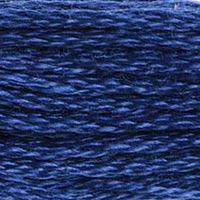
DMC 824 is called "Very Dark Blue" and has a hex color value of #396987. It belongs to the blues color family.
What is the Madeira equivalent of DMC 824?+
The closest Madeira equivalent to DMC 824 (Very Dark Blue) is Madeira 1010. This is a close match.
How DMC 824 Looks on Fabric
The same thread appears different depending on your fabric. Always test on your project fabric.
White Aida
Cream / Ecru
Black Aida
Pairs Well With
DMC colors commonly used alongside 824 Very Dark Blue.
Suggested Palette
Shading Companions
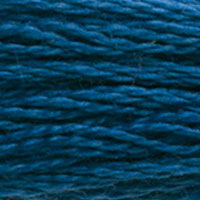
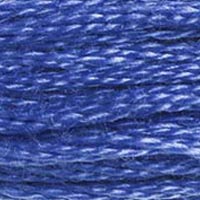
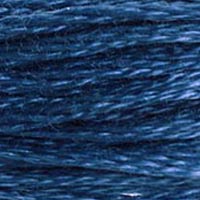
Detailed Conversions
Where to Buy DMC 824
This section contains affiliate links. We may earn a small commission at no cost to you.
Related Guides
Free Printable Thread Conversion Chart
Pick a brand, enter your email, and we'll send you a printable chart mapping all 552 DMC colors to that brand's equivalents. Zero spam, one chart.
Thanks! Here's your free chart:
Download Your ChartOpens in a new tab. Use your browser's Print → Save as PDF.
No spam. Your email is stored securely and never shared.