
Quick Conversion Table
| Brand | Equivalent | Match |
|---|---|---|
| Anchor | 277 | exact |
| Madeira | 2112 | close |
| Cosmo ⚠ | 775 | close |
| Sullivans | 45231 | close |
| J&P Coats | 5472 | close |
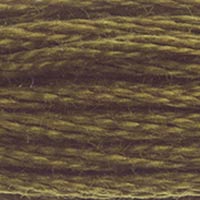
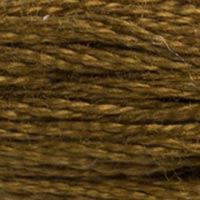
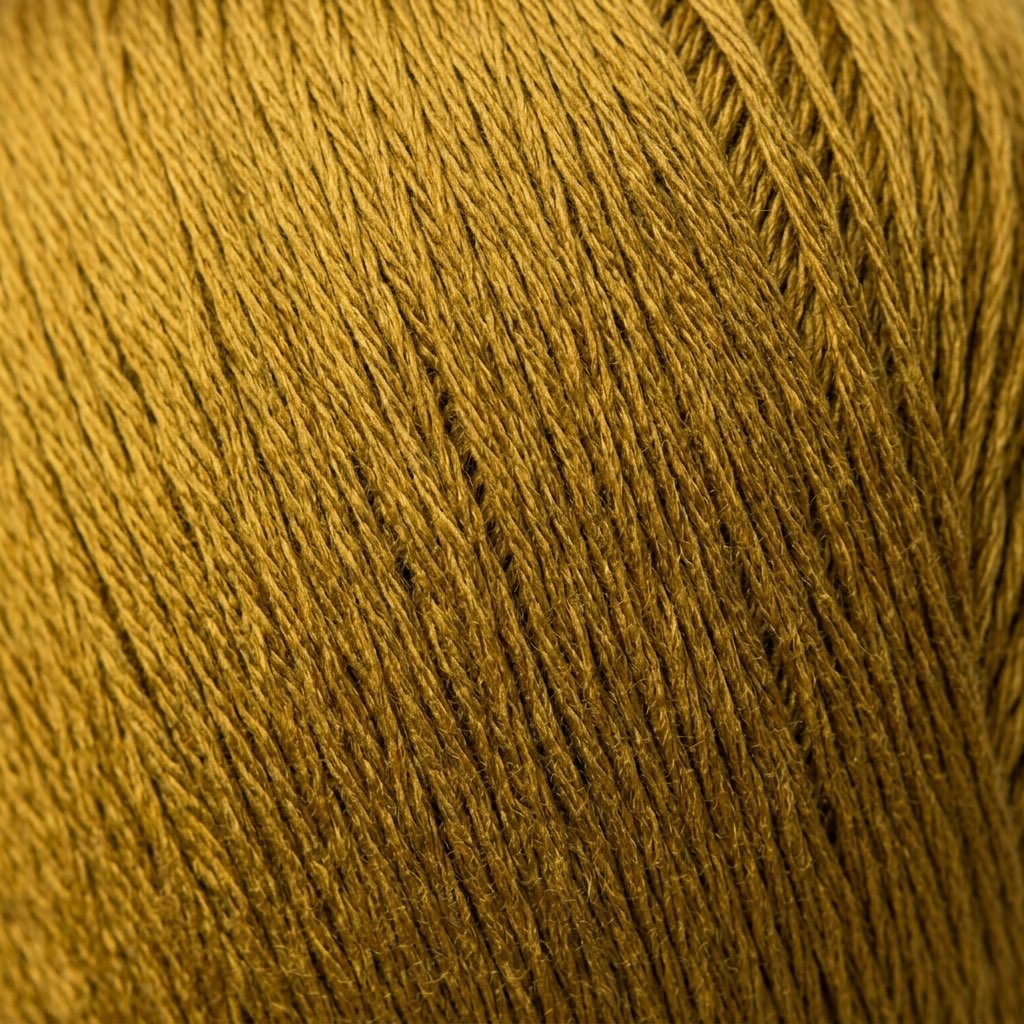
When light falls on antique brass — not the bright, polished-new brass of a modern fixture, but the darker, more complex patina of an old brass candlestick or a Victorian-era compass — the color that appears in shadow is something very close to DMC 830. Dark Golden Olive at hex #8D784B carries the particular quality of aged metal: yellow with green mixed in, brownish with depth, warm but not bright. It's a color that communicates age and craft rather than newness and machine production.
Second in the Golden Olive Sequence
DMC 830 is the second-darkest in the five-step golden olive family (829-834), which means it functions as both a shadow-area color when 829 is too dark and a base or fill color when the design calls for a relatively dark muted gold. This dual role makes 830 one of the more frequently reached-for colors in the family — it sits at a value that works in a wide range of contexts without committing to the extreme depth of 829 or the obvious lightness of the mid-tones.
For two-color golden olive work where you only need one light and one dark, 830 and 833 (Light Golden Olive) make a functional pair — enough contrast to read as dimensional, similar enough in character to feel cohesive. For the full five-step gradient, 830 handles the upper-shadow zone: the area that isn't the deepest shadow but is clearly below the midpoint in luminosity.
Autumn and Harvest Applications
Harvest festival designs, Thanksgiving-themed pieces, and general autumn compositions pull on 830 heavily. The color sits at exactly the right depth to render the body of a dried corn husk, the stem of a pumpkin, or the mid-tone of an oak leaf in autumn color. Alongside DMC 832 (Golden Olive) for the lighter leaf areas and DMC 829 (Very Dark Golden Olive) for deep shadow and veining, 830 fills the substantial middle ground of the autumn palette.
Wheat sheaves, dried herb bundles, and harvest-basket motifs that appear in cottage and farmhouse cross-stitch patterns use 830 as their darkest golden element. The color has just enough warmth to read as golden — it won't be mistaken for brown — while having enough depth to function as the dark anchor in a composition.
Mediterranean and Botanical Themes
Olive branches, laurel wreaths, and Mediterranean herb designs in cross-stitch frequently appear in the colors of the region's dried flora rather than its living colors — the yellowed, dried quality of herbs that have been picked and pressed, or the weathered quality of rocky Mediterranean hillsides in late summer. 830 appears often in these contexts, carrying the golden quality of dried sage, dried oregano, or the muted gold of lichen on limestone.
Botanical samplers that include olive or bay laurel specifically benefit from the full golden olive family, but 830 and 831 (Medium Golden Olive) handle the most visible foliage areas — the colors that carry the most surface area in the design. Getting these mid-tones right while 829 and 834 handle the extremes produces botanical work that reads as naturally organic rather than artificially bright.
Anchor 277 and Madeira 2112 both earn exact match ratings. Notably, Anchor 277 is also listed as the equivalent for DMC 831 (Medium Golden Olive) at a close rather than exact rating — so while 277 matches 830 exactly, it's a close-but-not-exact for 831. This suggests the two colors are near the edge of Anchor's calibration range, which makes sense given how subtle the value steps are in this family.
Cosmo 775 and Sullivans 45231 are both close matches. As noted for other colors in the golden olive family, Cosmo's thread tends to have a slightly different finish that can shift the apparent warmth of muted golds in different lighting. In designs where the specific golden-olive balance is critical, test alongside your other colors before committing.
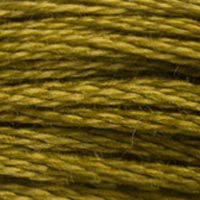
Within DMC, the direct neighbors are DMC 829 (Very Dark Golden Olive) and DMC 831 (Medium Golden Olive). If 830 is unavailable, either neighbor can substitute in designs that aren't using the full family — use 829 if you need more depth, 831 if you need less. In designs where 830 sits between those two in a gradient, substituting will compress your value range at one end.
Outside the golden olive family, DMC 869 (Very Dark Hazelnut Brown) is warmer and browner but occupies a similar dark earth-tone role in compositions. If your design uses 830 primarily for its depth rather than its specific golden character, 869 is a possible alternative.
Reference quality
How We Validate This Color Record
Use this page as a reference card for DMC 830: the structured data, quick conversions, and long-form copy are all tied back to the same stored color record.
- Methodology
- This page renders DMC 830, its hex value, and every brand equivalent from the site's source-of-truth color record, then checks long-form body copy against those same stored fields.
- Verification status
- Source-field checked. The page content is audited against the stored DMC number, brand equivalents, and match-quality labels before publishing.
- Last reviewed
- 2026-04-20
- Approximation warning
- Screen hex values, thread photos, and cross-brand conversions are reference aids. Dye lots, thread sheen, and fabric color can still shift the result in hand.
Decision guide
When to use the DMC 830 reference page
This page should help you decide faster between palette planning, brand substitution, and shade comparison without turning the color record into a thin lookup page.
Best for
- + Palette planning when you want the stored DMC 830 Dark Golden Olive record, hex value #8D784B, and linked brand equivalents in one place.
- + Checking the quickest cross-brand shortlist before you buy floss, compare stash substitutes, or route into a more specific conversion page.
- + Finding nearby shades in the yellows family before you commit to accents, shading, or background blends.
Watch for
- ! Screen previews are only reference aids. Dark Golden Olive can shift on real fabric because thread sheen, stitch coverage, and room lighting change how the color reads.
- ! A stored equivalent is still a shortlist, not a guarantee that two brands will disappear into each other in the same stitched motif.
- ! Older charts, discontinued kit floss, and dye-lot variation can all introduce small but visible differences that the page cannot detect for you.
Before you commit
- Confirm the role of DMC 830 Dark Golden Olive: decide whether you need an exact hero shade, a forgiving background, or a rough stash substitute.
- Compare on project fabric: view the skein or stitched sample on the same fabric count and color you will actually use.
- Use the linked conversion pages next: open the brand-specific pages when you need match-quality caveats before substituting away from the DMC reference.
DMC 830 FAQ
These questions appear on the page so the FAQ schema stays aligned with what visitors can actually read.
What is the Anchor equivalent of DMC 830?+
The closest Anchor equivalent to DMC 830 (Dark Golden Olive) is Anchor 277. This is an exact match.
What color is DMC 830?+
DMC 830 is called "Dark Golden Olive" and has a hex color value of #8D784B. It belongs to the yellows color family.
What is the Madeira equivalent of DMC 830?+
The closest Madeira equivalent to DMC 830 (Dark Golden Olive) is Madeira 2112. This is a close match.
How DMC 830 Looks on Fabric
The same thread appears different depending on your fabric. Always test on your project fabric.
White Aida
Cream / Ecru
Black Aida
Pairs Well With
DMC colors commonly used alongside 830 Dark Golden Olive.
Suggested Palette
Shading Companions
Detailed Conversions
Where to Buy DMC 830
This section contains affiliate links. We may earn a small commission at no cost to you.
Related Guides
Free Printable Thread Conversion Chart
Pick a brand, enter your email, and we'll send you a printable chart mapping all 552 DMC colors to that brand's equivalents. Zero spam, one chart.
Thanks! Here's your free chart:
Download Your ChartOpens in a new tab. Use your browser's Print → Save as PDF.
No spam. Your email is stored securely and never shared.