
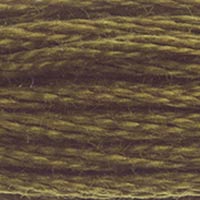
DMC 829 — Very Dark Golden Olive
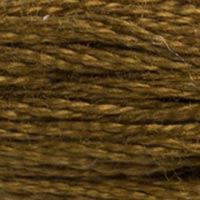
Yellows family · Hex #7E6B42
Quick Conversion Table
| Brand | Equivalent | Match |
|---|---|---|
| Anchor | 914 | exact |
| Madeira | 2114 | close |
| Cosmo ⚠ | 775 | close |
| Sullivans | 45230 | close |
| J&P Coats | 5889 | close |
Ancient olive groves cast a specific kind of shadow — not the green shadow of a temperate forest, but something drier, dustier, and more golden. The bark of old olive trees, the dried herb itself, the pressed oil in a stone crock: these things share a quality of deep, muted gold-brown that DMC 829 captures with unusual accuracy. Very Dark Golden Olive at hex #7E6B42 is the darkest value in a five-thread golden olive family (829 through 834), and it's this depth that gives the family its utility in naturalistic rendering.
Understanding the Golden Olive Family
The five colors spanning DMC 829 through 834 — Very Dark, Dark, Medium, Light, and Very Light Golden Olive — form one of the most useful earth-tone progressions in the entire DMC line. They're not brown, not green, and not yellow, but the intersection of all three: the color of dry grass in late autumn, of Mediterranean scrubland, of aged brass, of autumn wheat before the harvest. 829 at the dark end grounds this family in depth and shadow.
As the darkest, 829 functions primarily as the shadow and anchor color in any design that uses the golden olive family. In olive tree embroidery, botanical samplers featuring Mediterranean herbs, or any piece with dry, golden landscape elements, 829 establishes the deepest shadow tones while 832 (Golden Olive) and 834 (Very Light Golden Olive) handle the sun-struck highlights. The range between them creates a believable sense of three-dimensional form.
Autumn and Natural Designs
Autumn leaf palettes depend heavily on the golden olive family, and 829 specifically. The deepest shadow color in a dying leaf — the part of the leaf that's curled or folded, blocking light from both sides — reads very close to 829. Paired with DMC 830 (Dark Golden Olive) for mid-tone leaf body, DMC 832 (Golden Olive) for the main leaf color, and DMC 3820 (Dark Straw) for the brightest sun-struck highlights, 829 gives autumnal botanical pieces their characteristic golden richness.
Wheat and grain field designs also call on 829 for the deep shadow zones between grain stalks. In harvest-themed cross-stitch — a popular seasonal design category — the dense, dried stalks of wheat or barley need a dark muted gold that doesn't tip into brown. 829 occupies exactly that space.
Heraldic Gold and Metallic Effects
In designs that reference gold but can't use actual metallic thread (which can be fussy to stitch and behaves unpredictably on some fabric counts), 829 appears as the shadow of the gold — the part that doesn't catch light, the undersides of raised ornamental elements. Combined with DMC 832 as the main gold tone and DMC 834 or DMC 677 (Very Light Old Gold) as the highlight, this three-tone gold system can approximate the appearance of hammered gold or gilded surfaces in a way that flat single-color gold cannot.
Antique treasure and jewelry cross-stitch — crowns, coins, medallions — use this system regularly. The depth of 829 makes the lighter gold values read as genuinely luminous by contrast, which is the optical illusion that creates the impression of metallic sheen without any actual metallic thread.
Both Anchor 914 and Madeira 2114 earn exact match ratings, which is encouraging for a color with such a specific, nuanced undertone. The golden-olive balance is notoriously difficult to replicate across brands because even small shifts in the yellow-green ratio change the apparent character dramatically. The fact that Anchor and Madeira match well here suggests this is a carefully calibrated shade.
Cosmo 775 and Sullivans 45230 are close rather than exact. Cosmo's version may read slightly more olive-green or slightly more gold depending on the dye lot and lighting — the golden-olive family is particularly sensitive to this kind of minor variation. Testing alongside your other golden olive DMC colors before substituting mid-project is especially important in this family, where the subtle relationships between adjacent values are part of what makes the gradient work.
Within DMC, the obvious substitution question is whether DMC 830 (Dark Golden Olive) can substitute for 829 when 829 is unavailable. The answer is that 830 is noticeably lighter — the difference between the two is visible and meaningful in gradient work. If you need the full five-color golden olive range and 829 is out of stock, the only reasonable approach is to either wait for it or shift your entire palette one step lighter, using 830 where 829 would have been and adjusting upward accordingly.
Outside the golden olive family, DMC 869 (Very Dark Hazelnut Brown) shares a similar dark, muted earth-tone character and can substitute in designs where the golden quality of 829 isn't critical — if you need dark earth-tone depth without worrying about the specific golden-versus-brown character, 869 is worth considering.
Reference quality
How We Validate This Color Record
Use this page as a reference card for DMC 829: the structured data, quick conversions, and long-form copy are all tied back to the same stored color record.
- Methodology
- This page renders DMC 829, its hex value, and every brand equivalent from the site's source-of-truth color record, then checks long-form body copy against those same stored fields.
- Verification status
- Source-field checked. The page content is audited against the stored DMC number, brand equivalents, and match-quality labels before publishing.
- Last reviewed
- 2026-04-20
- Approximation warning
- Screen hex values, thread photos, and cross-brand conversions are reference aids. Dye lots, thread sheen, and fabric color can still shift the result in hand.
Decision guide
When to use the DMC 829 reference page
This page should help you decide faster between palette planning, brand substitution, and shade comparison without turning the color record into a thin lookup page.
Best for
- + Palette planning when you want the stored DMC 829 Very Dark Golden Olive record, hex value #7E6B42, and linked brand equivalents in one place.
- + Checking the quickest cross-brand shortlist before you buy floss, compare stash substitutes, or route into a more specific conversion page.
- + Finding nearby shades in the yellows family before you commit to accents, shading, or background blends.
Watch for
- ! Screen previews are only reference aids. Very Dark Golden Olive can shift on real fabric because thread sheen, stitch coverage, and room lighting change how the color reads.
- ! A stored equivalent is still a shortlist, not a guarantee that two brands will disappear into each other in the same stitched motif.
- ! Older charts, discontinued kit floss, and dye-lot variation can all introduce small but visible differences that the page cannot detect for you.
Before you commit
- Confirm the role of DMC 829 Very Dark Golden Olive: decide whether you need an exact hero shade, a forgiving background, or a rough stash substitute.
- Compare on project fabric: view the skein or stitched sample on the same fabric count and color you will actually use.
- Use the linked conversion pages next: open the brand-specific pages when you need match-quality caveats before substituting away from the DMC reference.
DMC 829 FAQ
These questions appear on the page so the FAQ schema stays aligned with what visitors can actually read.
What is the Anchor equivalent of DMC 829?+
The closest Anchor equivalent to DMC 829 (Very Dark Golden Olive) is Anchor 914. This is an exact match.
What color is DMC 829?+
DMC 829 is called "Very Dark Golden Olive" and has a hex color value of #7E6B42. It belongs to the yellows color family.
What is the Madeira equivalent of DMC 829?+
The closest Madeira equivalent to DMC 829 (Very Dark Golden Olive) is Madeira 2114. This is a close match.
How DMC 829 Looks on Fabric
The same thread appears different depending on your fabric. Always test on your project fabric.
White Aida
Cream / Ecru
Black Aida
Pairs Well With
DMC colors commonly used alongside 829 Very Dark Golden Olive.
Suggested Palette
Shading Companions
Detailed Conversions
Where to Buy DMC 829
This section contains affiliate links. We may earn a small commission at no cost to you.
Related Guides
Free Printable Thread Conversion Chart
Pick a brand, enter your email, and we'll send you a printable chart mapping all 552 DMC colors to that brand's equivalents. Zero spam, one chart.
Thanks! Here's your free chart:
Download Your ChartOpens in a new tab. Use your browser's Print → Save as PDF.
No spam. Your email is stored securely and never shared.