
Quick Conversion Table
| Brand | Equivalent | Match |
|---|---|---|
| Anchor | 355 | close |
| Madeira | 2303 | close |
| Cosmo ⚠ | 2642 | close |
| Sullivans | 45164 | close |
The cross-stitch community's relationship with variegated threads is genuinely complicated. On one hand, they're undeniably magical when they work — a single thread that cycles through warm browns and tans and copper tones can make a stitched tree bark or animal fur look more alive than any solid color could manage. On the other hand, the banding effects that variegated threads produce when worked in rows can ruin an otherwise careful design. DMC 93 Variegated Warm Brown sits in the more forgiving end of the variegated spectrum: its color family is warm, naturalistic, and constrained enough that even when the patterning is visible, it usually reads as intentional variation rather than as an error.
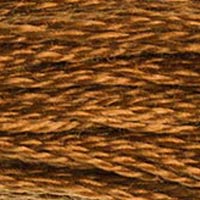
The hex #906040 represents roughly the mid-range of 93's dye cycle, which moves through warm brown tones — from a darker, richer brown at one end through medium warm brown and into lighter tan and golden-brown territory. The range stays within the warm brown family throughout; there are no surprise purple or teal moments. This predictability makes DMC 93 one of the more reliable variegated threads for naturalistic applications.
Where Warm Brown Variegation Earns Its Place
Animal fur is the most obvious and compelling application. A fox, squirrel, or rabbit rendered in cross-stitch benefits enormously from warm-brown variegated thread in the main fur fill — the natural color variation in the thread mimics the way individual hairs in fur catch light differently, creating a surface quality that no solid color achieves. DMC 93 in the main fur body, with DMC 433 (Medium Brown) or DMC 801 (Dark Coffee Brown) for the darkest shadow areas and DMC 738 (Very Light Tan) for the lightest highlights, creates a fur rendering with surprising realism.
Tree bark is another natural home. Real bark has complex tonal variation — warmer where it's dry, darker where it's wet or in shade, lighter where old growth has silvered. DMC 93 captures that complexity with a single thread choice, which simplifies the design without sacrificing the visual richness. Worked in vertical stitches following the direction of real bark growth, 93 creates a convincing textured surface.
Basket weaving and wicker designs also benefit from 93's warm brown variation. The interlaced structure of basketry creates its own light-and-dark patterning, and using a variegated thread adds a second layer of color variation that reads as material character rather than as a patterning effect. For cross-stitch representations of woven containers, wrapped handles, or traditional crafts involving natural fibers, DMC 93 is a natural choice.
Managing the Banding Problem
The standard advice for avoiding banding with variegated threads applies to DMC 93: work shorter lengths, stitch individual crosses rather than rows of half-crosses, and consider starting multiple lengths at different points in the dye cycle so adjacent areas don't synchronize. In large fill areas, deliberately starting new lengths at different points breaks up any visible pattern that might develop.
Alternating between DMC 93 and a nearby solid brown — DMC 433 (Medium Brown) or DMC 3826 (Golden Brown) — across a large area also reduces the banding effect while maintaining the warm-brown color family. This technique of interleaving variegated and solid threads is worth having in your toolkit for any large organic fill that needs color variation without a visible pattern.
All four brand equivalents for DMC 93 Variegated Warm Brown carry close ratings — as with all variegated thread conversions, exact matches across brands are impossible because each brand designs its own dye sequence. The substitutes cover broadly similar warm brown territory but differ in the specific values cycled, the interval lengths, and the precise warmth/coolness balance within the range.
Anchor 355 (close) and Madeira 2303 (close) are the most commonly referenced alternatives. Both cover warm brown variegation in the right chromatic territory. The practical question for any variegated substitution is whether the visual effect in your specific design will be acceptable — and the only way to know is to stitch a test area.
Cosmo 2642 and Sullivans 45164 both rate as close. Sullivans' variegated range can be somewhat harder to find depending on your location; Cosmo's is generally more widely available internationally.
If you need a non-variegated alternative for DMC 93, a blended needle combining DMC 433 (Medium Brown) and DMC 435 (Very Light Brown) — one strand each — produces a mid-range warm brown that reads comparably to the mid-point of DMC 93's range. This approach sacrifices the dynamic color variation of the variegated original but maintains the warm brown character for simpler applications where the variation effect is less critical.
Reference quality
How We Validate This Color Record
Use this page as a reference card for DMC 93: the structured data, quick conversions, and long-form copy are all tied back to the same stored color record.
- Methodology
- This page renders DMC 93, its hex value, and every brand equivalent from the site's source-of-truth color record, then checks long-form body copy against those same stored fields.
- Verification status
- Source-field checked. The page content is audited against the stored DMC number, brand equivalents, and match-quality labels before publishing.
- Last reviewed
- 2026-04-20
- Approximation warning
- Screen hex values, thread photos, and cross-brand conversions are reference aids. Dye lots, thread sheen, and fabric color can still shift the result in hand.
Decision guide
When to use the DMC 93 reference page
This page should help you decide faster between palette planning, brand substitution, and shade comparison without turning the color record into a thin lookup page.
Best for
- + Palette planning when you want the stored DMC 93 Variegated Warm Brown record, hex value #906040, and linked brand equivalents in one place.
- + Checking the quickest cross-brand shortlist before you buy floss, compare stash substitutes, or route into a more specific conversion page.
- + Finding nearby shades in the browns family before you commit to accents, shading, or background blends.
Watch for
- ! Screen previews are only reference aids. Variegated Warm Brown can shift on real fabric because thread sheen, stitch coverage, and room lighting change how the color reads.
- ! A stored equivalent is still a shortlist, not a guarantee that two brands will disappear into each other in the same stitched motif.
- ! Older charts, discontinued kit floss, and dye-lot variation can all introduce small but visible differences that the page cannot detect for you.
Before you commit
- Confirm the role of DMC 93 Variegated Warm Brown: decide whether you need an exact hero shade, a forgiving background, or a rough stash substitute.
- Compare on project fabric: view the skein or stitched sample on the same fabric count and color you will actually use.
- Use the linked conversion pages next: open the brand-specific pages when you need match-quality caveats before substituting away from the DMC reference.
DMC 93 FAQ
These questions appear on the page so the FAQ schema stays aligned with what visitors can actually read.
What is the Anchor equivalent of DMC 93?+
The closest Anchor equivalent to DMC 93 (Variegated Warm Brown) is Anchor 355. This is a close match.
What color is DMC 93?+
DMC 93 is called "Variegated Warm Brown" and has a hex color value of #906040. It belongs to the browns color family.
What is the Madeira equivalent of DMC 93?+
The closest Madeira equivalent to DMC 93 (Variegated Warm Brown) is Madeira 2303. This is a close match.
How DMC 93 Looks on Fabric
The same thread appears different depending on your fabric. Always test on your project fabric.
White Aida
Cream / Ecru
Black Aida
Pairs Well With
DMC colors commonly used alongside 93 Variegated Warm Brown.
Suggested Palette
Shading Companions
Detailed Conversions
Where to Buy DMC 93
This section contains affiliate links. We may earn a small commission at no cost to you.
Related Guides
Free Printable Thread Conversion Chart
Pick a brand, enter your email, and we'll send you a printable chart mapping all 552 DMC colors to that brand's equivalents. Zero spam, one chart.
Thanks! Here's your free chart:
Download Your ChartOpens in a new tab. Use your browser's Print → Save as PDF.
No spam. Your email is stored securely and never shared.