
Quick Conversion Table
| Brand | Equivalent | Match |
|---|---|---|
| Anchor | 374 | exact |
| Madeira | 2105 | close |
| Cosmo ⚠ | 575 | close |
| Sullivans | 45092 | close |
| J&P Coats | 5374 | close |
| Dimensions | 15374 | close |
| Bucilla | 16159 | close |
Wheat Fields and Harvest Gold
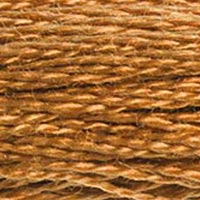
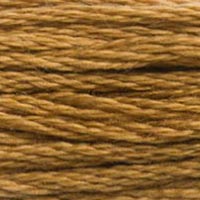
Thread a needle with DMC 420 and you're holding the color of a wheat field in late July — that particular golden brown where the stalks have dried past yellow but haven't yet reached the pale straw of full ripeness. It's the color of a hazelnut shell, exactly as the name promises, but also of dark honey in a jar held at arm's length, the crust of a sourdough boule, or the amber resin trapped in the knot of a pine board. This is a brown with serious gold content, sitting squarely between the brown and gold families in a way that makes it useful for both.
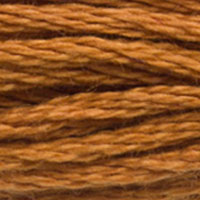
DMC 420 is the darkest in the hazelnut brown sequence (420, 869, 422), and it anchors that family with a richness that the lighter values depend on. Without 420 at the shadow end, a hazelnut palette can look washed out and indecisive — pretty golds floating without any grounding. With it, you get a gradient that moves convincingly from dark, resinous brown-gold through warm mid-tones to sunlit highlights, a progression that mirrors the way actual hazelnuts look in a bowl: the shells in shadow are 420, the ones catching light are 422.
Bread, Grain, and the Warm Kitchen Palette
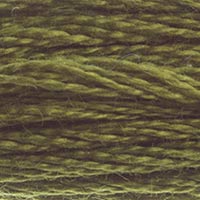
If you've ever stitched a kitchen sampler, a harvest scene, or a Thanksgiving design, you've probably used 420 or something close to it. This thread is the workhorse of grain and baking imagery. Sheaves of wheat, ears of barley, piles of golden bread rolls — they all need a dark golden-brown anchor, and 420 provides it. Pair it with DMC 422 (Light Hazelnut Brown) for the lighter grain heads, DMC 3047 (Light Yellow Beige) for the pale chaff, and DMC 3045 (Dark Yellow Beige) for an intermediate step, and you've got a palette that can handle an entire harvest landscape.
The bread association runs deep. For stitched bread designs — rustic loaves, bakery samplers, even the little bread-shaped ornaments that have become surprisingly popular in cross-stitch communities — 420 is the dark crust color that gives dimension to the loaf. The contrast between 420 in the crust shadows and DMC 738 (Very Light Tan) or DMC 739 (Ultra Very Light Tan) on the flour-dusted top is what makes a stitched loaf look rounded and real rather than flat and uniform.
Basket Weaving Textures in Thread
Wicker baskets are a staple motif in cross-stitch — harvest baskets, flower baskets, Easter baskets, the basket that kittens invariably sit in — and stitching convincing basketwork requires understanding how light plays across the woven surface. Each willow strip has a lit side and a shadow side, and where strips cross over each other, there are tiny shadows beneath the overlap. DMC 420 handles the shadow side of the weave beautifully, providing depth that makes the basket look three-dimensional.
Build a basket palette with 420 for the deepest weave shadows, DMC 869 (Very Dark Hazelnut Brown) for the dark-but-not-shadowed strips, DMC 422 (Light Hazelnut Brown) for the light faces of the strips, and DMC 437 (Light Tan) for the highlights where the weave catches direct light. The alternating pattern of light and dark strips mimics the over-under structure of actual basketwork, and getting those value transitions right is what separates a convincing basket from a brown blob.
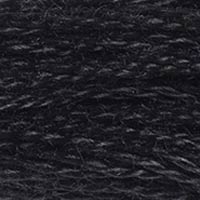
For the basket handle, where the wicker curves away from the viewer, darken everything by one step — 420 becomes the mid-tone and DMC 3781 (Dark Mocha Brown) handles the shadow, while 869 takes the lit side. This graduated darkening creates the illusion of a cylindrical form receding in space, a technique that works for any woven or rounded brown object, from basket handles to wicker furniture to the curved rim of a straw hat.
Preserving the Gold in the Brown
DMC 420 lives in the overlap between brown and gold, and a substitute that falls too far to either side — too neutrally brown or too purely golden — will shift the character of any palette built around it. The dark honey quality is essential.
Anchor 374 is an exact match and handles the golden-brown balance well. Madeira 2105, also exact, captures the warm, resinous quality faithfully. Both are safe substitutes that will integrate seamlessly into hazelnut or harvest palettes without introducing unwanted color shifts.
Cosmo 575 is close and generally maintains the golden undertone, though Cosmo's particular dye chemistry can sometimes produce a slightly greener gold at this value compared to DMC's warmer, more orange-gold. If your project features 420 prominently in a harvest or bread-themed palette, stitch a test area on your project fabric before committing. Sullivans 45092 is in the right territory — check it in natural light, since warm artificial light can make any gold-brown look more golden than it really is.
Within the DMC family, the closest alternative if 420 is unavailable is DMC 869 (Very Dark Hazelnut Brown), which is a step darker and shares the same golden-brown DNA. DMC 3045 (Dark Yellow Beige) is lighter and more yellow, but in some contexts — particularly where 420 appears as a background or fill color — it can serve as a reasonable stand-in. Avoid substituting with DMC 433 (Medium Brown) or DMC 434 (Light Brown), which are similar in value but completely lack the golden character. Those are true browns; 420 is a golden brown, and the distinction is both visible and important.
Reference quality
How We Validate This Color Record
Use this page as a reference card for DMC 420: the structured data, quick conversions, and long-form copy are all tied back to the same stored color record.
- Methodology
- This page renders DMC 420, its hex value, and every brand equivalent from the site's source-of-truth color record, then checks long-form body copy against those same stored fields.
- Verification status
- Source-field checked. The page content is audited against the stored DMC number, brand equivalents, and match-quality labels before publishing.
- Last reviewed
- 2026-04-20
- Approximation warning
- Screen hex values, thread photos, and cross-brand conversions are reference aids. Dye lots, thread sheen, and fabric color can still shift the result in hand.
Decision guide
When to use the DMC 420 reference page
This page should help you decide faster between palette planning, brand substitution, and shade comparison without turning the color record into a thin lookup page.
Best for
- + Palette planning when you want the stored DMC 420 Dark Hazelnut Brown record, hex value #A07042, and linked brand equivalents in one place.
- + Checking the quickest cross-brand shortlist before you buy floss, compare stash substitutes, or route into a more specific conversion page.
- + Finding nearby shades in the browns family before you commit to accents, shading, or background blends.
Watch for
- ! Screen previews are only reference aids. Dark Hazelnut Brown can shift on real fabric because thread sheen, stitch coverage, and room lighting change how the color reads.
- ! A stored equivalent is still a shortlist, not a guarantee that two brands will disappear into each other in the same stitched motif.
- ! Older charts, discontinued kit floss, and dye-lot variation can all introduce small but visible differences that the page cannot detect for you.
Before you commit
- Confirm the role of DMC 420 Dark Hazelnut Brown: decide whether you need an exact hero shade, a forgiving background, or a rough stash substitute.
- Compare on project fabric: view the skein or stitched sample on the same fabric count and color you will actually use.
- Use the linked conversion pages next: open the brand-specific pages when you need match-quality caveats before substituting away from the DMC reference.
DMC 420 FAQ
These questions appear on the page so the FAQ schema stays aligned with what visitors can actually read.
What is the Anchor equivalent of DMC 420?+
The closest Anchor equivalent to DMC 420 (Dark Hazelnut Brown) is Anchor 374. This is an exact match.
What color is DMC 420?+
DMC 420 is called "Dark Hazelnut Brown" and has a hex color value of #A07042. It belongs to the browns color family.
What is the Madeira equivalent of DMC 420?+
The closest Madeira equivalent to DMC 420 (Dark Hazelnut Brown) is Madeira 2105. This is a close match.
How DMC 420 Looks on Fabric
The same thread appears different depending on your fabric. Always test on your project fabric.
White Aida
Cream / Ecru
Black Aida
Pairs Well With
DMC colors commonly used alongside 420 Dark Hazelnut Brown.
Suggested Palette

Shading Companions
Detailed Conversions
Where to Buy DMC 420
This section contains affiliate links. We may earn a small commission at no cost to you.
Related Guides
Free Printable Thread Conversion Chart
Pick a brand, enter your email, and we'll send you a printable chart mapping all 552 DMC colors to that brand's equivalents. Zero spam, one chart.
Thanks! Here's your free chart:
Download Your ChartOpens in a new tab. Use your browser's Print → Save as PDF.
No spam. Your email is stored securely and never shared.