
Quick Conversion Table
| Brand | Equivalent | Match |
|---|---|---|
| Anchor | 845 | exact |
| Madeira | 1614 | close |
| Cosmo ⚠ | 826 | close |
| Sullivans | 45174 | close |
| J&P Coats | 5889 | close |
| Dimensions | 16845 | close |
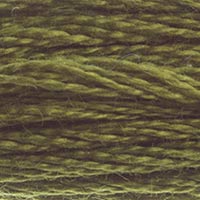
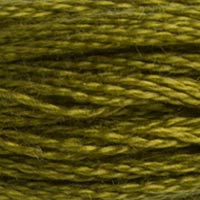
Military history gave us olive drab. DMC 730 Very Dark Olive Green gives us something more interesting: olive pushed so dark and so yellow-brown that it reads almost as much brown as green, a color that belongs simultaneously to both families. Its hex #827B30 shows a remarkably equal balance of red and green components with minimal blue — the recipe for a deep, warm, earth-toned green that naturalistic and historical designs have relied on for generations. This is the color of deep shade in autumn foliage, of military canvas, of the thick stem bases of mature plants.
The Darkest Olive — Specific Applications
Within the five-value Olive Green family (730 very dark, 731 dark, 732, 733 medium, 734 light), DMC 730 provides the shadow floor. It's dark enough to serve as near-black in designs with a limited palette, warm enough to prevent the cold heaviness that dark blue-greens bring. In landscapes and botanical work, 730 appears in the deepest shadow areas of foliage — where leaves overlap and light can't penetrate, where stems emerge from soil, where the underside of thick ground cover fades into complete shadow.
Its unusual darkness for an olive means it bridges between the green and brown families in ways that lighter olives can't. Bark texture often uses 730 alongside DMC 610 Dark Drab Brown or DMC 3031 Very Dark Mocha Brown — the two color families work together because 730's warm green reads as the moss and lichen tones that always accompany aged bark in nature. This collaboration between the olive and drab brown families is one of the most useful palette relationships in nature embroidery.
Historical and Military Contexts
Reproduction samplers and historical pieces that reference military or outdoors garments from the eighteenth and nineteenth centuries find DMC 730 invaluable for the deep olive-drab tones of hunting coats, military uniforms, and outdoor working clothes of the period. The color has genuine historical authenticity — plant-dyed fabrics of the era often achieved this dark olive through weld (yellow dye) overdyed with woad or indigo, and 730 evokes that specific color without the research required to specify it academically.
Camouflage pattern designs in cross stitch — whether literal military camo patterns or the more decorative hunting-inspired designs popular in certain regional markets — use 730 as the darkest green element. Combined with DMC 731, 733, and DMC 3345 or 895 for the other green values, it builds a complete camouflage palette that reads authentically.
Pairing Strategy
DMC 730's position at the dark, warm extreme of the olive range makes it a useful tone-setter for entire palettes. Pair it with DMC 732 and 734 for a complete olive shading sequence. Add DMC 729 Medium Old Gold for a golden accent that feels consistent with the family's warm, yellow-brown undertone. Against DMC 3041 Medium Antique Violet or DMC 3042 Light Antique Violet, the deep olive creates the muted complementary contrast of antique textiles and vintage botanical prints — a pairing used in Victorian crazy quilt embroidery and its modern descendants.
Anchor 845 and Madeira 1614 are exact matches for DMC 730. For a color this specific in its dark olive positioning, having exact matches matters — approximations in this range can easily tip into brown (losing the green character) or into a more conventional dark green (losing the warm, earthy olive quality).
Cosmo 826 and Sullivans 45174 are close. Cosmo 826 can read slightly more brown than 730, losing some of the distinctive olive-green quality. Sullivans 45174 is generally a good match in the olive register, though at this dark value, differences are sometimes more apparent than they'd be in paler colors. Test both against your other olive values (731, 732, etc.) before committing to a substitution in a shading sequence.
Within the DMC range, there's no single color that cleanly substitutes for 730's very dark olive position. DMC 3371 Black Brown is considerably darker and loses the olive character entirely. DMC 731 Dark Olive Green is the obvious lighter step in the same family. For an improvised blend approximating 730's deep warm olive, one strand of DMC 731 and one strand of DMC 610 Dark Drab Brown creates a dark, olive-ish brown blend that reads in similar territory — it won't have the same green quality as 730 but serves in landscapes and bark-texture applications where the precise green character is secondary to the overall dark earthy tone.
Reference quality
How We Validate This Color Record
Use this page as a reference card for DMC 730: the structured data, quick conversions, and long-form copy are all tied back to the same stored color record.
- Methodology
- This page renders DMC 730, its hex value, and every brand equivalent from the site's source-of-truth color record, then checks long-form body copy against those same stored fields.
- Verification status
- Source-field checked. The page content is audited against the stored DMC number, brand equivalents, and match-quality labels before publishing.
- Last reviewed
- 2026-04-20
- Approximation warning
- Screen hex values, thread photos, and cross-brand conversions are reference aids. Dye lots, thread sheen, and fabric color can still shift the result in hand.
Decision guide
When to use the DMC 730 reference page
This page should help you decide faster between palette planning, brand substitution, and shade comparison without turning the color record into a thin lookup page.
Best for
- + Palette planning when you want the stored DMC 730 Very Dark Olive Green record, hex value #827B30, and linked brand equivalents in one place.
- + Checking the quickest cross-brand shortlist before you buy floss, compare stash substitutes, or route into a more specific conversion page.
- + Finding nearby shades in the greens family before you commit to accents, shading, or background blends.
Watch for
- ! Screen previews are only reference aids. Very Dark Olive Green can shift on real fabric because thread sheen, stitch coverage, and room lighting change how the color reads.
- ! A stored equivalent is still a shortlist, not a guarantee that two brands will disappear into each other in the same stitched motif.
- ! Older charts, discontinued kit floss, and dye-lot variation can all introduce small but visible differences that the page cannot detect for you.
Before you commit
- Confirm the role of DMC 730 Very Dark Olive Green: decide whether you need an exact hero shade, a forgiving background, or a rough stash substitute.
- Compare on project fabric: view the skein or stitched sample on the same fabric count and color you will actually use.
- Use the linked conversion pages next: open the brand-specific pages when you need match-quality caveats before substituting away from the DMC reference.
DMC 730 FAQ
These questions appear on the page so the FAQ schema stays aligned with what visitors can actually read.
What is the Anchor equivalent of DMC 730?+
The closest Anchor equivalent to DMC 730 (Very Dark Olive Green) is Anchor 845. This is an exact match.
What color is DMC 730?+
DMC 730 is called "Very Dark Olive Green" and has a hex color value of #827B30. It belongs to the greens color family.
What is the Madeira equivalent of DMC 730?+
The closest Madeira equivalent to DMC 730 (Very Dark Olive Green) is Madeira 1614. This is a close match.
How DMC 730 Looks on Fabric
The same thread appears different depending on your fabric. Always test on your project fabric.
White Aida
Cream / Ecru
Black Aida
Pairs Well With
DMC colors commonly used alongside 730 Very Dark Olive Green.
Suggested Palette
Shading Companions

Detailed Conversions
Where to Buy DMC 730
This section contains affiliate links. We may earn a small commission at no cost to you.
Related Guides
Free Printable Thread Conversion Chart
Pick a brand, enter your email, and we'll send you a printable chart mapping all 552 DMC colors to that brand's equivalents. Zero spam, one chart.
Thanks! Here's your free chart:
Download Your ChartOpens in a new tab. Use your browser's Print → Save as PDF.
No spam. Your email is stored securely and never shared.