
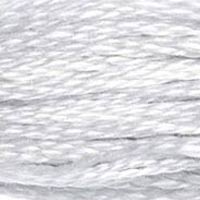
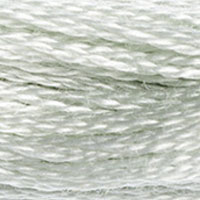
DMC 762 — Very Light Pearl Gray
Neutrals family · Hex #ECECEC
Quick Conversion Table
| Brand | Equivalent | Match |
|---|---|---|
| Anchor | 234 | exact |
| Madeira | 1804 | close |
| Cosmo ⚠ | 151 | close |
| Sullivans | 45193 | close |
| J&P Coats | 8510 | close |
| Dimensions | 6082 | close |
| Bucilla | 762 | close |
| Candamar | 6082 | close |
In the gray family, there's a point where a color becomes so light that it starts functioning more like a shadow than a color — where the thread reads as "less white" rather than "gray." DMC 762 Very Light Pearl Gray lives exactly at that threshold. It's the gray you reach for when you need to show that white fur isn't flat, when you need to suggest shadow without introducing a visible color, when you want your white snow to have depth without looking dirty.
The Indispensable White-Shadow Color
White animals in cross-stitch present a specific challenge: stitching them entirely in white or Blanc produces flat, featureless shapes with no sense of dimension. But stepping immediately to a medium gray like DMC 415 (Pearl Gray) creates shadows that look too dark and too visible for what should be a white animal. DMC 762 Very Light Pearl Gray solves this problem by providing just enough value contrast to create dimension while maintaining the visual impression of a white subject.
White cats, white rabbits, polar bears, snow owls, Samoyed dogs, and white horse designs almost universally rely on 762 as their shadow color. The convention is to stitch the highlighted areas in Blanc or DMC White (B5200), transition through 762 for the mid-shadow areas, and potentially add a single touch of DMC 415 (Pearl Gray) for the very deepest shadows only where the body folds on itself. Three values is usually enough; more gets muddy.
Snow and ice scenes use 762 similarly — it's the color of the shadow side of a snowdrift, the underside of icicles, the shadow beneath a snowman. Without it, snow looks like an empty white fabric area. With it, the snow suddenly has form and light direction.
Silver and Metallic Imitation
For designs that want a silver metallic effect without the handling complications of metallic threads, a gradient using DMC White or B5200, DMC 762, DMC 415 (Pearl Gray), and DMC 318 (Light Steel Gray) produces a convincing simulated silver. This approach is common in cross-stitch patterns for jewelry, silverware, and metallic ornamental elements where the designer wants dimensional shine without recommending specialty threads that not all stitchers stock or enjoy working with.
For chain mail, armor, and sword blades in historical or fantasy designs, 762 occupies the highlight position in the metallic gray sequence — the brightest gray that still clearly reads as gray rather than white, showing the maximum reflectivity of a polished metal surface.
Architecture and Urban Scenes
Stone, concrete, asphalt, and urban architecture in cross-stitch designs use the gray family extensively, and 762 serves as the lighter highlight value for stone walls, sidewalks, and building facades. In a stone wall panel, the individual stones might use 415 and DMC 317 (Pewter Gray) for their body color, with 762 as the highlight on the edge that catches the most light. Without this lighter value, the stonework reads as flat and uniform.
Fabric Behavior and Coverage Notes
Very light grays on white Aida need careful tension management to avoid the fabric ground showing through and creating an uneven appearance. Consistent thread tension and careful railroading is especially important for 762 fills — the near-white value means any coverage gap reads immediately as a bright spot. On linen, where the fabric ground is warmer and slightly darker, 762 reads with better contrast and is easier to work with for large fill areas.
Best Uses for Very Light Pearl Gray (DMC 762)
Cross stitch projects featuring DMC 762 benefit from its unique tonal qualities. When selecting the best cross stitch thread for your design, keep Very Light Pearl Gray in mind as a versatile choice that blends perfectly with other shades.
Anchor 234 and Madeira 1804 are both exact-rated for DMC 762, making them reliable substitutions. Both perform well in practice — the very light gray family is relatively consistent across brands because the low saturation limits the range of variation available. Either can be used in white-animal shadow work and should integrate without visual disruption.
Cosmo 151 and Sullivans 45193 are close-rated. For shadow colors in white-subject designs, the priority is that the shadow doesn't read as a different hue — gray is gray, and as long as the substitute maintains the same neutral tone without veering toward blue or warm gray, it should work. Check close-rated grays in your specific lighting conditions before using in large areas.
Within the DMC range, if you're looking for something one step darker to provide more visible shadow definition, DMC 415 (Pearl Gray) is the natural step up. One step lighter takes you to DMC White or DMC Blanc territory, which by definition has no gray component. It's worth noting that DMC 762 and DMC 3072 (Very Light Beaver Gray) are sometimes confused — 3072 is a very slightly warmer gray, and the difference is visible in direct comparison. Both are in the very-light gray range, but they're not interchangeable in designs where multiple grays are used simultaneously.
Reference quality
How We Validate This Color Record
Use this page as a reference card for DMC 762: the structured data, quick conversions, and long-form copy are all tied back to the same stored color record.
- Methodology
- This page renders DMC 762, its hex value, and every brand equivalent from the site's source-of-truth color record, then checks long-form body copy against those same stored fields.
- Verification status
- Source-field checked. The page content is audited against the stored DMC number, brand equivalents, and match-quality labels before publishing.
- Last reviewed
- 2026-04-20
- Approximation warning
- Screen hex values, thread photos, and cross-brand conversions are reference aids. Dye lots, thread sheen, and fabric color can still shift the result in hand.
Decision guide
When to use the DMC 762 reference page
This page should help you decide faster between palette planning, brand substitution, and shade comparison without turning the color record into a thin lookup page.
Best for
- + Palette planning when you want the stored DMC 762 Very Light Pearl Gray record, hex value #ECECEC, and linked brand equivalents in one place.
- + Checking the quickest cross-brand shortlist before you buy floss, compare stash substitutes, or route into a more specific conversion page.
- + Finding nearby shades in the neutrals family before you commit to accents, shading, or background blends.
Watch for
- ! Screen previews are only reference aids. Very Light Pearl Gray can shift on real fabric because thread sheen, stitch coverage, and room lighting change how the color reads.
- ! A stored equivalent is still a shortlist, not a guarantee that two brands will disappear into each other in the same stitched motif.
- ! Older charts, discontinued kit floss, and dye-lot variation can all introduce small but visible differences that the page cannot detect for you.
Before you commit
- Confirm the role of DMC 762 Very Light Pearl Gray: decide whether you need an exact hero shade, a forgiving background, or a rough stash substitute.
- Compare on project fabric: view the skein or stitched sample on the same fabric count and color you will actually use.
- Use the linked conversion pages next: open the brand-specific pages when you need match-quality caveats before substituting away from the DMC reference.
DMC 762 FAQ
These questions appear on the page so the FAQ schema stays aligned with what visitors can actually read.
What is the Anchor equivalent of DMC 762?+
The closest Anchor equivalent to DMC 762 (Very Light Pearl Gray) is Anchor 234. This is an exact match.
What color is DMC 762?+
DMC 762 is called "Very Light Pearl Gray" and has a hex color value of #ECECEC. It belongs to the neutrals color family.
What is the Madeira equivalent of DMC 762?+
The closest Madeira equivalent to DMC 762 (Very Light Pearl Gray) is Madeira 1804. This is a close match.
How DMC 762 Looks on Fabric
The same thread appears different depending on your fabric. Always test on your project fabric.
White Aida
Cream / Ecru
Black Aida
Pairs Well With
DMC colors commonly used alongside 762 Very Light Pearl Gray.
Suggested Palette
Shading Companions
Detailed Conversions
Where to Buy DMC 762
This section contains affiliate links. We may earn a small commission at no cost to you.
Related Guides
Free Printable Thread Conversion Chart
Pick a brand, enter your email, and we'll send you a printable chart mapping all 552 DMC colors to that brand's equivalents. Zero spam, one chart.
Thanks! Here's your free chart:
Download Your ChartOpens in a new tab. Use your browser's Print → Save as PDF.
No spam. Your email is stored securely and never shared.