
Quick Conversion Table
| Brand | Equivalent | Match |
|---|---|---|
| Anchor | 1084 | exact |
| Madeira | 1912 | close |
| Cosmo ⚠ | 384 | close |
| Sullivans | 45238 | close |
| J&P Coats | 5379 | close |
| Dimensions | 6100 | close |
| Bucilla | 6100 | close |
| Candamar | 6100 | close |
Ask someone to close their eyes and picture "brown" — not dark chocolate brown, not pale beige, but just brown — and what they picture probably falls close to DMC 840. Medium Beige Brown at hex #9A7C5C occupies the visual center of the warm, sandy-earth brown spectrum: dark enough to read clearly and provide contrast, light enough to function as a base color rather than a shadow, warm enough to feel organic and natural rather than neutral and manufactured. It's the platonic mid-brown of the beige brown family.
Mid-Point Utility in Realistic Rendering
In the five-step beige brown family (838-842), 840 is the exact center value. This central position means 840 is doing the most load-bearing work in any design that uses the full family — it's the primary fill color, the zone of the object that the eye reads as the color's identity before shadows and highlights are applied. Get 840 right, and the gradient reads naturally. Use a poorly matched 840, and the entire family relationship breaks down.
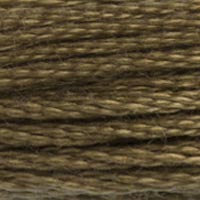
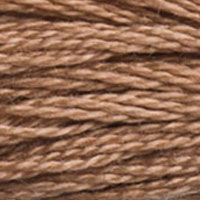
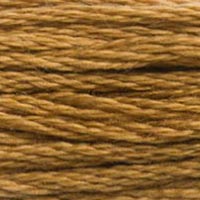
For animal subjects, this means 840 represents the average coat color — the color the animal is before specific lighting creates shadows or highlights. For a fawn deer or a wheaten terrier or a natural linen-colored cat, the mid-coat color around which the whole portrait is organized corresponds to 840. 839 (Dark Beige Brown) and 838 (Very Dark Beige Brown) exist to shadow it, while 841 (Light Beige Brown) and 842 (Very Light Beige Brown) exist to highlight it.
Practical Workhorse Status
840 shows up in patterns constantly, across a wide range of design categories. Landscape backgrounds where the ground plane is sandy earth rather than green grass, rustic architectural elements like stone walls and wooden structures, all manner of animal subjects from rabbits to horses to birds, and any piece featuring natural fiber or fabric textures — all of these pull on 840. It's the kind of color that doesn't generate excitement when you look at the skein but is genuinely missed when it isn't in your stash.
Stitchers who work in cross-country style across large full-coverage pieces find 840 is one of the smoothest-stitching colors in the DMC line — consistent coverage, good strand separation, minimal tangling. The mid-value position means it's easy to see while stitching, unlike the very dark 838, and substantial enough that it doesn't disappear against pale fabric the way lighter family members can.
Specific Design Applications
Medieval and historical-themed designs that reference coarse natural cloth — rough-spun wool, unbleached linen, hessian — use 840 as a primary texture element. The color reads as unprocessed, natural, pre-industrial fiber rather than modern manufactured textile. Combined with DMC 822 (Light Beige Gray) and DMC 3866 (Ultra Very Light Mocha Brown) for the lighter moments, 840 gives historical fabric rendering an appropriate earthiness.
Rabbit cross-stitch — from realistic wildlife portraits of hares to charming domestic bunny designs — almost always includes the beige brown family, with 840 handling the main body color for medium-toned rabbits. The classic grey-brown rabbit body that appears in Beatrix Potter-style illustrations corresponds closely to this mid-beige-brown range. For SAL groups working on bunny themes or Easter projects, 840 is a reliable color card staple.
Anchor 1084 and Madeira 1912 both earn exact match ratings, making 840 one of the better-supported mid-browns across brands. For a color doing so much load-bearing work in realistic designs, this cross-brand consistency is genuinely valuable — you can source from multiple brands with confidence that the visual result will be consistent.
Cosmo 384 and Sullivans 45238 are close matches. At this mid-range value in the beige brown family, minor brand differences in undertone tend to be more visible than in the darker family members — the color is light enough that subtle warm-versus-neutral shifts become perceptible. Test alongside your other beige brown colors before substituting in a design that requires the full family gradient.
Within DMC, the substitution path for 840 is clear: DMC 839 (Dark Beige Brown) gives you more depth and shadow, while DMC 841 (Light Beige Brown) gives you more lightness. In a design where 840 is the only beige brown color, either neighbor substitutes adequately with a slight shift in the overall tone. In gradient work, substituting 840 with either neighbor compresses the gradient at one end.
Outside the beige brown family, DMC 3790 (Ultra Very Dark Beige Gray) occupies a related space that's cooler and grayer — useful to know when your design needs something between the warm beige brown family and the cooler beige gray family. DMC 433 (Medium Brown) is warmer and more saturated, sharing some of the same utility territory as 840 but reading as distinctly more orange-red in its brown character. The choice between 840 and 433 often comes down to how warm and saturated the design's brown needs to feel.
Reference quality
How We Validate This Color Record
Use this page as a reference card for DMC 840: the structured data, quick conversions, and long-form copy are all tied back to the same stored color record.
- Methodology
- This page renders DMC 840, its hex value, and every brand equivalent from the site's source-of-truth color record, then checks long-form body copy against those same stored fields.
- Verification status
- Source-field checked. The page content is audited against the stored DMC number, brand equivalents, and match-quality labels before publishing.
- Last reviewed
- 2026-04-20
- Approximation warning
- Screen hex values, thread photos, and cross-brand conversions are reference aids. Dye lots, thread sheen, and fabric color can still shift the result in hand.
Decision guide
When to use the DMC 840 reference page
This page should help you decide faster between palette planning, brand substitution, and shade comparison without turning the color record into a thin lookup page.
Best for
- + Palette planning when you want the stored DMC 840 Medium Beige Brown record, hex value #9A7C5C, and linked brand equivalents in one place.
- + Checking the quickest cross-brand shortlist before you buy floss, compare stash substitutes, or route into a more specific conversion page.
- + Finding nearby shades in the browns family before you commit to accents, shading, or background blends.
Watch for
- ! Screen previews are only reference aids. Medium Beige Brown can shift on real fabric because thread sheen, stitch coverage, and room lighting change how the color reads.
- ! A stored equivalent is still a shortlist, not a guarantee that two brands will disappear into each other in the same stitched motif.
- ! Older charts, discontinued kit floss, and dye-lot variation can all introduce small but visible differences that the page cannot detect for you.
Before you commit
- Confirm the role of DMC 840 Medium Beige Brown: decide whether you need an exact hero shade, a forgiving background, or a rough stash substitute.
- Compare on project fabric: view the skein or stitched sample on the same fabric count and color you will actually use.
- Use the linked conversion pages next: open the brand-specific pages when you need match-quality caveats before substituting away from the DMC reference.
DMC 840 FAQ
These questions appear on the page so the FAQ schema stays aligned with what visitors can actually read.
What is the Anchor equivalent of DMC 840?+
The closest Anchor equivalent to DMC 840 (Medium Beige Brown) is Anchor 1084. This is an exact match.
What color is DMC 840?+
DMC 840 is called "Medium Beige Brown" and has a hex color value of #9A7C5C. It belongs to the browns color family.
What is the Madeira equivalent of DMC 840?+
The closest Madeira equivalent to DMC 840 (Medium Beige Brown) is Madeira 1912. This is a close match.
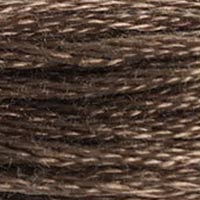
How DMC 840 Looks on Fabric
The same thread appears different depending on your fabric. Always test on your project fabric.
White Aida
Cream / Ecru
Black Aida
Pairs Well With
DMC colors commonly used alongside 840 Medium Beige Brown.
Suggested Palette
Shading Companions
Detailed Conversions
Where to Buy DMC 840
This section contains affiliate links. We may earn a small commission at no cost to you.
Related Guides
Free Printable Thread Conversion Chart
Pick a brand, enter your email, and we'll send you a printable chart mapping all 552 DMC colors to that brand's equivalents. Zero spam, one chart.
Thanks! Here's your free chart:
Download Your ChartOpens in a new tab. Use your browser's Print → Save as PDF.
No spam. Your email is stored securely and never shared.