
Quick Conversion Table
| Brand | Equivalent | Match |
|---|---|---|
| Anchor | 280 | exact |
| Madeira | 1611 | close |
| Cosmo ⚠ | 823 | close |
| Sullivans | 45177 | close |
| J&P Coats | 6845 | close |
Palette building across greens is one of the more nuanced skills in cross stitch, and DMC 733 Medium Olive Green represents a particularly interesting palette intersection: it sits where the olive family begins to show significant yellow content, where the warmth that was earthy and grounded in DMC 730 and 731 starts to tip toward something almost chartreuse. At hex #BCB34C, it's a lighter, more golden olive — the color of lichen on sun-exposed rock, of certain mosses in dry conditions, of wheat before it fully ripens. It's a step up the scale that brings energy without abandoning the family's characteristic warmth.
Where the Olive Family Gets Interesting
The progression from DMC 732 Olive Green to 733 Medium Olive Green is larger in character than the step from 730 to 731. As the olive family lightens, the yellow component becomes proportionally more visible against the overall value, and 733's lighter value reveals the yellow-green nature of olive that the darker values keep subdued. Some stitchers find 733 surprising when they see it in person — it reads lighter and more yellow-olive than the word "medium" suggests, particularly against the darker family members.
This characteristic makes 733 particularly useful at the transition zones in large gradients — where you're moving from the earthy mid-greens through toward chartreuse or yellow-green, 733 provides a bridge that maintains the olive warmth without the full commitment to a pure chartreuse direction. In foliage sequences that need to suggest sun-dappled light without fully bright highlights, 733 handles the penultimate lighting zone.
Moss, Lichen, and Specific Nature Subjects
Certain natural subjects call for 733's specific lighter olive by their very nature. Rock lichen in the yellow-green varieties — common on exposed granite, slate, and limestone in temperate regions — is exactly this color. The crustose and foliose lichens that give old stone walls their golden-green character are rendered convincingly with 733 as the primary tone, with DMC 732 for shadow and DMC 734 for the brightest patches in full light.
Dried herbs — sage, oregano, thyme — have this lighter olive when dried, the vivid green of fresh growth converted to a muted yellow-green through desiccation. Herb garden samplers and still-life herb arrangements use 733 for dried herb bundles alongside 731 and 730 for fresh green stems. The color also appears in botanical embroidery for the seed pods and calyx of many plants that turn olive-golden as they mature and dry.
Companion Threads
DMC 733 creates interesting combinations outside the olive family. With DMC 3740 Dark Antique Violet, it replicates the muted complementary pairing of antique textile art where the olive-violets and dusty purples appear together in aged needlework. With DMC 3047 Light Yellow Beige, it builds a complete dry-grass palette for meadow and prairie landscapes. Paired with DMC 680 Dark Old Gold, it provides the darker and lighter components of a complete honey-amber-olive scheme for autumn harvest designs featuring wheat, dried flowers, and rustic materials.
On the technical side, DMC 733 at this medium-light value has good coverage characteristics on standard Aida counts — two strands on 14-count give solid, even fill without the transparency that sometimes affects very pale threads at the same count. At 18-count, two strands can be slightly dense; some stitchers prefer one and a half strands (strip a 6-strand skein and use three strands in a needle, then split to use one strand from each stripped length) for finer coverage at higher counts. The color's warmth means any coverage inconsistency reads as texture rather than flaw, which makes 733 more forgiving to work than some of the cooler grays and greens in the DMC range.
Anchor 280 and Madeira 1611 are exact matches for DMC 733. The olive family has generally good cross-brand support, with exact matches for most values, making it one of the more brand-flexible families in the green range.
Cosmo 823 and Sullivans 45177 are close. At this lighter value where the yellow component of the olive becomes more prominent, Cosmo 823 can read somewhat more yellow-bright than DMC 733 — closer to chartreuse olive than to the earthier, dustier olive of the DMC version. For applications where the golden-lichen quality of 733 matters, compare swatches before committing to Cosmo 823 in significant quantities.
Within the DMC range, the natural moves are to DMC 732 (darker) or DMC 734 (lighter) in the same family. From outside the olive family, DMC 472 Ultra Light Avocado Green is lighter and more purely yellow-green — similar in general territory but without the dusty, muted character that defines the olive family. DMC 3013 Light Khaki Green is in a related zone but cooler and more muted. DMC 907 Light Parrot Green is too vivid and too purely green to substitute for 733's warm, dusty quality. If you're looking for an improvised blend that approximates 733's character, one strand of DMC 732 and one strand of DMC 734 in a blended needle splits the difference between the family members and creates a reasonable mid-olive at two-strand coverage.
Reference quality
How We Validate This Color Record
Use this page as a reference card for DMC 733: the structured data, quick conversions, and long-form copy are all tied back to the same stored color record.
- Methodology
- This page renders DMC 733, its hex value, and every brand equivalent from the site's source-of-truth color record, then checks long-form body copy against those same stored fields.
- Verification status
- Source-field checked. The page content is audited against the stored DMC number, brand equivalents, and match-quality labels before publishing.
- Last reviewed
- 2026-04-20
- Approximation warning
- Screen hex values, thread photos, and cross-brand conversions are reference aids. Dye lots, thread sheen, and fabric color can still shift the result in hand.
Decision guide
When to use the DMC 733 reference page
This page should help you decide faster between palette planning, brand substitution, and shade comparison without turning the color record into a thin lookup page.
Best for
- + Palette planning when you want the stored DMC 733 Medium Olive Green record, hex value #BCB34C, and linked brand equivalents in one place.
- + Checking the quickest cross-brand shortlist before you buy floss, compare stash substitutes, or route into a more specific conversion page.
- + Finding nearby shades in the greens family before you commit to accents, shading, or background blends.
Watch for
- ! Screen previews are only reference aids. Medium Olive Green can shift on real fabric because thread sheen, stitch coverage, and room lighting change how the color reads.
- ! A stored equivalent is still a shortlist, not a guarantee that two brands will disappear into each other in the same stitched motif.
- ! Older charts, discontinued kit floss, and dye-lot variation can all introduce small but visible differences that the page cannot detect for you.
Before you commit
- Confirm the role of DMC 733 Medium Olive Green: decide whether you need an exact hero shade, a forgiving background, or a rough stash substitute.
- Compare on project fabric: view the skein or stitched sample on the same fabric count and color you will actually use.
- Use the linked conversion pages next: open the brand-specific pages when you need match-quality caveats before substituting away from the DMC reference.
DMC 733 FAQ
These questions appear on the page so the FAQ schema stays aligned with what visitors can actually read.
What is the Anchor equivalent of DMC 733?+
The closest Anchor equivalent to DMC 733 (Medium Olive Green) is Anchor 280. This is an exact match.
What color is DMC 733?+
DMC 733 is called "Medium Olive Green" and has a hex color value of #BCB34C. It belongs to the greens color family.
What is the Madeira equivalent of DMC 733?+
The closest Madeira equivalent to DMC 733 (Medium Olive Green) is Madeira 1611. This is a close match.
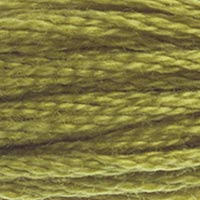
How DMC 733 Looks on Fabric
The same thread appears different depending on your fabric. Always test on your project fabric.
White Aida
Cream / Ecru
Black Aida
Pairs Well With
DMC colors commonly used alongside 733 Medium Olive Green.
Suggested Palette
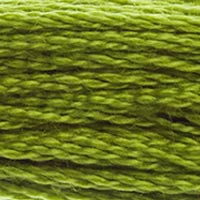
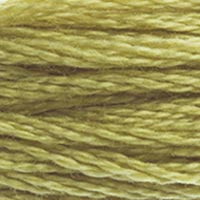
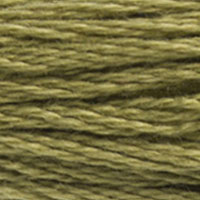
Shading Companions
Detailed Conversions
Where to Buy DMC 733
This section contains affiliate links. We may earn a small commission at no cost to you.
Related Guides
Free Printable Thread Conversion Chart
Pick a brand, enter your email, and we'll send you a printable chart mapping all 552 DMC colors to that brand's equivalents. Zero spam, one chart.
Thanks! Here's your free chart:
Download Your ChartOpens in a new tab. Use your browser's Print → Save as PDF.
No spam. Your email is stored securely and never shared.