
Quick Conversion Table
| Brand | Equivalent | Match |
|---|---|---|
| Anchor | 281 | close |
| Madeira | 1502 | close |
| Cosmo ⚠ | 2631 | close |
| Sullivans | 45132 | close |
| J&P Coats | 6010 | close |
Chartreuse's Responsible Older Sibling
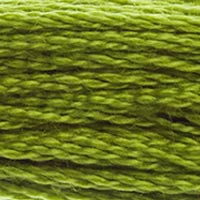
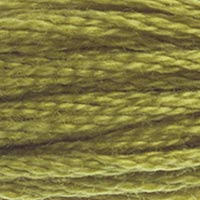
If DMC 703 (Chartreuse) is the color that walks into a party and immediately starts a conversation, DMC 581 is the one standing nearby, equally interesting but perfectly happy to let you come to it. Moss Green has chartreuse's yellow-forward DNA — that bright, warm, almost acidic lean that sets the yellow-greens apart from their cooler cousins — but it's tempered by just enough darkness and grey to feel grounded. The result is a color that's vivid without being confrontational, warm without being overwhelming, and genuinely useful in a way that the full-throttle chartreuses sometimes aren't.
At hex #A7AE38, DMC 581 occupies an interesting position: too yellow to sit comfortably with the conventional greens, too green to pass as gold or olive, and too vivid to disappear into a background. It insists on being seen, but it does so politely. In a palette of muted earth tones, 581 provides the spark of life — the single vivid note that prevents a design from looking dull. In a palette of brighter greens, it provides the warm counterpoint that adds temperature variety.
Wildlife Meadows in Thread
Open a field guide to European or North American grasslands and look at the color of the grasses themselves — not the idealized green of a suburban lawn, but the actual color of wild grasses in midsummer, when they've grown tall enough to seed and the chlorophyll is at its most concentrated. That yellow-rich, assertive green is 581. It's the color of meadow grasses catching low-angle sunlight, of unmowed verges along country roads, of the wild-grown edges of cultivated fields.
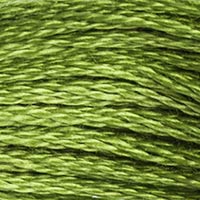
For wildlife habitat designs — meadow scenes, grassland birds, field flower borders — DMC 581 provides the dominant grass tone. Use it for the sunlit upper portions of grass blades, with DMC 580 (Dark Moss Green) for the shadowed bases and DMC 734 (Light Olive Green) or DMC 733 (Medium Olive Green) for the dry, seed-heavy tops. This combination gives you grass that looks alive and species-specific rather than generically "green." Add DMC 3078 (Very Light Golden Yellow) for the dried seed heads and DMC 869 (Very Dark Hazel Brown) for the exposed soil between clumps.
Managing This Thread in Photographs
A specific frustration with DMC 581 and the yellow-greens generally: they photograph unpredictably. Camera sensors process yellow-green wavelengths differently depending on the white balance setting, and auto white balance frequently shifts 581 toward either pure green (losing the yellow warmth) or pure yellow (losing the green identity). The thread looks one way to your eyes and another way in every photo you take.
For FlossTube creators and Instagram stitchers, the workaround is manual white balance. Set your camera to daylight white balance rather than auto, shoot in indirect natural light, and if you're editing in post, resist the temptation to boost the green channel — doing so will cool the entire image and make 581 look like something it isn't. Some stitchers find that shooting against a neutral grey background (rather than white) gives their camera's metering system a better reference point and produces more accurate color.
In person, under daylight, DMC 581 is unmistakable: warm, lively, and beautifully mossy. It's one of those threads that rewards you for putting down the phone and just looking at your work with your own eyes.
Note that Anchor 281 is rated as a close match rather than exact — an important distinction for this color. The yellow-green balance in 581 is specific enough that even small shifts change the character of the thread. If Anchor 281 pulls slightly cooler or slightly less saturated, it may lose the mossy warmth that defines the color. Test it against DMC 580 (Dark Moss Green) if you're using both, to confirm the family relationship still holds.
Madeira 1502 is the more reliable substitute here, rated as an exact match with good fidelity to the warm, saturated character of the DMC original. If you have access to both Anchor and Madeira, Madeira is the safer choice for 581 specifically.
Cosmo 2631 is another close match, and the same caution applies — any drift toward conventional green and away from yellow-green will change the personality of this thread from "mossy meadow" to "standard foliage," which may or may not matter depending on your project. For a woodland floor scene where 581 is one of several greens, a slight character shift is absorbed by context. For a design where the moss palette (580/581) is the star, precision matters more.
Within DMC's range, DMC 581 doesn't have a direct replacement at the same value and undertone. DMC 937 (Medium Avocado Green) is nearby but darker and more olive. DMC 734 (Light Olive Green) is nearby but lighter and more yellow. Neither is a swap — they're neighbors that serve different purposes in a palette.
Reference quality
How We Validate This Color Record
Use this page as a reference card for DMC 581: the structured data, quick conversions, and long-form copy are all tied back to the same stored color record.
- Methodology
- This page renders DMC 581, its hex value, and every brand equivalent from the site's source-of-truth color record, then checks long-form body copy against those same stored fields.
- Verification status
- Source-field checked. The page content is audited against the stored DMC number, brand equivalents, and match-quality labels before publishing.
- Last reviewed
- 2026-04-20
- Approximation warning
- Screen hex values, thread photos, and cross-brand conversions are reference aids. Dye lots, thread sheen, and fabric color can still shift the result in hand.
Decision guide
When to use the DMC 581 reference page
This page should help you decide faster between palette planning, brand substitution, and shade comparison without turning the color record into a thin lookup page.
Best for
- + Palette planning when you want the stored DMC 581 Moss Green record, hex value #A7AE38, and linked brand equivalents in one place.
- + Checking the quickest cross-brand shortlist before you buy floss, compare stash substitutes, or route into a more specific conversion page.
- + Finding nearby shades in the greens family before you commit to accents, shading, or background blends.
Watch for
- ! Screen previews are only reference aids. Moss Green can shift on real fabric because thread sheen, stitch coverage, and room lighting change how the color reads.
- ! A stored equivalent is still a shortlist, not a guarantee that two brands will disappear into each other in the same stitched motif.
- ! Older charts, discontinued kit floss, and dye-lot variation can all introduce small but visible differences that the page cannot detect for you.
Before you commit
- Confirm the role of DMC 581 Moss Green: decide whether you need an exact hero shade, a forgiving background, or a rough stash substitute.
- Compare on project fabric: view the skein or stitched sample on the same fabric count and color you will actually use.
- Use the linked conversion pages next: open the brand-specific pages when you need match-quality caveats before substituting away from the DMC reference.
DMC 581 FAQ
These questions appear on the page so the FAQ schema stays aligned with what visitors can actually read.
What is the Anchor equivalent of DMC 581?+
The closest Anchor equivalent to DMC 581 (Moss Green) is Anchor 281. This is a close match.
What color is DMC 581?+
DMC 581 is called "Moss Green" and has a hex color value of #A7AE38. It belongs to the greens color family.
What is the Madeira equivalent of DMC 581?+
The closest Madeira equivalent to DMC 581 (Moss Green) is Madeira 1502. This is a close match.
How DMC 581 Looks on Fabric
The same thread appears different depending on your fabric. Always test on your project fabric.
White Aida
Cream / Ecru
Black Aida
Pairs Well With
DMC colors commonly used alongside 581 Moss Green.
Suggested Palette
Shading Companions
Detailed Conversions
Where to Buy DMC 581
This section contains affiliate links. We may earn a small commission at no cost to you.
Related Guides
Free Printable Thread Conversion Chart
Pick a brand, enter your email, and we'll send you a printable chart mapping all 552 DMC colors to that brand's equivalents. Zero spam, one chart.
Thanks! Here's your free chart:
Download Your ChartOpens in a new tab. Use your browser's Print → Save as PDF.
No spam. Your email is stored securely and never shared.