
Quick Conversion Table
| Brand | Equivalent | Match |
|---|---|---|
| Anchor | 208 | exact |
| Madeira | 1207 | close |
| Cosmo ⚠ | 843 | close |
| Sullivans | 45129 | close |
| J&P Coats | 6210 | close |
| Dimensions | 16210 | close |
| Bucilla | 563 | close |
Mint, Sea Glass, and the Green Everyone Agrees On
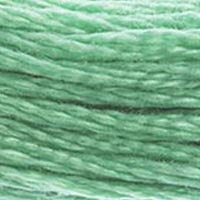
Most greens provoke opinions. The chartreuse family splits rooms. The olive greens bore some stitchers and delight others. The Christmas greens feel dated to some and essential to others. But DMC 563 — Light Jade — is one of those rare greens that seems to make everyone happy. It's fresh without being aggressive, cool without being cold, light without being washed out. If you need a green that plays well with others and offends absolutely no one, this is the thread you reach for.
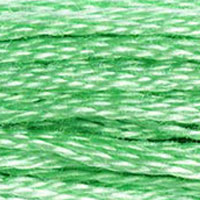
That universal appeal comes from balance. At hex #8FC098, DMC 563 sits in a Goldilocks zone: enough blue to feel sophisticated, enough yellow to feel natural, enough saturation to register clearly, and a light enough value to feel approachable. It reads as mint in food contexts, sea glass in coastal designs, jade in gemstone motifs, and simply "pleasant green" in everything else. This chameleon quality makes it one of the more versatile threads in the DMC range.
Blending the Jade Gradient
Within the jade family (561/562/563/564), DMC 563 occupies the light position, one step above Very Light Jade (564) and two steps below the deep 561. This is where the family starts to breathe — 563 is where shadow gives way to open light, where the dense jungle canopy thins and you can see sky between the leaves. In any design using the full jade range, 563 marks the transition from depth to lightness.
Blending across the jade family is particularly smooth because DMC designed these shades with consistent undertone throughout the value range. A blended needle using one strand of 562 and one strand of 563 gives you a convincing intermediate step that doesn't shift hue — just value. This is rarer than you might think. Many DMC families drift in undertone as they lighten (greens especially tend to shift toward yellow at lighter values), but the jade family maintains its blue-green character all the way from 561 to 564.
This consistency makes the jade family a favorite for technique-focused projects like thread painting and needle painting, where smooth gradients are the entire point. If you're learning needle painting and want a forgiving green family to practice with, the jades are an excellent choice — the value steps are clear, the undertone is stable, and the colors are pretty enough that even imperfect blending produces attractive results.
Coastal and Nautical Designs
Sea glass. If you've ever walked a beach and collected those frosted, tumbled fragments of old bottles, you know the color: a soft, cloudy green that's been smoothed and muted by decades of salt water and sand. DMC 563 is remarkably close to the most common variety of sea glass (which comes from old green bottles). For coastal-themed designs — beach samplers, nautical borders, seaside cottage scenes — 563 provides a color that immediately registers as "ocean" without being the obvious blue that most people default to.
Pair 563 with DMC 3768 (Dark Gray Green) for weathered dock wood, DMC 3033 (Very Light Mocha Brown) for beach sand, and DMC 159 (Light Gray Blue) for the sky, and you have a complete coastal palette that feels naturally harmonious. Add DMC 562 for the deeper water and DMC 564 for sea foam, and the jade family handles the entire water column from depth to surface spray.
For those stitching Dimensions kits or similar branded designs with coastal themes, you'll frequently find 563 on the thread list. It's become almost standard vocabulary for "light water" in commercial pattern design — not because it's literally the color of the ocean, but because it evokes the feeling of ocean without requiring you to use a conventional blue.
Anchor 208 reproduces the mint-jade balance accurately and is the substitute most stitchers reach for without hesitation. The thread weight and twist are close enough to DMC that you won't notice a brand change in the finished piece, even on higher-count fabrics where strand behavior is more visible.
Madeira 1207 is equally well-matched and, at this lighter value, Madeira's slightly silkier finish is more noticeable than in the darker members of the family. Some stitchers actually prefer it — the extra sheen adds a subtle luminosity that suits the "sea glass" character of this shade. Others find it slightly too glossy for matte, naturalistic applications. Personal preference territory.
Cosmo 843 gets you into the right range but may lean a touch more purely green, sacrificing some of the blue component that gives 563 its jade character. In a mixed-green palette, this shift is easily absorbed. In a design where the jade family is the dominant green presence, test Cosmo 843 against your 562 and 564 to confirm the gradient still reads as cohesive.
Sullivans 45129 is adequate as a general-purpose substitute. At this light value, differences in thread finish become more perceptible, so if your project involves large areas of 563, compare the Sullivans option in natural daylight against your fabric before committing to several skeins. DMC 913 (Medium Nile Green) is sometimes suggested as an internal DMC alternative — it's close in value but has a warmer, more yellow-green character. The two threads coexist beautifully in a palette but aren't interchangeable.
Reference quality
How We Validate This Color Record
Use this page as a reference card for DMC 563: the structured data, quick conversions, and long-form copy are all tied back to the same stored color record.
- Methodology
- This page renders DMC 563, its hex value, and every brand equivalent from the site's source-of-truth color record, then checks long-form body copy against those same stored fields.
- Verification status
- Source-field checked. The page content is audited against the stored DMC number, brand equivalents, and match-quality labels before publishing.
- Last reviewed
- 2026-04-20
- Approximation warning
- Screen hex values, thread photos, and cross-brand conversions are reference aids. Dye lots, thread sheen, and fabric color can still shift the result in hand.
Decision guide
When to use the DMC 563 reference page
This page should help you decide faster between palette planning, brand substitution, and shade comparison without turning the color record into a thin lookup page.
Best for
- + Palette planning when you want the stored DMC 563 Light Jade record, hex value #8FC098, and linked brand equivalents in one place.
- + Checking the quickest cross-brand shortlist before you buy floss, compare stash substitutes, or route into a more specific conversion page.
- + Finding nearby shades in the greens family before you commit to accents, shading, or background blends.
Watch for
- ! Screen previews are only reference aids. Light Jade can shift on real fabric because thread sheen, stitch coverage, and room lighting change how the color reads.
- ! A stored equivalent is still a shortlist, not a guarantee that two brands will disappear into each other in the same stitched motif.
- ! Older charts, discontinued kit floss, and dye-lot variation can all introduce small but visible differences that the page cannot detect for you.
Before you commit
- Confirm the role of DMC 563 Light Jade: decide whether you need an exact hero shade, a forgiving background, or a rough stash substitute.
- Compare on project fabric: view the skein or stitched sample on the same fabric count and color you will actually use.
- Use the linked conversion pages next: open the brand-specific pages when you need match-quality caveats before substituting away from the DMC reference.
DMC 563 FAQ
These questions appear on the page so the FAQ schema stays aligned with what visitors can actually read.
What is the Anchor equivalent of DMC 563?+
The closest Anchor equivalent to DMC 563 (Light Jade) is Anchor 208. This is an exact match.
What color is DMC 563?+
DMC 563 is called "Light Jade" and has a hex color value of #8FC098. It belongs to the greens color family.
What is the Madeira equivalent of DMC 563?+
The closest Madeira equivalent to DMC 563 (Light Jade) is Madeira 1207. This is a close match.
How DMC 563 Looks on Fabric
The same thread appears different depending on your fabric. Always test on your project fabric.
White Aida
Cream / Ecru
Black Aida
Pairs Well With
DMC colors commonly used alongside 563 Light Jade.
Suggested Palette
Shading Companions
Detailed Conversions
Where to Buy DMC 563
This section contains affiliate links. We may earn a small commission at no cost to you.
Related Guides
Free Printable Thread Conversion Chart
Pick a brand, enter your email, and we'll send you a printable chart mapping all 552 DMC colors to that brand's equivalents. Zero spam, one chart.
Thanks! Here's your free chart:
Download Your ChartOpens in a new tab. Use your browser's Print → Save as PDF.
No spam. Your email is stored securely and never shared.