
DMC 476 — Ultra Very Light Avocado Green
Greens family · Hex #E8F0B0
Quick Conversion Table
| Brand | Equivalent | Match |
|---|---|---|
| Anchor | 264 | close |
| Madeira | 1416 | close |
| Cosmo ⚠ | 986 | close |
| Sullivans | 45331 | close |
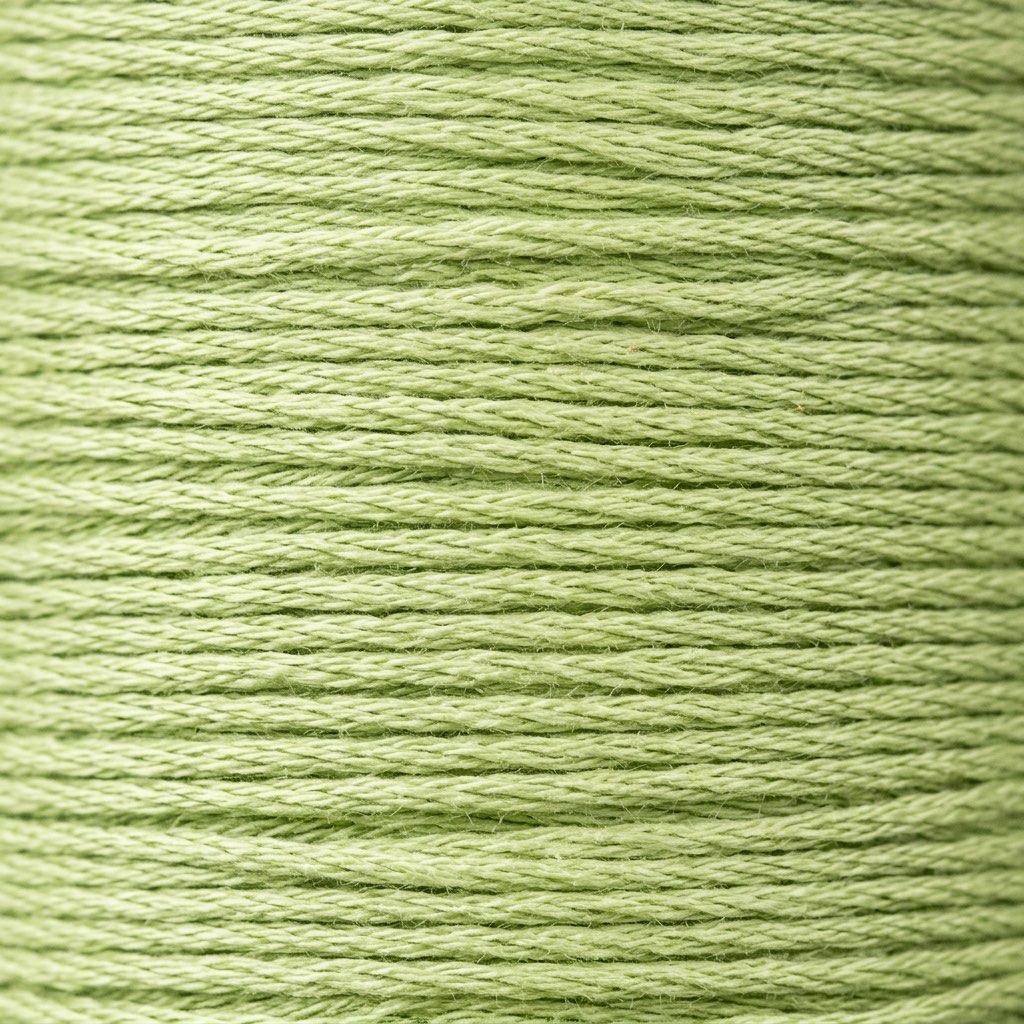
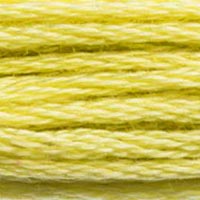
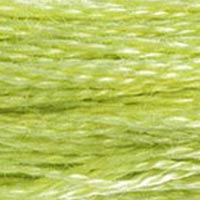
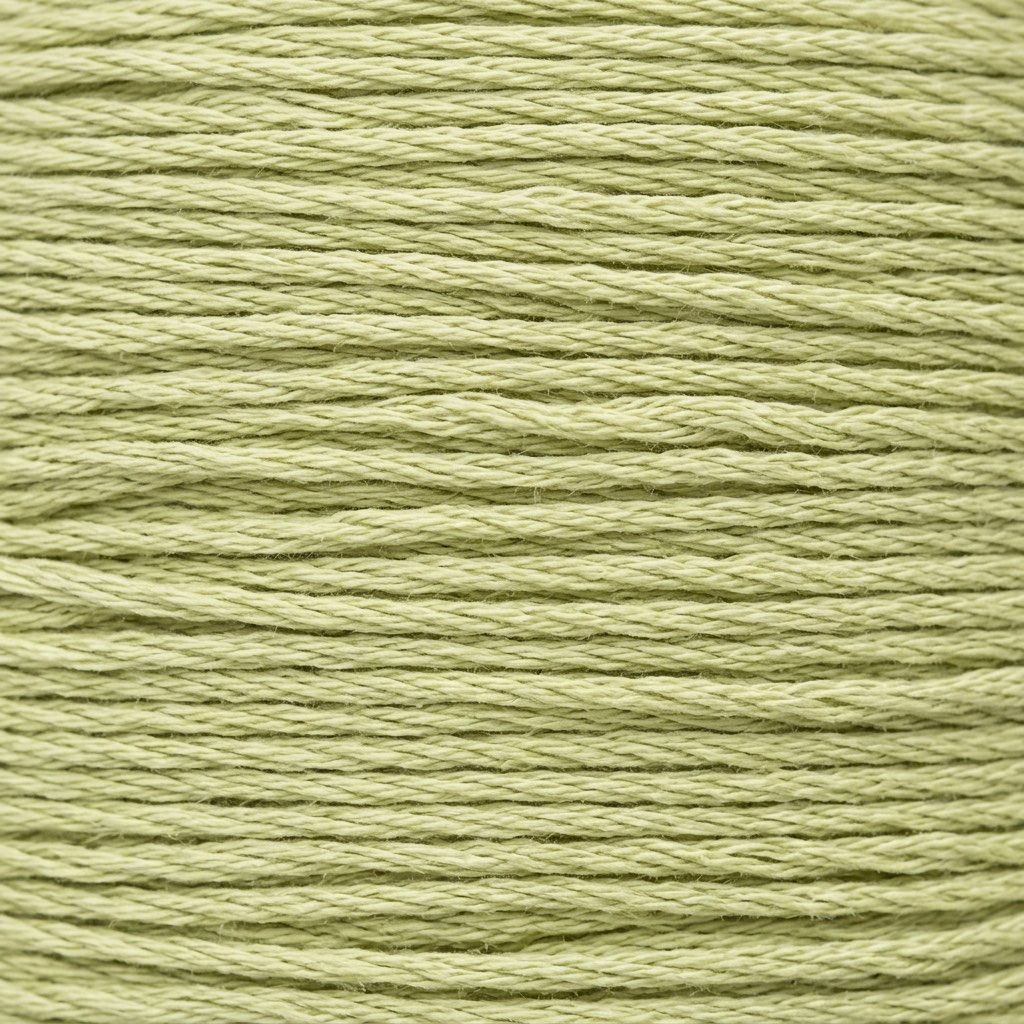
The name "Ultra Very Light Avocado Green" is, admittedly, pushing the limits of descriptive nomenclature — at this paleness, calling it avocado requires some imagination. What DMC 476 actually looks like in the skein is closer to the color of pale chartreuse or the faintest possible spring yellow-green: barely-there, nearly white, but with a definite warm quality that keeps it from reading as simply pale yellow or near-neutral. It's a sophisticated, difficult-to-categorize color that earns its place by solving very specific problems.
What This Shade Actually Does
Extremely pale colors like 476 function differently than most threads in a stash. They don't carry a design on their own; they push the limits of an existing gradient toward maximum luminosity. On white Aida, 476 is nearly invisible — it needs either dark-colored fabric to show clearly, or it needs to be surrounded by colors with enough contrast to make its pale presence read. On antique linen or natural evenweave, the warmth of the fabric creates enough contrast for 476 to read as a distinct pale warm green rather than near-white.
The primary application is in extremely detailed thread painting and botanical illustration where the gradient must extend all the way to the lightest possible value of a green object before white. In a painstaking rendering of a large backlit leaf, the very center of the most intensely lit section — where light bleaches color almost completely — needs one or two stitches of 476 to maintain green identity rather than snapping abruptly to white. This kind of hyper-precise gradient building happens mostly in needlepoint and in counted canvas work on very fine grounds, where individual stitches are small enough to create smooth gradation.
The Relationship with 474 and 472
Understanding 476 requires placing it in context with its gradient neighbors. DMC 474 (Very Light Avocado) sits just one step darker; DMC 472 (Ultra Light Avocado Green) is two steps darker and noticeably more vivid. At the 476 level, these distinctions are very small in absolute color difference but significant in gradient logic. If you're building a five or six-step avocado gradient that needs to reach maximum luminosity, 476 is your terminal step. If your gradient only needs four steps, 474 is probably your terminal step and 476 stays in the stash.
The fact that Anchor 264 is listed as a match for both 474 and 476 illustrates how close these two DMC shades are at the Anchor scale of color differentiation. For Anchor users building an avocado gradient, using 264 for the lightest step and 265 or 266 for subsequent steps is likely the most practical approach, since the Anchor range doesn't subdivide this pale territory as finely as DMC does.
Specialty Applications
Outside its gradient role, 476 finds use in pale botanical motifs on dark fabric where its apparent value appears higher than it does on light fabric. On black or navy evenweave, 476 reads as a noticeably pale warm green — actually readable as a distinct color rather than near-white. This makes it useful in folk art embroidery pieces on dark linen, and in modern interpretations of whitework that use very pale colors instead of white thread on dark fabric.
At this level of paleness, substitution is both easier and harder than at medium values — easier because small color differences are less visible in absolute terms, harder because the thread needs to perform reliably at very low saturation without coverage problems. Anchor 264 (shared with DMC 474) is the recommended close match and works reasonably well, though the shared Anchor number means you're not getting a precisely differentiated shade if you need both 474 and 476 in the same project.
Madeira 1416 provides a dedicated match for 476 specifically (as opposed to the shared Anchor number situation), which makes Madeira a better choice if your project genuinely requires distinction between 474 and 476. The Madeira thread in this zone is well-made and performs reliably on both light and dark fabric grounds.
Cosmo 986 is a close match. For this level of paleness, Cosmo's performance is generally on par with DMC — the quality gap between brands at near-white values is smaller than at mid-range saturation, making Cosmo a practical economy substitute for 476 in most applications.
Sullivans 45331 is adequate for casual applications where extreme precision isn't required. As noted throughout this family, Sullivans' pale shades are among their more competitive offerings relative to the premium brands.
Practical blending alternative: one strand of DMC 474 with one strand of DMC Blanc (White) in a blended needle creates a very close approximation of 476 on most fabrics. This is a convenient on-the-fly substitute that avoids needing to stock a separate skein of this very specialized shade, especially for stitchers who rarely need the terminal step of an avocado gradient.
Reference quality
How We Validate This Color Record
Use this page as a reference card for DMC 476: the structured data, quick conversions, and long-form copy are all tied back to the same stored color record.
- Methodology
- This page renders DMC 476, its hex value, and every brand equivalent from the site's source-of-truth color record, then checks long-form body copy against those same stored fields.
- Verification status
- Source-field checked. The page content is audited against the stored DMC number, brand equivalents, and match-quality labels before publishing.
- Last reviewed
- 2026-04-20
- Approximation warning
- Screen hex values, thread photos, and cross-brand conversions are reference aids. Dye lots, thread sheen, and fabric color can still shift the result in hand.
Decision guide
When to use the DMC 476 reference page
This page should help you decide faster between palette planning, brand substitution, and shade comparison without turning the color record into a thin lookup page.
Best for
- + Palette planning when you want the stored DMC 476 Ultra Very Light Avocado Green record, hex value #E8F0B0, and linked brand equivalents in one place.
- + Checking the quickest cross-brand shortlist before you buy floss, compare stash substitutes, or route into a more specific conversion page.
- + Finding nearby shades in the greens family before you commit to accents, shading, or background blends.
Watch for
- ! Screen previews are only reference aids. Ultra Very Light Avocado Green can shift on real fabric because thread sheen, stitch coverage, and room lighting change how the color reads.
- ! A stored equivalent is still a shortlist, not a guarantee that two brands will disappear into each other in the same stitched motif.
- ! Older charts, discontinued kit floss, and dye-lot variation can all introduce small but visible differences that the page cannot detect for you.
Before you commit
- Confirm the role of DMC 476 Ultra Very Light Avocado Green: decide whether you need an exact hero shade, a forgiving background, or a rough stash substitute.
- Compare on project fabric: view the skein or stitched sample on the same fabric count and color you will actually use.
- Use the linked conversion pages next: open the brand-specific pages when you need match-quality caveats before substituting away from the DMC reference.
DMC 476 FAQ
These questions appear on the page so the FAQ schema stays aligned with what visitors can actually read.
What is the Anchor equivalent of DMC 476?+
The closest Anchor equivalent to DMC 476 (Ultra Very Light Avocado Green) is Anchor 264. This is a close match.
What color is DMC 476?+
DMC 476 is called "Ultra Very Light Avocado Green" and has a hex color value of #E8F0B0. It belongs to the greens color family.
What is the Madeira equivalent of DMC 476?+
The closest Madeira equivalent to DMC 476 (Ultra Very Light Avocado Green) is Madeira 1416. This is a close match.
How DMC 476 Looks on Fabric
The same thread appears different depending on your fabric. Always test on your project fabric.
White Aida
Cream / Ecru
Black Aida
Pairs Well With
DMC colors commonly used alongside 476 Ultra Very Light Avocado Green.
Suggested Palette
Detailed Conversions
Where to Buy DMC 476
This section contains affiliate links. We may earn a small commission at no cost to you.
Related Guides
Free Printable Thread Conversion Chart
Pick a brand, enter your email, and we'll send you a printable chart mapping all 552 DMC colors to that brand's equivalents. Zero spam, one chart.
Thanks! Here's your free chart:
Download Your ChartOpens in a new tab. Use your browser's Print → Save as PDF.
No spam. Your email is stored securely and never shared.