
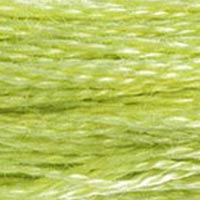
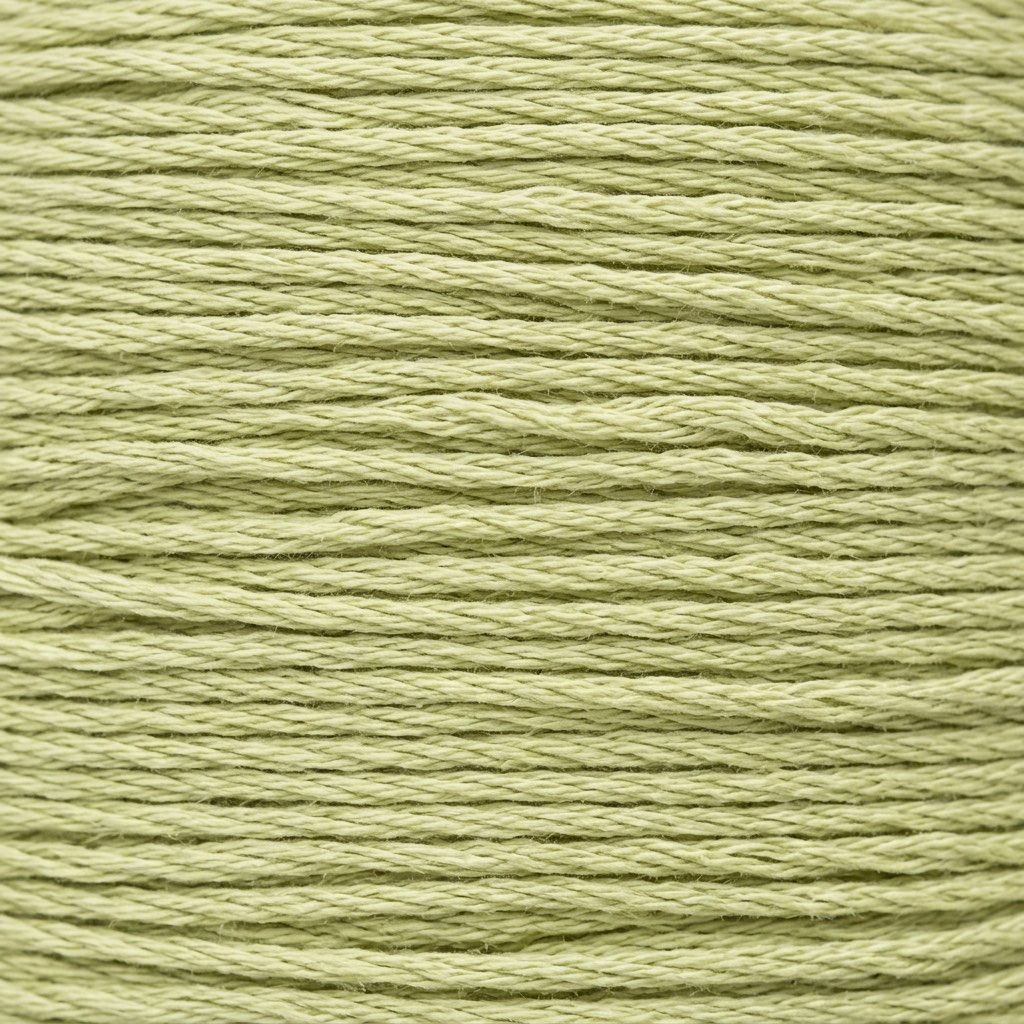
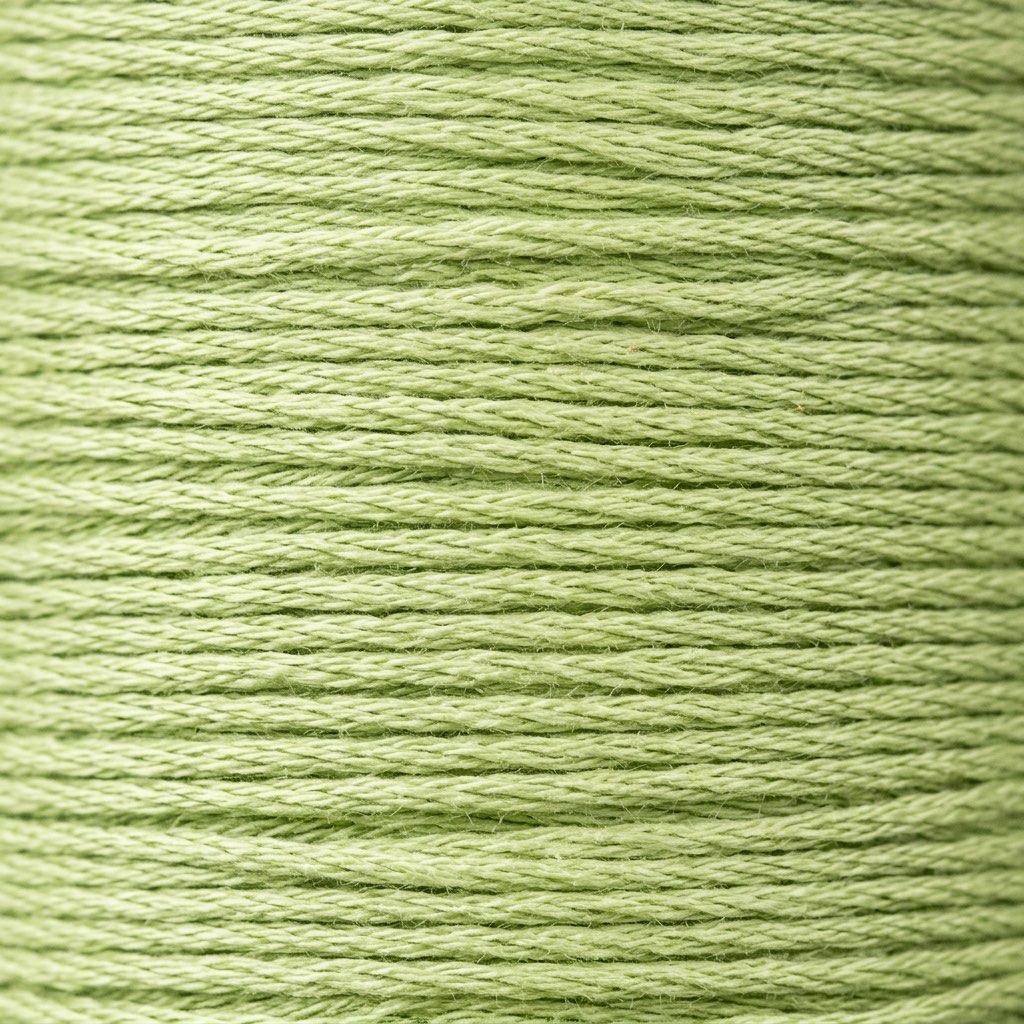
DMC 472 — Ultra Light Avocado Green
Greens family · Hex #D8E498
Quick Conversion Table
| Brand | Equivalent | Match |
|---|---|---|
| Anchor | 253 | exact |
| Madeira | 1414 | close |
| Cosmo ⚠ | 630 | close |
| Sullivans | 45107 | close |
| J&P Coats | 6253 | close |
| Dimensions | 6069 | close |
| Bucilla | 1472 | close |
| Candamar | 6073 | close |
When light strikes a green leaf at a shallow angle and the color bleaches almost to lime, when a lichen dries out on a sun-baked rock and loses its saturated color, when new fern growth catches direct noon sun and practically disappears — these are the moments DMC 472 Ultra Light Avocado Green was made for. At this value, the avocado family reaches its point of maximum luminosity: still clearly warm yellow-green, but pale enough to function as a true highlight or as an almost-neutral warm accent.
At the Pale End of the Avocado Family
472 is the terminal point of the avocado gradient (469 → 470 → 471 → 472), the lightest value in a family defined by warmth and earthiness. At this point the color has lightened so much that the olive character is almost completely washed out — what remains is essentially a very pale yellow-green, cooler and brighter than the darker family members but still sharing their warmth-bias relative to the blue-green and celadon families.
Importantly, 472 occupies similar visual territory to DMC 474 (Very Light Avocado) and DMC 476 (Ultra Very Light Avocado Green) from a related but distinct color family — these are close enough to create confusion when building palettes. The distinctions are subtle: 472 (this thread) runs slightly warmer and more yellow, while 474 and 476 lean toward a cooler, slightly greener-grey. Examining them side by side before purchasing for a gradient project is worthwhile.
Where Ultra-Light Warm Greens Earn Their Place
The use cases for 472 are specific but important. In thread painting of botanical subjects, it appears at the very edge of a leaf where backlighting causes near-total bleaching — one or two stitches at the leaf margin that push the gradient into the almost-white zone while maintaining green identity. In large-coverage foliage backgrounds on lighter-value pieces, 472 creates the sense of dappled, sun-washed light without requiring actual light-colored stitching over dark.
For stitchers who work with variegated threads or blended needles, 472 is a practical blending partner for pushing any green toward greater luminosity. One strand of 472 combined with one strand of a mid-value green in a blended needle creates a halfway point that no single thread achieves — particularly useful when a pattern specifies a shade that doesn't quite exist in DMC's catalog and you're working from a hand-digitized chart or your own original design.
Beyond Botanical: Other Applications
Ultra Light Avocado Green appears in designs beyond strictly botanical contexts. Wildlife patterns featuring certain moth and caterpillar species — specifically, geometrid moths and many inchworm species that use exactly this pale warm-yellow-green as camouflage — are natural homes for 472. Some stitchers use it for the green element in pale Easter palettes where a more vivid green would feel out of place. In vintage-style designs with a deliberately muted, faded quality, 472 can substitute for what would normally be a medium-value green, creating the impression of a color that has aged and bleached over decades.
Anchor 253 earns its exact match rating and is a reliable substitute. At the pale end of the green spectrum, Anchor's performance is generally very good — their quality control in light values is consistent, and stitchers shouldn't expect surprises. Anchor 253 is distinct from the Anchor 266 that covers the darker DMC 470 and 471, so you won't run into the same overlap problem at this end of the family.
Madeira 1414 is the designated exact match and performs accordingly. Note that this is a different number from the 1501–1503 sequence that covers the main avocado family — the Madeira numbering doesn't always follow DMC's family logic. Double-check before ordering if you're building a Madeira stash of avocado shades.
Cosmo 630 is a close match that works well for most applications. At this level of lightness, the slight warmth variation between Cosmo and DMC is less visible than in the darker family members, making Cosmo 630 a particularly good substitute choice if cost or availability is a factor. For all but the most technically demanding gradient work, it should perform equivalently.
Sullivans 45107 is adequate for casual use and actually among the more reliable Sullivans options in this color zone. The very light values in Sullivans' range tend to be more consistent with the premium brands than their mid-range shades, because there's less room for dye variation to show at very low saturation levels.
For blending purposes: combining one strand of DMC 471 with one strand of DMC 3823 (Ultra Pale Yellow) in a blended needle approximates 472 reasonably closely — a useful option if you need to recreate the shade without purchasing a dedicated skein.
Reference quality
How We Validate This Color Record
Use this page as a reference card for DMC 472: the structured data, quick conversions, and long-form copy are all tied back to the same stored color record.
- Methodology
- This page renders DMC 472, its hex value, and every brand equivalent from the site's source-of-truth color record, then checks long-form body copy against those same stored fields.
- Verification status
- Source-field checked. The page content is audited against the stored DMC number, brand equivalents, and match-quality labels before publishing.
- Last reviewed
- 2026-04-20
- Approximation warning
- Screen hex values, thread photos, and cross-brand conversions are reference aids. Dye lots, thread sheen, and fabric color can still shift the result in hand.
Decision guide
When to use the DMC 472 reference page
This page should help you decide faster between palette planning, brand substitution, and shade comparison without turning the color record into a thin lookup page.
Best for
- + Palette planning when you want the stored DMC 472 Ultra Light Avocado Green record, hex value #D8E498, and linked brand equivalents in one place.
- + Checking the quickest cross-brand shortlist before you buy floss, compare stash substitutes, or route into a more specific conversion page.
- + Finding nearby shades in the greens family before you commit to accents, shading, or background blends.
Watch for
- ! Screen previews are only reference aids. Ultra Light Avocado Green can shift on real fabric because thread sheen, stitch coverage, and room lighting change how the color reads.
- ! A stored equivalent is still a shortlist, not a guarantee that two brands will disappear into each other in the same stitched motif.
- ! Older charts, discontinued kit floss, and dye-lot variation can all introduce small but visible differences that the page cannot detect for you.
Before you commit
- Confirm the role of DMC 472 Ultra Light Avocado Green: decide whether you need an exact hero shade, a forgiving background, or a rough stash substitute.
- Compare on project fabric: view the skein or stitched sample on the same fabric count and color you will actually use.
- Use the linked conversion pages next: open the brand-specific pages when you need match-quality caveats before substituting away from the DMC reference.
DMC 472 FAQ
These questions appear on the page so the FAQ schema stays aligned with what visitors can actually read.
What is the Anchor equivalent of DMC 472?+
The closest Anchor equivalent to DMC 472 (Ultra Light Avocado Green) is Anchor 253. This is an exact match.
What color is DMC 472?+
DMC 472 is called "Ultra Light Avocado Green" and has a hex color value of #D8E498. It belongs to the greens color family.
What is the Madeira equivalent of DMC 472?+
The closest Madeira equivalent to DMC 472 (Ultra Light Avocado Green) is Madeira 1414. This is a close match.
How DMC 472 Looks on Fabric
The same thread appears different depending on your fabric. Always test on your project fabric.
White Aida
Cream / Ecru
Black Aida
Pairs Well With
DMC colors commonly used alongside 472 Ultra Light Avocado Green.
Suggested Palette
Detailed Conversions
Where to Buy DMC 472
This section contains affiliate links. We may earn a small commission at no cost to you.
Related Guides
Free Printable Thread Conversion Chart
Pick a brand, enter your email, and we'll send you a printable chart mapping all 552 DMC colors to that brand's equivalents. Zero spam, one chart.
Thanks! Here's your free chart:
Download Your ChartOpens in a new tab. Use your browser's Print → Save as PDF.
No spam. Your email is stored securely and never shared.