
Quick Conversion Table
| Brand | Equivalent | Match |
|---|---|---|
| Anchor | 311 | exact |
| Madeira | 2013 | close |
| Cosmo ⚠ | 574 | close |
| Sullivans | 45424 | close |
| J&P Coats | 5351 | close |
| Dimensions | 15350 | close |
| Bucilla | 3827 | close |
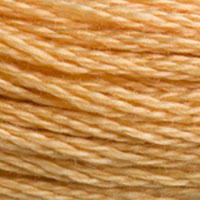
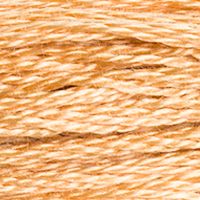
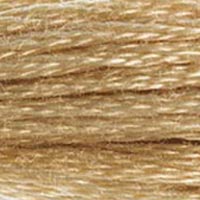
Pale Golden Brown shares its hex code (#F7BB77) with DMC 3825 (Pale Pumpkin) in the batch data — a reminder that hex approximations for thread colors have limits, and that two threads sharing an approximate hex can read quite differently in practice. Where DMC 3825 reads as distinctly orange-warm, DMC 3827 sits in a slightly more complex position: still warm, still golden, but with a quality that reads as more brown and less orange. The difference between 'pale pumpkin' and 'pale golden brown' is a real distinction in use, even if the hex values converge.
At its heart, DMC 3827 is the lightest, most golden member of the golden-brown family. It provides the warm, honey-gold highlight that DMC 3826 (Golden Brown) and DMC 3828 (Hazelnut Brown) need to show their depth and warmth. In a gradient sequence, 3827 is the color that makes the others read as mid and dark — without it, the sequence loses its luminosity.
Highlight Role in Warm Palettes
In animal fur shading, 3827 appears as the lightest warm tone: the sun-bleached tip of a deer's ear, the bright highlight on a golden retriever's brow, the pale underbelly of a chipmunk. It's warm enough to belong to the same palette as the deeper golden-browns while light enough to create genuine value contrast. Remove it and fur looks like it's in shadow; include it and the animal seems to be sitting in warm afternoon light.
In wood grain representation, 3827 handles the lightest grain highlights — the pale line in wood where the light catches the surface texture most strongly. Real wood grain has this quality of light and dark variation within a single color family, and 3827 provides the light end of that range convincingly. Too pale and it reads as white highlight rather than grain; too dark and it doesn't create enough contrast. 3827's specific pale golden quality is well-calibrated for this use.
Golden Age Aesthetic and Historical Design
For historically-inspired cross-stitch — reproduction medieval patterns, Renaissance tapestry-adjacent designs, Baroque decorative pieces — 3827 serves as the thread that represents gold leafing in textile form. Real gold leaf and gilded surfaces, when represented in needlework, use this kind of pale, warm gold thread (often supplemented with metallic threads, but not always). The color reads as 'gold' in historical contexts more convincingly than a brighter, more saturated gold thread would.
Bible verse samplers, church-inspired decorative pieces, and Advent or Christmas designs with historical aesthetic all use 3827 in this gold-representation role. Combined with DMC 3770 (Very Light Tawny) for the palest gold areas and DMC 3826 (Golden Brown) for deeper gold shadows, you can build credible gilded lettering or decorative frames in cross-stitch without metallic thread.
Autumn leaves in their most golden phase — the brief moment before they turn orange or brown — use 3827 accurately for the brightest, most luminous sections. Birch leaves, aspen, and certain maple varieties hit this particular golden tone at peak color change.
A note on storing and working with this color alongside its very similar neighbor DMC 3825 (Pale Pumpkin): in a skein organizer under artificial light, these two threads can look nearly identical. Both are pale golden-orange in the same value range. The easiest distinguishing test: 3827 should read as slightly more brown-gold, 3825 as slightly more orange-gold. Holding both against a piece of white paper in daylight is the most reliable way to see the difference. Confusing them in your needle is a surprisingly common mistake, especially when both are parked simultaneously in a complex gradient piece — label your parking positions clearly.
Anchor 311 is an exact match for DMC 3827, which is particularly useful given the role this color plays as a highlight value in larger gradient sequences. Exact matches in highlight positions matter because the contrast relationship with adjacent values is where inaccuracy shows most readily. Anchor 311 maintains the same warm-golden quality that makes 3827 work as a highlight.
Madeira 2013 is rated close. In this pale golden range, Madeira can read slightly more yellow in some dye lots — shifting from golden-brown toward more purely golden. This is usually fine in most applications, though in wood grain work where the brown quality matters as much as the golden quality, checking the swatch is worthwhile.
Cosmo 574 and Sullivans 45424 are both rated close. Cosmo 574 is generally reliable. Sullivans 45424 is acceptable with the standard dye lot caveat for warm light colors.
Within the DMC range, 3827 is the lightest in the golden-brown family. DMC 3826 (Golden Brown) is one step deeper and more saturated. DMC 3825 (Pale Pumpkin) is adjacent but more distinctly orange — the difference is subtle but real. DMC 676 (Light Old Gold) covers related pale-gold territory with a slightly cooler, more yellow-gold quality. DMC 3855 (Light Autumn Gold) is in the same pale warm-gold range with slightly more warmth. For the very palest gold highlight, DMC 677 (Very Light Old Gold) goes lighter than 3827 with a cooler golden quality.
Reference quality
How We Validate This Color Record
Use this page as a reference card for DMC 3827: the structured data, quick conversions, and long-form copy are all tied back to the same stored color record.
- Methodology
- This page renders DMC 3827, its hex value, and every brand equivalent from the site's source-of-truth color record, then checks long-form body copy against those same stored fields.
- Verification status
- Source-field checked. The page content is audited against the stored DMC number, brand equivalents, and match-quality labels before publishing.
- Last reviewed
- 2026-04-20
- Approximation warning
- Screen hex values, thread photos, and cross-brand conversions are reference aids. Dye lots, thread sheen, and fabric color can still shift the result in hand.
Decision guide
When to use the DMC 3827 reference page
This page should help you decide faster between palette planning, brand substitution, and shade comparison without turning the color record into a thin lookup page.
Best for
- + Palette planning when you want the stored DMC 3827 Pale Golden Brown record, hex value #F7BB77, and linked brand equivalents in one place.
- + Checking the quickest cross-brand shortlist before you buy floss, compare stash substitutes, or route into a more specific conversion page.
- + Finding nearby shades in the browns family before you commit to accents, shading, or background blends.
Watch for
- ! Screen previews are only reference aids. Pale Golden Brown can shift on real fabric because thread sheen, stitch coverage, and room lighting change how the color reads.
- ! A stored equivalent is still a shortlist, not a guarantee that two brands will disappear into each other in the same stitched motif.
- ! Older charts, discontinued kit floss, and dye-lot variation can all introduce small but visible differences that the page cannot detect for you.
Before you commit
- Confirm the role of DMC 3827 Pale Golden Brown: decide whether you need an exact hero shade, a forgiving background, or a rough stash substitute.
- Compare on project fabric: view the skein or stitched sample on the same fabric count and color you will actually use.
- Use the linked conversion pages next: open the brand-specific pages when you need match-quality caveats before substituting away from the DMC reference.
DMC 3827 FAQ
These questions appear on the page so the FAQ schema stays aligned with what visitors can actually read.
What is the Anchor equivalent of DMC 3827?+
The closest Anchor equivalent to DMC 3827 (Pale Golden Brown) is Anchor 311. This is an exact match.
What color is DMC 3827?+
DMC 3827 is called "Pale Golden Brown" and has a hex color value of #F7BB77. It belongs to the browns color family.
What is the Madeira equivalent of DMC 3827?+
The closest Madeira equivalent to DMC 3827 (Pale Golden Brown) is Madeira 2013. This is a close match.
How DMC 3827 Looks on Fabric
The same thread appears different depending on your fabric. Always test on your project fabric.
White Aida
Cream / Ecru
Black Aida
Pairs Well With
DMC colors commonly used alongside 3827 Pale Golden Brown.
Suggested Palette
Shading Companions
Detailed Conversions
Where to Buy DMC 3827
This section contains affiliate links. We may earn a small commission at no cost to you.
Related Guides
Free Printable Thread Conversion Chart
Pick a brand, enter your email, and we'll send you a printable chart mapping all 552 DMC colors to that brand's equivalents. Zero spam, one chart.
Thanks! Here's your free chart:
Download Your ChartOpens in a new tab. Use your browser's Print → Save as PDF.
No spam. Your email is stored securely and never shared.