
Quick Conversion Table
| Brand | Equivalent | Match |
|---|---|---|
| Anchor | 1203 | close |
| Madeira | 2209 | close |
| Cosmo ⚠ | 2581 | close |
| Sullivans | 45162 | close |
Golden Hour in a Skein
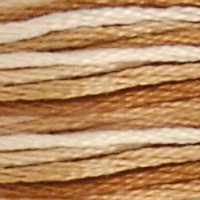
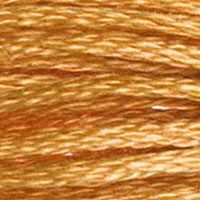
There's a moment just before sunset when ordinary brown surfaces — a wooden fence, a hayfield, a stretch of sandy path — seem to glow from within, cycling through honey, amber, tawny, and warm gold as the light shifts. DMC 105 captures that quality in thread form. This variegated brown moves through a range of warm golden-brown tones, from something close to dark butterscotch down to a toasty medium brown, creating a shimmering, light-dappled effect that solid browns can only dream of.
Unlike its cooler sibling DMC 101 (Variegated Gray Brown), which drifts between neutral and cool tones, 105 stays firmly in warm territory throughout its entire color cycle. Every point on the gradient reads as some variety of golden brown — there are no cool surprises, no sudden shifts into gray or olive. This makes 105 more predictable to work with than many variegated threads, and it means you can use it confidently in warm-palette designs without worrying about stray cool notes disrupting your color harmony.
The golden character of this thread makes it a natural for anything associated with warmth, harvest, and sunlight. Wheat sheaves and hayfields benefit enormously from 105's built-in variation — a solid gold thread makes a wheat field look like a carpet, while 105 makes it look like actual grain bending in a breeze. Similarly, honey and maple syrup in kitchen-themed samplers gain a translucent, liquid quality when stitched with 105 that solid DMC 976 or 977 can't match on their own.
The Warm Wood Grain Effect
Perhaps 105's most compelling use is for wood grain in furniture and architectural elements. Real wood — especially golden hardwoods like oak, ash, and maple — isn't a single color. It's a complex interplay of lighter sapwood and darker heartwood, of grain lines that catch light differently depending on the angle. A solid brown thread can represent wood, but 105 can suggest wood, which is a different thing entirely. The automatic color variation mimics the way grain catches light, the way one section of a plank differs from the next.
For larger areas of wood — a cabin wall, a hardwood floor, a rustic table in a country kitchen design — 105 saves you the work of planning and stitching a multi-shade gradient by hand. Stitch it using the Danish method for a gentler, more uniform grain effect, or use cross-country stitching for a knotty, more figured look with pronounced color variation. On 14-count Aida with two strands, the color shifts play out across roughly three to five stitches per transition, which gives you enough resolution to see the pattern without it becoming too busy.
Pair 105 with solid anchors at either end of its range to extend the palette: DMC 3826 (Golden Brown) for deeper shadow areas where you want consistent warmth, and DMC 3827 (Pale Golden Brown) for highlights that continue the golden theme. For a rustic timber-frame design, adding DMC 898 (Very Dark Coffee Brown) for the deepest beam shadows and DMC 738 (Very Light Tan) for sunlit surfaces gives you a five-thread wood palette with 105 doing the heavy textural lifting in the mid-tones.
Seasonal Work and Kitchen Samplers
Autumn SALs and harvest-themed projects make heavy use of the golden-brown family, and 105 offers a shortcut that many stitchers overlook. Instead of carefully planning which of four or five solid golden browns goes where in a cornucopia or autumn wreath, try 105 for the background fill or the body of harvest elements — corn husks, dried sunflower centers, woven basket weaves — and let the variegation do the compositional work. The result often looks more natural and less planned than a carefully mapped gradient, because real organic textures aren't neatly organized by value.
For baking and kitchen-themed samplers — designs featuring bread loaves, pastry crusts, wooden spoons, cutting boards, and pie lattice — 105 is practically custom-made. Golden-brown baked goods have exactly the kind of uneven, warm color variation that variegated thread reproduces naturally. A bread crust stitched in 105 looks freshly baked; the same crust in solid 976 looks painted. If the pattern calls for a solid golden brown in these contexts, consider swapping in 105 as a design upgrade. Just test a small section first to make sure the color range works with the rest of the palette.
Staying in the Golden Range
With DMC 105, the substitution challenge is maintaining that consistently warm, golden color cycle. Some variegated brown threads from other brands drift into cooler or more neutral territory at points in their gradient, which would introduce unwanted cool spots into designs where 105's reliable warmth is the whole point.
Anchor 1203 is listed as close, and it covers a similar warm-brown range, though the transition points may fall at slightly different intervals along the thread. Stitch a test patch using your planned technique before committing — the overall impression matters more than matching any single point in the gradient. Madeira 2209 follows a comparable golden-brown cycle and is worth trying if DMC is unavailable. Madeira's slight sheen can actually enhance the honey-gold quality of the lighter portions of the gradient.
Cosmo 2581 gets you into warm brown variegated territory, though Cosmo's color transitions sometimes feel slightly more abrupt than DMC's smoother drifts. This isn't necessarily worse — it depends on whether you want a flowing gradient or more distinct color pockets.
If variegated substitutes aren't available, you can approximate 105's effect with a blended needle approach: one strand of DMC 977 (Light Golden Brown) paired with one strand of DMC 3828 (Hazelnut Brown). The result won't cycle the way a variegated thread does, but it produces a warm, heathered golden-brown that captures some of the same character. For wood grain textures specifically, try randomly alternating between DMC 976, 977, and 3827 every few stitches — it takes more thread management, but the result can look remarkably similar to 105's natural variation.
Reference quality
How We Validate This Color Record
Use this page as a reference card for DMC 105: the structured data, quick conversions, and long-form copy are all tied back to the same stored color record.
- Methodology
- This page renders DMC 105, its hex value, and every brand equivalent from the site's source-of-truth color record, then checks long-form body copy against those same stored fields.
- Verification status
- Source-field checked. The page content is audited against the stored DMC number, brand equivalents, and match-quality labels before publishing.
- Last reviewed
- 2026-04-20
- Approximation warning
- Screen hex values, thread photos, and cross-brand conversions are reference aids. Dye lots, thread sheen, and fabric color can still shift the result in hand.
Decision guide
When to use the DMC 105 reference page
This page should help you decide faster between palette planning, brand substitution, and shade comparison without turning the color record into a thin lookup page.
Best for
- + Palette planning when you want the stored DMC 105 Variegated Brown record, hex value #D4A864, and linked brand equivalents in one place.
- + Checking the quickest cross-brand shortlist before you buy floss, compare stash substitutes, or route into a more specific conversion page.
- + Finding nearby shades in the browns family before you commit to accents, shading, or background blends.
Watch for
- ! Screen previews are only reference aids. Variegated Brown can shift on real fabric because thread sheen, stitch coverage, and room lighting change how the color reads.
- ! A stored equivalent is still a shortlist, not a guarantee that two brands will disappear into each other in the same stitched motif.
- ! Older charts, discontinued kit floss, and dye-lot variation can all introduce small but visible differences that the page cannot detect for you.
Before you commit
- Confirm the role of DMC 105 Variegated Brown: decide whether you need an exact hero shade, a forgiving background, or a rough stash substitute.
- Compare on project fabric: view the skein or stitched sample on the same fabric count and color you will actually use.
- Use the linked conversion pages next: open the brand-specific pages when you need match-quality caveats before substituting away from the DMC reference.
DMC 105 FAQ
These questions appear on the page so the FAQ schema stays aligned with what visitors can actually read.
What is the Anchor equivalent of DMC 105?+
The closest Anchor equivalent to DMC 105 (Variegated Brown) is Anchor 1203. This is a close match.
What color is DMC 105?+
DMC 105 is called "Variegated Brown" and has a hex color value of #D4A864. It belongs to the browns color family.
What is the Madeira equivalent of DMC 105?+
The closest Madeira equivalent to DMC 105 (Variegated Brown) is Madeira 2209. This is a close match.
How DMC 105 Looks on Fabric
The same thread appears different depending on your fabric. Always test on your project fabric.
White Aida
Cream / Ecru
Black Aida
Pairs Well With
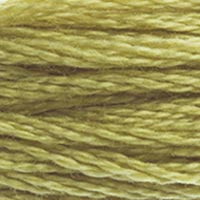
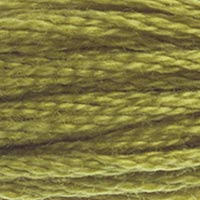
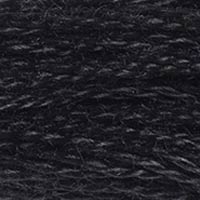
DMC colors commonly used alongside 105 Variegated Brown.
Suggested Palette
Shading Companions
Detailed Conversions
Where to Buy DMC 105
This section contains affiliate links. We may earn a small commission at no cost to you.
Related Guides
Free Printable Thread Conversion Chart
Pick a brand, enter your email, and we'll send you a printable chart mapping all 552 DMC colors to that brand's equivalents. Zero spam, one chart.
Thanks! Here's your free chart:
Download Your ChartOpens in a new tab. Use your browser's Print → Save as PDF.
No spam. Your email is stored securely and never shared.