
Quick Conversion Table
| Brand | Equivalent | Match |
|---|---|---|
| Anchor | 361 | exact |
| Madeira | 2102 | close |
| Cosmo ⚠ | 307 | close |
| Sullivans | 45179 | close |
| J&P Coats | 5345 | close |
| Dimensions | 6738 | close |
| Bucilla | 1738 | close |
| Candamar | 6224 | close |
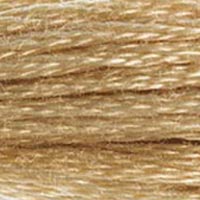
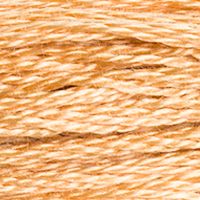
Sandy beach at noon, unbleached cotton, the light underside of a chestnut horse's flank — DMC 738 Very Light Tan reads as one of the most natural, unforced neutrals in the brown family. Its hex #ECCC9E shows a pale warm tone with just enough pink to prevent it from going yellow, just enough warmth to prevent it from going gray. In a thread collection, it's one of those colors that turns out to be more used than expected: it shows up as highlights in tan and brown shading sequences, as skin mid-tones, as light fur and feather texture, and as the straw-pale backgrounds in country and cottage designs.
The Tan Family in Context
The DMC tan sequence includes several members: DMC 437 Light Tan, DMC 436 Tan, DMC 435 Very Light Brown, and at the lighter end, 738 Very Light Tan and 739 Ultra Very Light Tan. At this pale end of the range, the distinction between tan and cream narrows, and the choice between 738, 739, and nearby neutrals like DMC 712 Cream or DMC 3033 Very Light Mocha Brown is often a subtle but meaningful decision based on the underlying warmth and pink component of each.
DMC 738 sits in the warmest zone of this pale range — it's paler than 437 but carries more warmth than either the beige grays or the cool mocha browns. It's the specific tan that sand looks when dry, that raw linen looks before washing, that wooden furniture looks in old photographs. A color with genuine material associations that enrich its usefulness in period and naturalistic work.
Animal Portraits and Natural History
In animal embroidery, pale warm tans cover an enormous range of subjects. Labrador retrievers and golden retrievers use 738 alongside 437 and 435 for their characteristic fur. Jersey and Guernsey cows, Palomino horses, and fawn-colored deer all have this light tan in their coats. Birds with sandy, buff-colored plumage — many sparrows, the common buzzard's underwing, sandpipers and shore birds — use 738 for their lightest areas where the pale buff-tan catches maximum light.
Big cat portraits — lions, mountain lions, cheetahs — use the tan family extensively, with 738 and 739 providing the highlight and near-highlight tones that give the coat its pale, sandy quality. Working over-two on evenweave in a parallel stitch direction for the coat direction, the tan sequence reads remarkably like actual fur texture when the shading is carefully placed.
Skin Tones and Portrait Work
For medium to light skin tones in portrait embroidery, 738 serves as the light-to-mid highlight in areas receiving moderate direct light. It's warm enough to read as organic skin rather than plastic or painted surface, pale enough to contribute genuine highlighting without blowing out. Paired with DMC 3773 Medium Desert Sand and DMC 632 Ultra Very Dark Desert Sand for deeper values, and with DMC 739 for the brightest highlights, 738 occupies the crucial mid-light zone where the skin's warmth is most fully expressed.
One practical note for stitchers who work a lot of portrait and figurative embroidery: the very light tans (738, 739) tend to be consumed more quickly than expected in skin-tone sequences. The highlighted areas of a face, neck, and hands add up to significant coverage even in medium-sized pieces, and the pale values at the light end of any gradient cover more area as you move toward the outer edges of the lit zones. Buying two skeins of 738 at the start of a portrait project is rarely a mistake; running out mid-cheek and needing to find a matching dye lot is a frustration worth preventing.
Anchor 361 and Madeira 2102 are both exact matches for DMC 738. In the tan and brown families, exact cross-brand matches are common at the lighter values, where the color is simple enough that brands can calibrate it consistently. Both Anchor and Madeira versions of this pale tan are reliable substitutes.
Cosmo 307 and Sullivans 45179 are close. Cosmo 307 can read slightly more golden-yellow in certain lights — the warmth shifts slightly toward straw rather than neutral tan. Sullivans 45179 is a solid close match in most contexts. For large fill areas where 738 is providing the primary pale-tan tone of a sandy subject (an animal coat, a background fill), comparing swatches in your working environment before committing is the right approach.
Within the DMC range, DMC 739 Ultra Very Light Tan is the obvious lighter step in the same family. DMC 437 Light Tan is the next step darker. In emergencies, DMC 3047 Light Yellow Beige is slightly more golden and less pink-warm than 738, but covers similar pale-warm territory. DMC 712 Cream is somewhat cooler and less tan in character. For a blended approximation, one strand of 437 and one strand of 739 creates a mid-point that reads close to 738 in hue and value — not identical but a functional stopgap in mid-WIP situations.
Reference quality
How We Validate This Color Record
Use this page as a reference card for DMC 738: the structured data, quick conversions, and long-form copy are all tied back to the same stored color record.
- Methodology
- This page renders DMC 738, its hex value, and every brand equivalent from the site's source-of-truth color record, then checks long-form body copy against those same stored fields.
- Verification status
- Source-field checked. The page content is audited against the stored DMC number, brand equivalents, and match-quality labels before publishing.
- Last reviewed
- 2026-04-20
- Approximation warning
- Screen hex values, thread photos, and cross-brand conversions are reference aids. Dye lots, thread sheen, and fabric color can still shift the result in hand.
Decision guide
When to use the DMC 738 reference page
This page should help you decide faster between palette planning, brand substitution, and shade comparison without turning the color record into a thin lookup page.
Best for
- + Palette planning when you want the stored DMC 738 Very Light Tan record, hex value #ECCC9E, and linked brand equivalents in one place.
- + Checking the quickest cross-brand shortlist before you buy floss, compare stash substitutes, or route into a more specific conversion page.
- + Finding nearby shades in the browns family before you commit to accents, shading, or background blends.
Watch for
- ! Screen previews are only reference aids. Very Light Tan can shift on real fabric because thread sheen, stitch coverage, and room lighting change how the color reads.
- ! A stored equivalent is still a shortlist, not a guarantee that two brands will disappear into each other in the same stitched motif.
- ! Older charts, discontinued kit floss, and dye-lot variation can all introduce small but visible differences that the page cannot detect for you.
Before you commit
- Confirm the role of DMC 738 Very Light Tan: decide whether you need an exact hero shade, a forgiving background, or a rough stash substitute.
- Compare on project fabric: view the skein or stitched sample on the same fabric count and color you will actually use.
- Use the linked conversion pages next: open the brand-specific pages when you need match-quality caveats before substituting away from the DMC reference.
DMC 738 FAQ
These questions appear on the page so the FAQ schema stays aligned with what visitors can actually read.
What is the Anchor equivalent of DMC 738?+
The closest Anchor equivalent to DMC 738 (Very Light Tan) is Anchor 361. This is an exact match.
What color is DMC 738?+
DMC 738 is called "Very Light Tan" and has a hex color value of #ECCC9E. It belongs to the browns color family.
What is the Madeira equivalent of DMC 738?+
The closest Madeira equivalent to DMC 738 (Very Light Tan) is Madeira 2102. This is a close match.
How DMC 738 Looks on Fabric
The same thread appears different depending on your fabric. Always test on your project fabric.
White Aida
Cream / Ecru
Black Aida
Pairs Well With
DMC colors commonly used alongside 738 Very Light Tan.
Suggested Palette
Shading Companions
Detailed Conversions
Where to Buy DMC 738
This section contains affiliate links. We may earn a small commission at no cost to you.
Related Guides
Free Printable Thread Conversion Chart
Pick a brand, enter your email, and we'll send you a printable chart mapping all 552 DMC colors to that brand's equivalents. Zero spam, one chart.
Thanks! Here's your free chart:
Download Your ChartOpens in a new tab. Use your browser's Print → Save as PDF.
No spam. Your email is stored securely and never shared.