
Quick Conversion Table
| Brand | Equivalent | Match |
|---|---|---|
| Anchor | 1008 | close |
| Madeira | 1909 | close |
| Cosmo ⚠ | 424 | close |
| Sullivans | 45387 | close |
| J&P Coats | 2336 | close |
| Candamar | 6205 | close |
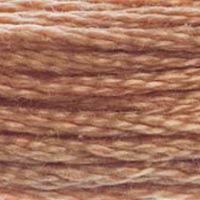
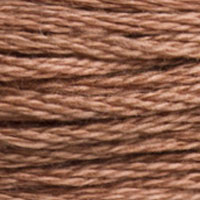
The middle of a gradient is often the most underappreciated position in a color family. Highlights get attention for their brightness; darks get credit for their depth. But the midtone does the organizing work — it's the color that everything else reads against, the value that makes the lighter threads seem light and the darker threads seem dark. DMC 3773, Desert Sand, occupies this critical middle position in the Desert Sand family. At hex #B67552, it's a warm, mid-value golden-brown that reads as exactly what sand looks like in afternoon light: neither bleached pale nor burnt dark.
What makes 3773 distinct from the many warm browns in the DMC range is its particular combination of orange and brown. It leans toward the orange side of the brown spectrum without becoming copper or sienna — it keeps its sandy quality, that association with dry, sun-warmed earth, rather than slipping into wood or metal territory. That specificity makes it useful in specific ways that more generic mid-browns aren't.
Animal and Nature Applications
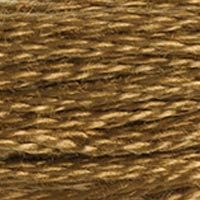
Sandy-colored animals — lions, camels, deer in their summer coats, rabbits, golden retriever fur, sand-colored cats — use this color range extensively in cross-stitch patterns. DMC 3773 typically fills the primary body color in these subjects, with DMC 3772 (Very Dark Desert Sand) for shadows and DMC 3774 (Very Light Desert Sand) for the lightest highlights. The result is naturalistic animal coloring that photographs well and holds up under close inspection.
For landscape work featuring sandy terrain, desert scenes, or beach subjects, 3773 provides the visual anchor of the palette — the color you look at when you think of this landscape at its most typical. Dune crests in raking afternoon light, tide-washed beach flat, the packed earth of a savanna path — all of these can be built from the Desert Sand family with 3773 at the center.
Pairing with Other Color Families
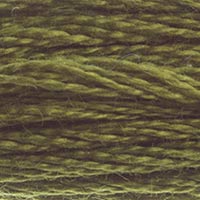
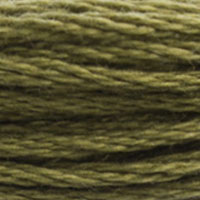
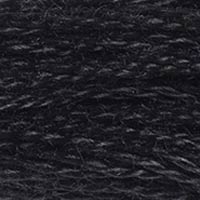
The warm, slightly orange-brown quality of 3773 makes it an excellent companion in Southwestern, North African, or Mediterranean-themed palettes. Pair it with DMC 3777 (Very Dark Terra Cotta) and DMC 842 (Very Light Beige Brown) for a palette that reads as sun-baked and earthen. Add DMC 3760 (Medium Wedgwood) for a complementary blue accent — the warm earth against the cool blue is a classic pairing that appears everywhere from Moroccan tile work to Santa Fe pottery.
In folk art styles — Norwegian, Polish, Mexican embroidery-inspired cross-stitch — 3773 provides the background or ground color that makes bright accent colors pop. DMC 3825 (Pale Pumpkin), DMC 321 (Christmas Red), or DMC 3819 (Light Moss Green) all read vividly against 3773's warm mid-tone. Using it as a background requires good coverage, though — on 14-count, two strands covers adequately, but a test square is worthwhile in large background areas.
One useful quality of 3773 that stitchers discover when working on long pieces: it's a relatively forgiving thread to park. The mid-value warm-brown doesn't show looping marks or handling patina as readily as very light or very dark threads can, which matters in long SAL or year-long sampler projects where threads sit parked for extended periods. Keeping parking loops loose and consistent is still good practice, but 3773 tends to come off the parking position cleanly.
Madeira 1909 is an exact match for DMC 3773 — reliable and recommended if you're sourcing from Madeira. This is particularly good news given how useful this color is in large-area work like backgrounds and animal fills, where you might need multiple skeins and color consistency matters.
Anchor 1008 is rated close. It typically reads slightly more orange-warm than DMC 3773 in practice, which may or may not matter depending on your project. In animal coloring work where the Desert Sand family is building naturalistic fur tones, a slightly more orange Anchor equivalent can actually read better in certain subjects — golden retrievers and certain big cats, for instance. In landscape work where you need a more neutral sandy quality, the shift can be less welcome.
Cosmo 424 and Sullivans 45387 are both rated close and are workable substitutes in most contexts. Neither consistently outperforms the other as a substitute — both are acceptable when the exact DMC isn't available.
Within DMC, the Desert Sand family is best navigated by understanding its neighbors: DMC 3772 (Very Dark Desert Sand) goes darker, DMC 3774 (Very Light Desert Sand) goes lighter, and DMC 951 (Light Tawny) is adjacent in a related warm-brown family. DMC 437 (Light Tan) offers a cooler, less orange warm-brown alternative at a similar value if 3773's warmth is too much for your design.
Reference quality
How We Validate This Color Record
Use this page as a reference card for DMC 3773: the structured data, quick conversions, and long-form copy are all tied back to the same stored color record.
- Methodology
- This page renders DMC 3773, its hex value, and every brand equivalent from the site's source-of-truth color record, then checks long-form body copy against those same stored fields.
- Verification status
- Source-field checked. The page content is audited against the stored DMC number, brand equivalents, and match-quality labels before publishing.
- Last reviewed
- 2026-04-20
- Approximation warning
- Screen hex values, thread photos, and cross-brand conversions are reference aids. Dye lots, thread sheen, and fabric color can still shift the result in hand.
Decision guide
When to use the DMC 3773 reference page
This page should help you decide faster between palette planning, brand substitution, and shade comparison without turning the color record into a thin lookup page.
Best for
- + Palette planning when you want the stored DMC 3773 Desert Sand record, hex value #B67552, and linked brand equivalents in one place.
- + Checking the quickest cross-brand shortlist before you buy floss, compare stash substitutes, or route into a more specific conversion page.
- + Finding nearby shades in the browns family before you commit to accents, shading, or background blends.
Watch for
- ! Screen previews are only reference aids. Desert Sand can shift on real fabric because thread sheen, stitch coverage, and room lighting change how the color reads.
- ! A stored equivalent is still a shortlist, not a guarantee that two brands will disappear into each other in the same stitched motif.
- ! Older charts, discontinued kit floss, and dye-lot variation can all introduce small but visible differences that the page cannot detect for you.
Before you commit
- Confirm the role of DMC 3773 Desert Sand: decide whether you need an exact hero shade, a forgiving background, or a rough stash substitute.
- Compare on project fabric: view the skein or stitched sample on the same fabric count and color you will actually use.
- Use the linked conversion pages next: open the brand-specific pages when you need match-quality caveats before substituting away from the DMC reference.
DMC 3773 FAQ
These questions appear on the page so the FAQ schema stays aligned with what visitors can actually read.
What is the Anchor equivalent of DMC 3773?+
The closest Anchor equivalent to DMC 3773 (Desert Sand) is Anchor 1008. This is a close match.
What color is DMC 3773?+
DMC 3773 is called "Desert Sand" and has a hex color value of #B67552. It belongs to the browns color family.
What is the Madeira equivalent of DMC 3773?+
The closest Madeira equivalent to DMC 3773 (Desert Sand) is Madeira 1909. This is a close match.
How DMC 3773 Looks on Fabric
The same thread appears different depending on your fabric. Always test on your project fabric.

White Aida
Cream / Ecru
Black Aida
Pairs Well With
DMC colors commonly used alongside 3773 Desert Sand.
Suggested Palette
Shading Companions
Detailed Conversions
Where to Buy DMC 3773
This section contains affiliate links. We may earn a small commission at no cost to you.
Related Guides
Free Printable Thread Conversion Chart
Pick a brand, enter your email, and we'll send you a printable chart mapping all 552 DMC colors to that brand's equivalents. Zero spam, one chart.
Thanks! Here's your free chart:
Download Your ChartOpens in a new tab. Use your browser's Print → Save as PDF.
No spam. Your email is stored securely and never shared.