
Quick Conversion Table
| Brand | Equivalent | Match |
|---|---|---|
| Anchor | 914 | exact |
| Madeira | 2312 | close |
| Cosmo ⚠ | 425 | close |
| Sullivans | 45088 | close |
| J&P Coats | 5578 | close |
| Dimensions | 15376 | close |
| Bucilla | 6243 | close |
| Candamar | 6243 | close |
A Mug of Something Warm
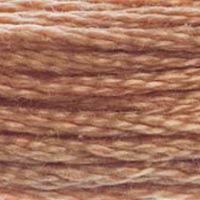
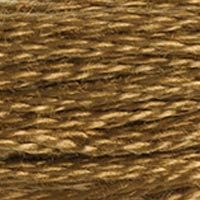
There's a reason DMC named this one Cocoa and not just "brown." Pull a strand of 407 out of the skein and what you're looking at isn't earth or bark or leather — it's the color of hot chocolate that's been stirred just enough to blend in the milk, the inside of a ceramic mug stained by years of morning cocoa, the dusty surface of a truffle before you bite into it. It's a pink-toned brown with a softness that most browns lack, a warmth that comes from the red-pink family rather than the orange-gold family. If brown is the color of the ground, 407 is the color of the cup of cocoa you drink while looking at the ground through a frosty window.
That pink undertone places 407 in interesting territory. It sits at the border between the brown family and the flesh/skin tone range, which gives it remarkable versatility. In a landscape, it can read as a warm, slightly rosy clay or sandstone. In a portrait, it might be a shadow tone for lighter skin. In a still life, it's the body of a terracotta pot. In a primitive folk art sampler, it's one of those beautifully ambiguous tones that could be faded red or aged brown, exactly the kind of color that antique samplers develop as their original red dyes oxidize over centuries.
Teddy Bears and the Art of Stitching Softness
Cross-stitch teddy bear patterns are a genre unto themselves — birth samplers, nursery designs, children's room art — and DMC 407 is one of the essential teddy bear browns. Unlike the harder, more saturated browns like 434 or 801, 407 has that rosy, soft quality that reads as "plush" rather than "wooden." It's the difference between stitching something that looks like a carved bear and something that looks like a bear you'd want to hug.
For a classic teddy bear, use 407 as the mid-tone body color, with DMC 632 (Ultra Very Dark Desert Sand) for the shadows under the arms and behind the ears, DMC 842 (Very Light Beige Brown) for the lighter belly and inner ear areas, and DMC 950 (Light Desert Sand) for the muzzle and paw pads. The pink undertone in 407 ties it naturally to the pinkish paw pads and inner ears, creating a palette that looks cohesive rather than assembled from unrelated browns. This is why experienced pattern designers choose 407 over a more neutral brown for stuffed animal fur — it creates visual harmony across the warm, cuddly areas of the design.
Folk Art and Faded Red Traditions
In reproduction sampler stitching — recreating antique needlework from the 17th, 18th, and 19th centuries — DMC 407 serves a fascinating role as a stand-in for faded red. Many antique samplers that look predominantly brown today were actually stitched in reds that degraded over time. The silk and wool dyes used for red were often madder-based, and exposure to light and air caused them to shift from true red toward a rosy brown that looks remarkably like DMC 407. Reproduction sampler designers who want that authentic "aged" appearance without waiting two hundred years reach for threads in this zone.
Pair 407 with DMC 3064 (Desert Sand) and DMC 3773 (Medium Desert Sand) for a three-step palette that captures the full range of "red that has become brown." Add DMC 3781 (Dark Mocha Brown) for the darker motifs and DMC 3033 (Very Light Mocha Brown) for background elements, and you've assembled a palette that would look at home on the wall of a historical society museum. The whole approach to primitive samplers leans on these ambiguous, warm-cool browns that carry the ghost of their original red.
On fabric choice, 407 looks its best on natural linen or oatmeal-colored Aida, where its pink-brown tone harmonizes with the warm fabric color. On stark white, the pink undertone can become unexpectedly prominent, making the thread look more like a dusty rose than a cocoa brown. This isn't necessarily bad — it depends on the effect you want — but it's a real shift in character worth being aware of before you start a large project.
Matching the Pink in the Brown
The critical quality in DMC 407 is that pink-brown softness. A standard medium brown — even at exactly the right value — will look fundamentally different because it lacks the rosy undertone. Your substitute needs to feel warm and slightly pink, not warm and golden or warm and orange.
Anchor 914 is an exact match and handles this beautifully — the pink-brown character comes through clearly, and dye lot consistency is generally good. Madeira 2312 is equally exact and carries the cocoa warmth faithfully. At this value level, where the pink is subtle rather than obvious, Madeira's slightly different sheen doesn't alter the color character meaningfully.
Cosmo 425 is rated close and usually works well, though Cosmo threads can occasionally shift slightly toward a more neutral brown, losing a touch of the pink. If you're using 407 as part of a teddy bear or skin tone palette where the pink undertone is functionally important, verify your Cosmo substitute in context rather than just comparing skeins. Sullivans 45088 is in the neighborhood — hold it against your fabric and check specifically for that pink warmth.
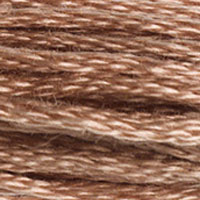
Within the DMC range, DMC 3064 (Desert Sand) is 407's closest relative — both share that pink-brown DNA, though 3064 is a step lighter and slightly more grey. DMC 3773 (Medium Desert Sand) is another sibling with similar warmth. Don't substitute with DMC 434 (Light Brown) or DMC 435 (Very Light Brown), which are similarly valued but completely different in undertone — those are golden-warm browns, and the pink-to-gold shift will be immediately visible in any design where the undertone matters.
Reference quality
How We Validate This Color Record
Use this page as a reference card for DMC 407: the structured data, quick conversions, and long-form copy are all tied back to the same stored color record.
- Methodology
- This page renders DMC 407, its hex value, and every brand equivalent from the site's source-of-truth color record, then checks long-form body copy against those same stored fields.
- Verification status
- Source-field checked. The page content is audited against the stored DMC number, brand equivalents, and match-quality labels before publishing.
- Last reviewed
- 2026-04-20
- Approximation warning
- Screen hex values, thread photos, and cross-brand conversions are reference aids. Dye lots, thread sheen, and fabric color can still shift the result in hand.
Decision guide
When to use the DMC 407 reference page
This page should help you decide faster between palette planning, brand substitution, and shade comparison without turning the color record into a thin lookup page.
Best for
- + Palette planning when you want the stored DMC 407 Medium Cocoa record, hex value #BB8161, and linked brand equivalents in one place.
- + Checking the quickest cross-brand shortlist before you buy floss, compare stash substitutes, or route into a more specific conversion page.
- + Finding nearby shades in the browns family before you commit to accents, shading, or background blends.
Watch for
- ! Screen previews are only reference aids. Medium Cocoa can shift on real fabric because thread sheen, stitch coverage, and room lighting change how the color reads.
- ! A stored equivalent is still a shortlist, not a guarantee that two brands will disappear into each other in the same stitched motif.
- ! Older charts, discontinued kit floss, and dye-lot variation can all introduce small but visible differences that the page cannot detect for you.
Before you commit
- Confirm the role of DMC 407 Medium Cocoa: decide whether you need an exact hero shade, a forgiving background, or a rough stash substitute.
- Compare on project fabric: view the skein or stitched sample on the same fabric count and color you will actually use.
- Use the linked conversion pages next: open the brand-specific pages when you need match-quality caveats before substituting away from the DMC reference.
DMC 407 FAQ
These questions appear on the page so the FAQ schema stays aligned with what visitors can actually read.
What is the Anchor equivalent of DMC 407?+
The closest Anchor equivalent to DMC 407 (Medium Cocoa) is Anchor 914. This is an exact match.
What color is DMC 407?+
DMC 407 is called "Medium Cocoa" and has a hex color value of #BB8161. It belongs to the browns color family.
What is the Madeira equivalent of DMC 407?+
The closest Madeira equivalent to DMC 407 (Medium Cocoa) is Madeira 2312. This is a close match.
How DMC 407 Looks on Fabric
The same thread appears different depending on your fabric. Always test on your project fabric.
White Aida
Cream / Ecru
Black Aida
Pairs Well With
DMC colors commonly used alongside 407 Medium Cocoa.
Suggested Palette

Shading Companions

Detailed Conversions
Where to Buy DMC 407
This section contains affiliate links. We may earn a small commission at no cost to you.
Related Guides
Free Printable Thread Conversion Chart
Pick a brand, enter your email, and we'll send you a printable chart mapping all 552 DMC colors to that brand's equivalents. Zero spam, one chart.
Thanks! Here's your free chart:
Download Your ChartOpens in a new tab. Use your browser's Print → Save as PDF.
No spam. Your email is stored securely and never shared.