
Quick Conversion Table
| Brand | Equivalent | Match |
|---|---|---|
| Anchor | 230 | exact |
| Madeira | 1301 | close |
| Cosmo ⚠ | 338 | close |
| Sullivans | 45258 | close |
| J&P Coats | 6031 | close |
| Dimensions | 16031 | close |
| Bucilla | 2763 | close |
| Candamar | 6054 | close |
Most discussions of the DMC Emerald Green family focus on DMC 909 (the darkest) or DMC 912 (the lightest) because they occupy the dramatic ends of the gradient. DMC 910 Dark Emerald Green, one step up from the darkest, is the color that actually does the heavy lifting — it covers the large shadow-to-mid-tone transition zones that constitute most of the foliage in a typical design. Understanding 910 as a workhorse rather than a feature color changes how you think about using it.
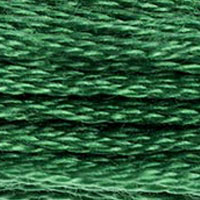
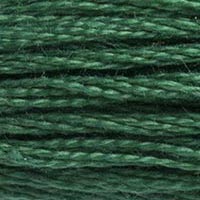
At #187E56, this is an unmistakably emerald shade — rich, saturated, and green without any yellow-green or blue-green distraction. It sits right in the center of what most people picture when they think "dark green": deep enough to suggest shadow and depth, bright enough to read as green rather than as a dark neutral. The saturation level is high enough that 910 fills fabric coverage impressively, even at lower stitch densities.
Foliage Work: The Practical Reality
In any design with substantial green foliage — and there are a lot of them, from Christmas patterns to garden scenes to forest landscapes — the stitcher typically goes through far more of the second-darkest green than any other shade in the family. The very darkest goes only into the deepest shadows; the very lightest touches only the brightest highlights. Everything in between — the sides of leaves, the bases of stems, the mid-body of grass blades — gets filled with the 910 and 911 range.
This means 910 is a color worth stocking in bulk if you work on large or complex nature-themed designs. Running out of your main fill green partway through a WIP is one of the more frustrating experiences in the hobby — especially if the dye lot changes between your original skein and a new purchase. When your pattern calls for 910 as a primary fill, buying extra at the outset is simply practical.
For stitchers who use parking extensively in cross-country work, managing the 910 needle is part of the rhythm of a foliage-heavy design. The color shows up in enough places that you'll be moving it frequently — which is actually a good argument for completing some areas before parking becomes necessary, reducing the total number of parked needles competing for real estate in the fabric.
Cross-Stitch Patterns and Emerald
DMC 910 appears in a broad range of commercial pattern types. It's a reliable indicator thread in many floss organizer card systems precisely because it's so commonly called for. Nature and wildlife patterns use it extensively: bird plumage, fish scales, reptile skin, leaf fills, grass bases. Holiday designs reach for it in Christmas wreaths, holiday trees, and winter botanical arrangements. It even shows up in Celtic and knot designs where a rich emerald feel is appropriate.
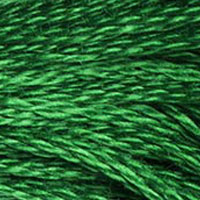
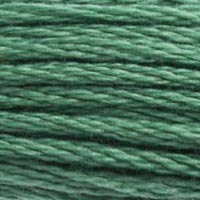
Pairing 910 with DMC 909 (Very Dark Emerald Green) in the shadows and DMC 911 (Medium Emerald Green) in the lighter zones creates a clean three-step shading that handles most foliage rendering tasks. Adding DMC 912 (Light Emerald Green) extends the range for more detailed work or for capturing the effect of full sunlight on leaf surfaces. Adding DMC 3818 (Ultra Very Dark Emerald Green) at the darkest end creates an even more dramatic range for large-scale pieces.
Anchor 230 and Madeira 1301 both carry exact ratings for DMC 910, making it one of the better-supported dark greens for brand substitution. The full Anchor Emerald Green sequence (230, 230, 205, 209) maps reliably to the DMC 909–338 range, which simplifies thread sourcing for stitchers who use Anchor primarily or who shop internationally where DMC availability varies.
Anchor 230 is a trustworthy substitute. The color character is comparable, and it performs similarly in fill and backstitch roles. Madeira 1301 is also reliable and offers Madeira's characteristic excellent colorfastness — a meaningful advantage for pieces intended for long-term display or framing.
Cosmo 338 and Sullivans 45258 carry close ratings. Both read as dark emerald green in the right territory but may not precisely match DMC 910's specific shade. For large fill areas where 910 is the dominant color of the design, a test area before committing is worthwhile — the difference between close and exact can be more visible in large fills than in small accents.
Within the DMC range, if 910 is unavailable, its immediate neighbors — DMC 909 (one step darker) or DMC 911 (one step lighter) — are the closest alternatives. For fill purposes in a design where 910 carries a specific value step in a gradient, substituting an adjacent shade will affect the smoothness of the gradient but maintain the color family. DMC 699 (Christmas Green) is another option that shares the saturated emerald quality, though it's a slightly different shade.
Reference quality
How We Validate This Color Record
Use this page as a reference card for DMC 910: the structured data, quick conversions, and long-form copy are all tied back to the same stored color record.
- Methodology
- This page renders DMC 910, its hex value, and every brand equivalent from the site's source-of-truth color record, then checks long-form body copy against those same stored fields.
- Verification status
- Source-field checked. The page content is audited against the stored DMC number, brand equivalents, and match-quality labels before publishing.
- Last reviewed
- 2026-04-20
- Approximation warning
- Screen hex values, thread photos, and cross-brand conversions are reference aids. Dye lots, thread sheen, and fabric color can still shift the result in hand.
Decision guide
When to use the DMC 910 reference page
This page should help you decide faster between palette planning, brand substitution, and shade comparison without turning the color record into a thin lookup page.
Best for
- + Palette planning when you want the stored DMC 910 Dark Emerald Green record, hex value #187E56, and linked brand equivalents in one place.
- + Checking the quickest cross-brand shortlist before you buy floss, compare stash substitutes, or route into a more specific conversion page.
- + Finding nearby shades in the greens family before you commit to accents, shading, or background blends.
Watch for
- ! Screen previews are only reference aids. Dark Emerald Green can shift on real fabric because thread sheen, stitch coverage, and room lighting change how the color reads.
- ! A stored equivalent is still a shortlist, not a guarantee that two brands will disappear into each other in the same stitched motif.
- ! Older charts, discontinued kit floss, and dye-lot variation can all introduce small but visible differences that the page cannot detect for you.
Before you commit
- Confirm the role of DMC 910 Dark Emerald Green: decide whether you need an exact hero shade, a forgiving background, or a rough stash substitute.
- Compare on project fabric: view the skein or stitched sample on the same fabric count and color you will actually use.
- Use the linked conversion pages next: open the brand-specific pages when you need match-quality caveats before substituting away from the DMC reference.
DMC 910 FAQ
These questions appear on the page so the FAQ schema stays aligned with what visitors can actually read.
What is the Anchor equivalent of DMC 910?+
The closest Anchor equivalent to DMC 910 (Dark Emerald Green) is Anchor 230. This is an exact match.
What color is DMC 910?+
DMC 910 is called "Dark Emerald Green" and has a hex color value of #187E56. It belongs to the greens color family.
What is the Madeira equivalent of DMC 910?+
The closest Madeira equivalent to DMC 910 (Dark Emerald Green) is Madeira 1301. This is a close match.
How DMC 910 Looks on Fabric
The same thread appears different depending on your fabric. Always test on your project fabric.
White Aida
Cream / Ecru
Black Aida
Pairs Well With
DMC colors commonly used alongside 910 Dark Emerald Green.
Suggested Palette
Shading Companions
Detailed Conversions
Where to Buy DMC 910
This section contains affiliate links. We may earn a small commission at no cost to you.
Related Guides
Free Printable Thread Conversion Chart
Pick a brand, enter your email, and we'll send you a printable chart mapping all 552 DMC colors to that brand's equivalents. Zero spam, one chart.
Thanks! Here's your free chart:
Download Your ChartOpens in a new tab. Use your browser's Print → Save as PDF.
No spam. Your email is stored securely and never shared.