
Quick Conversion Table
| Brand | Equivalent | Match |
|---|---|---|
| Anchor | 877 | close |
| Madeira | 1703 | close |
| Cosmo ⚠ | 536 | close |
| Sullivans | 45412 | close |
| J&P Coats | 6876 | close |
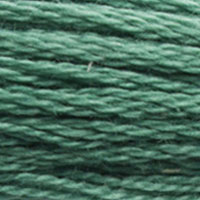
Celadon glaze — the grey-green that defines Song dynasty Chinese ceramics and Korean Goryeo pottery — is one of the most copied and admired surface treatments in the history of ceramics. The specific quality of celadon is its restraint: a soft, desaturated green that seems to glow with a self-contained luminosity, as if the light is coming from within the glaze rather than reflecting off the surface. DMC has captured this quality across a small family of celadon greens, and DMC 3815, Dark Celadon Green, provides the deepest value in that family. At hex #477759, it's a rich, muted dark green with a subtle gray-blue undertone that keeps it from reading as simply 'dark forest green.'
The celadon quality — that gray-green restraint — comes from 3815's balance between green and gray. It's never pure green; there's always a muting element that prevents vividness in favor of depth. This makes it a sophisticated color: it doesn't shout, it resonates.
East Asian-Inspired Design
For cross-stitch designs drawing on East Asian aesthetics — Chinese palace embroidery traditions, Japanese ink-painting-inspired pieces, Korean folk motifs — the celadon family is an essential color range. DMC 3815 specifically provides the depth that makes these pieces feel authentically inspired rather than superficially themed. Bamboo designs, chrysanthemum patterns, koi pond water, and crane feather detailing all use this specific quality of muted dark green.
Traditional Chinese cross-stitch patterns (十字绣) and Japanese sashiko-influenced designs frequently use the celadon range as a primary color family. In these contexts, 3815's relative restraint compared to Western emerald greens reads as culturally appropriate — it's a green that belongs to a tradition of refined naturalism rather than decorative vibrancy.
Botanical and Garden Foliage
In Western cross-stitch botanical work, 3815 functions as a shadow foliage color for plants with blue-green leaves: hostas in their deepest shadow areas, blue cedar foliage, glaucous-leaved garden plants. It's the green that says 'silver-leaved plant in shadow' rather than 'standard green in shadow' — a distinction that matters in botanically accurate rendering.
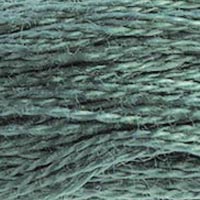
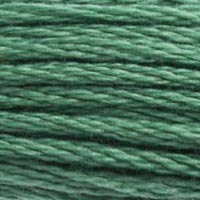
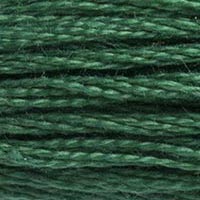
For herb garden samplers — a classic and enduring cross-stitch genre — sage, rosemary, and lavender foliage can use 3815 for their darker areas. These silver-green herbs have a specific muted quality in their shadows that warmer, more saturated greens can't capture. Paired with DMC 3816 (Celadon Green) for midtones and DMC 3817 (Light Celadon Green) for highlights, you can build convincing herb foliage that retains the plants' characteristic blue-gray quality throughout the shading sequence.
In fern designs, 3815 handles the heavily-shaded frond areas where the fern's deep color shows its full complexity. Combine it with DMC 3816 for the main frond color and DMC 3817 for the lightest frond tips to achieve that distinctive fern coloring that reads as genuinely botanical.
On linen especially, DMC 3815's restrained dark-green quality reads as particularly distinguished. The thread's muting sits in conversation with linen's natural warmth in a way that creates visual depth without harshness. Stitchers who work primarily on natural or antique white evenweave often find celadon greens more pleasing on their fabric than the bolder greens — and 3815 at the dark end of the family gives you the shadow values you need without the jarring quality that saturated forest greens can have against a warm linen background.
Madeira 1703 is an exact match for DMC 3815 — the celadon family is one where Madeira's matching quality is particularly reliable, making it a confident choice for projects where the specific celadon character matters. For East Asian-inspired or botanical work where 3815's restrained dark green is central to the design's success, Madeira 1703 is the substitute to trust.
Anchor 877 is rated close and sits slightly differently in the green spectrum — some stitchers report it as slightly more yellow-green, others as slightly more saturated. The celadon quality (that muting gray undertone) can be slightly reduced in the Anchor equivalent, which gives it a touch more vividity than DMC 3815 in direct comparison. In East Asian-inspired work where the restraint is important, this can matter. In botanical shadow work, it usually doesn't.
Cosmo 536 and Sullivans 45412 are both rated close and are workable in most applications.
Within the DMC range, the celadon family completes itself nicely: DMC 3816 (Celadon Green) and DMC 3817 (Light Celadon Green) are the lighter family members, providing the complete value range for the color. Outside the celadon family, DMC 502 (Blue Green) covers adjacent dark blue-green territory with slightly more blue than 3815. DMC 501 (Dark Blue Green) goes darker and more distinctly blue-green. DMC 3051 (Dark Green Gray) provides a cooler, more gray-green alternative in the dark range.
Reference quality
How We Validate This Color Record
Use this page as a reference card for DMC 3815: the structured data, quick conversions, and long-form copy are all tied back to the same stored color record.
- Methodology
- This page renders DMC 3815, its hex value, and every brand equivalent from the site's source-of-truth color record, then checks long-form body copy against those same stored fields.
- Verification status
- Source-field checked. The page content is audited against the stored DMC number, brand equivalents, and match-quality labels before publishing.
- Last reviewed
- 2026-04-20
- Approximation warning
- Screen hex values, thread photos, and cross-brand conversions are reference aids. Dye lots, thread sheen, and fabric color can still shift the result in hand.
Decision guide
When to use the DMC 3815 reference page
This page should help you decide faster between palette planning, brand substitution, and shade comparison without turning the color record into a thin lookup page.
Best for
- + Palette planning when you want the stored DMC 3815 Dark Celadon Green record, hex value #477759, and linked brand equivalents in one place.
- + Checking the quickest cross-brand shortlist before you buy floss, compare stash substitutes, or route into a more specific conversion page.
- + Finding nearby shades in the greens family before you commit to accents, shading, or background blends.
Watch for
- ! Screen previews are only reference aids. Dark Celadon Green can shift on real fabric because thread sheen, stitch coverage, and room lighting change how the color reads.
- ! A stored equivalent is still a shortlist, not a guarantee that two brands will disappear into each other in the same stitched motif.
- ! Older charts, discontinued kit floss, and dye-lot variation can all introduce small but visible differences that the page cannot detect for you.
Before you commit
- Confirm the role of DMC 3815 Dark Celadon Green: decide whether you need an exact hero shade, a forgiving background, or a rough stash substitute.
- Compare on project fabric: view the skein or stitched sample on the same fabric count and color you will actually use.
- Use the linked conversion pages next: open the brand-specific pages when you need match-quality caveats before substituting away from the DMC reference.
DMC 3815 FAQ
These questions appear on the page so the FAQ schema stays aligned with what visitors can actually read.
What is the Anchor equivalent of DMC 3815?+
The closest Anchor equivalent to DMC 3815 (Dark Celadon Green) is Anchor 877. This is a close match.
What color is DMC 3815?+
DMC 3815 is called "Dark Celadon Green" and has a hex color value of #477759. It belongs to the greens color family.
What is the Madeira equivalent of DMC 3815?+
The closest Madeira equivalent to DMC 3815 (Dark Celadon Green) is Madeira 1703. This is a close match.
How DMC 3815 Looks on Fabric
The same thread appears different depending on your fabric. Always test on your project fabric.
White Aida
Cream / Ecru
Black Aida
Pairs Well With
DMC colors commonly used alongside 3815 Dark Celadon Green.
Suggested Palette
Shading Companions
Detailed Conversions
Where to Buy DMC 3815
This section contains affiliate links. We may earn a small commission at no cost to you.
Related Guides
Free Printable Thread Conversion Chart
Pick a brand, enter your email, and we'll send you a printable chart mapping all 552 DMC colors to that brand's equivalents. Zero spam, one chart.
Thanks! Here's your free chart:
Download Your ChartOpens in a new tab. Use your browser's Print → Save as PDF.
No spam. Your email is stored securely and never shared.