
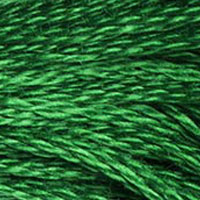
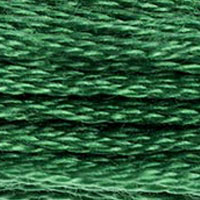
DMC 909 — Very Dark Emerald Green
Greens family · Hex #156F49
Quick Conversion Table
| Brand | Equivalent | Match |
|---|---|---|
| Anchor | 923 | exact |
| Madeira | 1302 | close |
| Cosmo ⚠ | 338 | close |
| Sullivans | 45257 | close |
| J&P Coats | 6228 | close |
| Dimensions | 16031 | close |
| Bucilla | 321 | close |
| Candamar | 6053 | close |
Emerald has a particular visual weight that most greens don't. It's not just about saturation — it's about the combination of depth and clarity that makes the color feel simultaneously rich and luminous. DMC 909 Very Dark Emerald Green captures the shadow side of that quality: not the gem itself, but the deep interior of the gem, where light has penetrated far enough to become colored but not enough to emerge bright. It's a forest-floor green, a deep-water-weed green, the green inside a glass bottle held up to weak winter light.
In the DMC Emerald Green family — 909 (Very Dark), DMC 910 (Dark), DMC 911 (Medium), DMC 912 (Light) — 909 anchors the shadow end. The jumps between steps in this family are relatively even, giving you a clean four-stop shading gradient that works reliably for leaves, grass, evergreen foliage, and any subject that needs true rich green rather than a yellow-green or blue-green variant. The family is cooler than the Parrot Greens but warmer than the Hunter Greens — it sits in what you might call the most conventionally "green" part of the spectrum.
The Shadow Work Role
In needle painting and thread painting applications, very dark shadow colors do specific work: they create the illusion of depth by suggesting that light simply doesn't reach certain recesses. DMC 909 performs this function beautifully. In a realistic rose design, 909 goes into the deepest recesses between petals (even on red roses — dark green in shadow reads as shadow, not as green). In ivy or climbing vine designs, it occupies the stems and leaf undersides where the foliage overlaps and light is blocked.
For stitchers who enjoy the blackwork and voided work traditions, 909 is an interesting alternative to DMC 310 (Black) for designs where a very dark green reads more appropriately than pure black — historical botanical specimens, forest scenes, wildlife subjects. The depth is comparable to black at normal viewing distances while maintaining chromatic warmth.
Backstitching with 909 on green-toned fills is often preferable to using black. For designs with foliage, ferns, or plant elements, using 909 for the outline backstitch keeps the green family cohesive rather than introducing the visual interrupt of a neutral. It reads as shadow rather than as contour line, which produces a more naturalistic result in botanical subjects.
Emerald in Seasonal and Cultural Context
Emerald green has strong cultural resonances — Irish national identity, St. Patrick's Day, the Emerald City of Oz, certain strands of environmental imagery. DMC 909 and its family handle all of these applications with authority. For Celtic and Irish-themed designs, the darker members of this family feel more authentic than the brighter Parrot Greens; there's something appropriately serious and rooted about the depth of 909 in a Celtic knotwork border.
Christmas designs frequently use the emerald family for their primary evergreen elements. Holly leaves, Christmas trees, and wreaths rendered in the 909–912 gradient have the dimensional quality that single-color green fills lack. Pairing 909 with DMC 321 (Christmas Red) for the classic holiday combination works particularly well because 909's depth brings out the warmth of the red rather than competing with it.
Anchor 923 and Madeira 1302 both carry exact ratings for DMC 909, making this a well-supported color for brand substitution. Anchor's Emerald Green family (923, 229, 205, 209) provides a complete parallel to the DMC 909–912 range, which is convenient for anyone building the complete shading gradient from a single brand.
Anchor 923 performs reliably as a substitute in both fill and backstitch applications. One thing worth noting: Anchor thread has a slightly different sheen character than DMC, and with a very dark color like 909, this can affect how the thread reads in directional light. In designs where thread direction is carefully managed — railroading for smooth coverage, specific directional runs in thread painting — testing the Anchor version before committing is worthwhile.
Madeira 1302 is an equally strong substitute, with Madeira's silk-finish quality giving emerald shades a particular luminosity that some stitchers prefer for jewel-toned subjects. Cosmo 338 and Sullivans 45257 carry close ratings and perform adequately for most applications, though the precise depth and saturation of DMC 909 may not be exactly replicated.
If DMC 909 is unavailable and you must stay within DMC, DMC 890 (Ultra Dark Pistachio Green) is a comparable very dark green with a slightly cooler, bluer character. DMC 3818 (Ultra Very Dark Emerald Green) is even darker and useful when 909 feels too light for the deepest shadow areas. For most practical shadow work, either of these adjacent dark greens will fill the role.
Reference quality
How We Validate This Color Record
Use this page as a reference card for DMC 909: the structured data, quick conversions, and long-form copy are all tied back to the same stored color record.
- Methodology
- This page renders DMC 909, its hex value, and every brand equivalent from the site's source-of-truth color record, then checks long-form body copy against those same stored fields.
- Verification status
- Source-field checked. The page content is audited against the stored DMC number, brand equivalents, and match-quality labels before publishing.
- Last reviewed
- 2026-04-20
- Approximation warning
- Screen hex values, thread photos, and cross-brand conversions are reference aids. Dye lots, thread sheen, and fabric color can still shift the result in hand.
Decision guide
When to use the DMC 909 reference page
This page should help you decide faster between palette planning, brand substitution, and shade comparison without turning the color record into a thin lookup page.
Best for
- + Palette planning when you want the stored DMC 909 Very Dark Emerald Green record, hex value #156F49, and linked brand equivalents in one place.
- + Checking the quickest cross-brand shortlist before you buy floss, compare stash substitutes, or route into a more specific conversion page.
- + Finding nearby shades in the greens family before you commit to accents, shading, or background blends.
Watch for
- ! Screen previews are only reference aids. Very Dark Emerald Green can shift on real fabric because thread sheen, stitch coverage, and room lighting change how the color reads.
- ! A stored equivalent is still a shortlist, not a guarantee that two brands will disappear into each other in the same stitched motif.
- ! Older charts, discontinued kit floss, and dye-lot variation can all introduce small but visible differences that the page cannot detect for you.
Before you commit
- Confirm the role of DMC 909 Very Dark Emerald Green: decide whether you need an exact hero shade, a forgiving background, or a rough stash substitute.
- Compare on project fabric: view the skein or stitched sample on the same fabric count and color you will actually use.
- Use the linked conversion pages next: open the brand-specific pages when you need match-quality caveats before substituting away from the DMC reference.
DMC 909 FAQ
These questions appear on the page so the FAQ schema stays aligned with what visitors can actually read.
What is the Anchor equivalent of DMC 909?+
The closest Anchor equivalent to DMC 909 (Very Dark Emerald Green) is Anchor 923. This is an exact match.
What color is DMC 909?+
DMC 909 is called "Very Dark Emerald Green" and has a hex color value of #156F49. It belongs to the greens color family.
What is the Madeira equivalent of DMC 909?+
The closest Madeira equivalent to DMC 909 (Very Dark Emerald Green) is Madeira 1302. This is a close match.
How DMC 909 Looks on Fabric
The same thread appears different depending on your fabric. Always test on your project fabric.
White Aida
Cream / Ecru
Black Aida
Pairs Well With
DMC colors commonly used alongside 909 Very Dark Emerald Green.
Detailed Conversions
Where to Buy DMC 909
This section contains affiliate links. We may earn a small commission at no cost to you.
Related Guides
Free Printable Thread Conversion Chart
Pick a brand, enter your email, and we'll send you a printable chart mapping all 552 DMC colors to that brand's equivalents. Zero spam, one chart.
Thanks! Here's your free chart:
Download Your ChartOpens in a new tab. Use your browser's Print → Save as PDF.
No spam. Your email is stored securely and never shared.