
Quick Conversion Table
| Brand | Equivalent | Match |
|---|---|---|
| Anchor | 889 | exact |
| Madeira | 2107 | close |
| Cosmo ⚠ | 311 | close |
| Sullivans | 45143 | close |
| J&P Coats | 5889 | close |
| Dimensions | 15889 | close |
| Bucilla | 3610 | close |
The Color of Drab Cloth: A Military History in Thread
Before "drab" became an insult meaning dull or boring, it was a word with real specificity. Drab was a thick, undyed woolen cloth — olive-tinted, brownish, unremarkable by design — used for military uniforms from the 18th century onward. British soldiers in the Napoleonic Wars wore drab. American frontier troops wore drab. The whole point was a color that didn't stand out, that blended into mud and field and hillside. DMC 610 is, quite literally, the color of drab cloth. And understanding that heritage changes how you see this thread.
This isn't a brown that failed to be interesting. It's a brown that succeeds at something most colors can't do: disappear into a composition while quietly holding everything together. That olive-green undertone — not enough to make it green, but enough to pull it away from the clean, warm browns — gives 610 a complexity that reads as genuinely organic. This is decomposing leaf litter. Dried mud on a boot. The underside of bark. Stone walls in overcast light. It's the color your eye slides over in a landscape scene, which is exactly why the landscape scene works.
Experienced stitchers — the ones with stash boxes organized by undertone rather than just color family — learn to love threads like 610. They're the mortar between the bricks. You might never pick 610 as a favorite color, but pull it out of a well-designed nature palette and the whole thing falls apart. Suddenly your greens don't connect to your browns, your path doesn't meet your meadow, and your tree trunks are floating above the ground instead of growing out of it.
Landscapes, Samplers, and the Art of Blending In
Where 610 truly earns its keep is in transitional areas — those in-between spaces where one element of a design meets another. The base of a grassy hillside where earth shows through. A dirt path winding through a green field. The shadow side of a hay bale. Stone cottage walls before you add the highlight stitches. In all these contexts, 610 mediates between the pure browns and pure greens in your palette, smoothing transitions that would otherwise look abrupt.
For landscape work on 18-count or higher, 610 benefits from careful attention to strand count and tension. Two strands give you good coverage on 14-count Aida, but on 18-count you'll want to railroad consistently to keep the stitches flat and even — the olive undertone can look muddy if your strands twist and create uneven light reflection. On 28-count linen over two, 610 is a dream: the natural linen color harmonizes with the thread's earthy quality in a way that white Aida simply can't match.
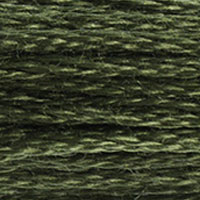
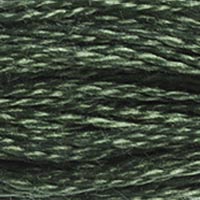
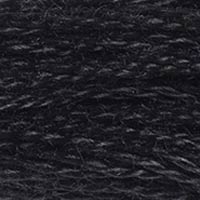
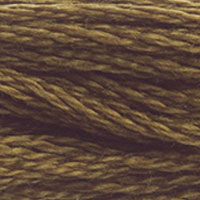
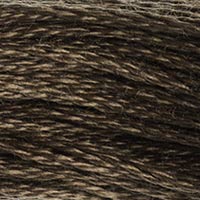
The drab brown family — 610, 611, and 612 — gives you a ready-made three-value gradient for muted earth tones. Use all three together for dry fields, sandy paths, or dormant winter grass. Extend the range by adding DMC 3787 (Dark Brown Grey) at the shadow end and DMC 3047 (Light Yellow Beige) at the highlight end for a five-step progression that handles everything from deep shade to sunlit ground. For primitive or folk art samplers, pair the 610 family with DMC 3011 and 3012 (the khaki greens) and DMC 3781 (Dark Mocha Brown) for an authentically aged, naturally-dyed look that reproduction sampler designers reach for constantly.
If you're working a SAL with a nature or landscape theme and the thread list includes 610, don't skip it or swap it for a warmer brown thinking it won't matter. It will matter. That slight olive cast is doing real work in the overall color harmony, even if you can't quite articulate what it's doing until you see the finished piece.
Preserving the Olive Undertone in DMC 610 Substitutes
Most browns are warm. Most brown substitution mistakes involve swapping a warm brown for a cool one, or vice versa. With 610, the issue is more nuanced: you need to match that specific olive-grey muting that makes drab brown drab. A clean, warm brown — even at the right value — will stick out in a palette designed around 610's quiet complexity.
Both Anchor 889 and Madeira 2107 are rated exact matches, and both deliver. Anchor 889 nails the olive quality with impressive consistency between dye lots, making it the substitute I'd recommend first if you're working a historical sampler where the muted earth-tone palette is the entire aesthetic. Madeira 2107 is equally faithful to the hue, and Madeira's slightly silkier finish doesn't alter the color's character at this value — the greyed-down, matte quality of the shade absorbs sheen differences that might be more visible in a brighter thread.
Cosmo 311 gets you into the neighborhood but may drift slightly toward pure brown, losing a touch of that green-olive complexity. For a landscape design where 610 is one thread among many earth tones, this drift is unlikely to cause problems — the surrounding colors will contextualize it. But if you're stitching a primitive sampler where the drab family (610, 611, 612) carries the entire palette, test Cosmo 311 against your other drab shades before committing. The family coherence matters more than any single thread's accuracy.
Sullivans 45143 captures the general territory. The main question with any substitute at this color is whether the grey muting is achieved the same way — some brands darken their browns by deepening the pigment rather than greying it out, and the results look different even at matching values. Hold your candidate substitute against a scrap of the fabric you're using, in natural light, before you stitch a single cross.
One tempting but risky swap within the DMC range: don't reach for DMC 3011 (Dark Khaki Green) as a stand-in. They share genetic material — both live in that olive-brown borderland — but 3011 reads as a green that happens to be warm, while 610 reads as a brown that happens to have green. In a landscape, that distinction controls whether an area looks like earth or vegetation, and getting it wrong will confuse the eye. Similarly, DMC 640 (Very Dark Beige Grey) might seem close, but it lacks the olive character entirely and skews cool grey-brown instead.
Reference quality
How We Validate This Color Record
Use this page as a reference card for DMC 610: the structured data, quick conversions, and long-form copy are all tied back to the same stored color record.
- Methodology
- This page renders DMC 610, its hex value, and every brand equivalent from the site's source-of-truth color record, then checks long-form body copy against those same stored fields.
- Verification status
- Source-field checked. The page content is audited against the stored DMC number, brand equivalents, and match-quality labels before publishing.
- Last reviewed
- 2026-04-20
- Approximation warning
- Screen hex values, thread photos, and cross-brand conversions are reference aids. Dye lots, thread sheen, and fabric color can still shift the result in hand.
Decision guide
When to use the DMC 610 reference page
This page should help you decide faster between palette planning, brand substitution, and shade comparison without turning the color record into a thin lookup page.
Best for
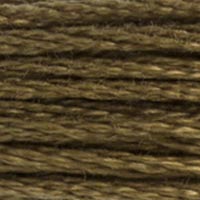
- + Palette planning when you want the stored DMC 610 Dark Drab Brown record, hex value #796047, and linked brand equivalents in one place.
- + Checking the quickest cross-brand shortlist before you buy floss, compare stash substitutes, or route into a more specific conversion page.
- + Finding nearby shades in the browns family before you commit to accents, shading, or background blends.
Watch for
- ! Screen previews are only reference aids. Dark Drab Brown can shift on real fabric because thread sheen, stitch coverage, and room lighting change how the color reads.
- ! A stored equivalent is still a shortlist, not a guarantee that two brands will disappear into each other in the same stitched motif.
- ! Older charts, discontinued kit floss, and dye-lot variation can all introduce small but visible differences that the page cannot detect for you.
Before you commit
- Confirm the role of DMC 610 Dark Drab Brown: decide whether you need an exact hero shade, a forgiving background, or a rough stash substitute.
- Compare on project fabric: view the skein or stitched sample on the same fabric count and color you will actually use.
- Use the linked conversion pages next: open the brand-specific pages when you need match-quality caveats before substituting away from the DMC reference.
DMC 610 FAQ
These questions appear on the page so the FAQ schema stays aligned with what visitors can actually read.
What is the Anchor equivalent of DMC 610?+
The closest Anchor equivalent to DMC 610 (Dark Drab Brown) is Anchor 889. This is an exact match.
What color is DMC 610?+
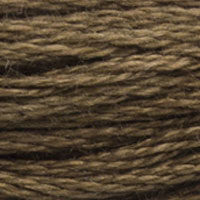
DMC 610 is called "Dark Drab Brown" and has a hex color value of #796047. It belongs to the browns color family.
What is the Madeira equivalent of DMC 610?+
The closest Madeira equivalent to DMC 610 (Dark Drab Brown) is Madeira 2107. This is a close match.
How DMC 610 Looks on Fabric
The same thread appears different depending on your fabric. Always test on your project fabric.
White Aida
Cream / Ecru
Black Aida
Pairs Well With
DMC colors commonly used alongside 610 Dark Drab Brown.
Suggested Palette
Shading Companions
Detailed Conversions
Where to Buy DMC 610
This section contains affiliate links. We may earn a small commission at no cost to you.
Related Guides
Free Printable Thread Conversion Chart
Pick a brand, enter your email, and we'll send you a printable chart mapping all 552 DMC colors to that brand's equivalents. Zero spam, one chart.
Thanks! Here's your free chart:
Download Your ChartOpens in a new tab. Use your browser's Print → Save as PDF.
No spam. Your email is stored securely and never shared.