
Quick Conversion Table
| Brand | Equivalent | Match |
|---|---|---|
| Anchor | 926 | exact |
| Madeira | 1908 | close |
| Cosmo ⚠ | 1000 | close |
| Sullivans | 45165 | close |
| J&P Coats | 1002 | close |
| Dimensions | 6155 | close |
| Bucilla | 1712 | close |
| Candamar | 6275 | close |
The community debate around DMC 712 Cream is simple but persistent: when should you use Cream instead of Ecru (DMC 3033), and when should you use it instead of Blanc or DMC 3865 Ultra White? The answer matters more than it might seem, because at this pale end of the value range, temperature differences between near-whites are the most obvious they'll ever be. Cream reads warm. Ecru reads slightly warmer still. Blanc reads cool. Understanding where each sits is the key to not accidentally making your white snowflakes read pink or your antique lace read blue.
The Temperature of Pale
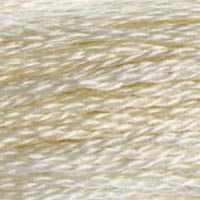
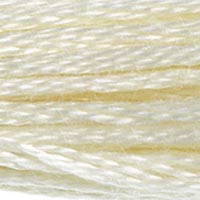
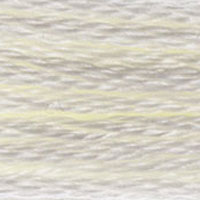
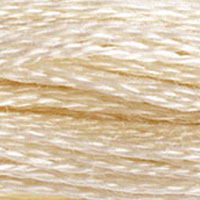
DMC 712's hex value #FFFBEF tells the story clearly: very high red and green values, slightly lower blue, creating a warm, slightly yellow-tinged off-white. The warmth is subtle enough that stitchers sometimes reach for 712 thinking it's essentially white, only to find on the finished piece that it reads cream next to their other whites. This isn't a flaw — it's the point. That warmth is what makes 712 look like actual cream fabric, actual antique lace, actual old ivory rather than bleached-white modern material.
On warm-toned fabrics like natural or antique linen, 712 almost merges with the ground fabric, creating areas that read as texture without strong color contrast. This effect is deliberate in certain hardanger and whitework traditions where the interplay of stitched and unstitched areas is the design. On white Aida, 712 asserts itself clearly as a warm cream tone, reading unmistakably warmer than Blanc and only slightly lighter and less golden than Ecru.
Whitework, Hardanger, and Traditional Applications
Traditional whitework embroidery — including Mountmellick work, Hedebo, and pulled-thread work — is often executed in cream tones rather than stark white because cream reads as more elegant and less clinical on the finished piece. DMC 712 satisfies this requirement with a warmth that ages gracefully. In hardanger specifically, the satin stitch blocks in 712 on antique white evenweave catch light beautifully, with the warmth of the thread enhancing rather than fighting the fabric's natural tone.
Lace motifs in cross stitch and needlepoint frequently specify 712 for the lace elements because real lace is rarely true white — it oxidizes toward cream over time, and 712 captures that authenticity. Wedding samplers, christening records, and anniversary pieces often use 712 for the white elements specifically to evoke the warmth of real occasion textiles.
Background and Fill Applications
As a background fill color for pieces where you want a warm, aged-paper quality to the ground, 712 on linen creates something remarkably beautiful. The thread's warmth and the fabric's natural variation interact to produce a surface that suggests parchment or aged vellum. Over-two on 28-count natural linen in cream — particularly in the stab method, which gives even coverage — creates backgrounds for illuminated letter designs, heraldic pieces, and botanical illustrations that look as though they've always been there.
Pair DMC 712 with DMC 3866 Ultra Very Light Mocha Brown for the warmest highlight in a cream palette, and with DMC 822 Light Beige Gray for shadows in cream-on-cream sculptural effects. With DMC 677 Very Light Old Gold as an accent, it reads as antique gilt-and-cream — the palette of aged ceremonial textiles.
Anchor 926 is an exact match for DMC 712, which is particularly useful since "cream" is one of the most common thread requests across all embroidery styles, and having a reliable Anchor equivalent matters for stitchers who work from vintage or non-DMC patterns.
Madeira 1908, Cosmo 1000, and Sullivans 45165 all rate as close rather than exact. For a pale neutral like 712, "close" is usually more than adequate — the warmth and value are near enough that substitutions are rarely perceptible in finished work, especially since cream typically appears as a background or accent rather than a primary design color where tiny differences would show most clearly.
The more interesting substitution question for DMC 712 is within the DMC range: when should you use 712 rather than DMC 3865 Ultra White (cooler and slightly less warm), DMC Ecru (marginally darker and warmer), or DMC 3033 Very Light Mocha Brown (warmer and slightly more tan)? For true antique cream effects, 712 is usually the right call. For the lightest possible warm white, 3865 serves better. For aged tan effects, 3033 pushes further in that direction. If you run out of 712 mid-piece and can't source it immediately, Ecru is the most forgiving substitute — slightly darker and warmer, which usually blends passably into areas already worked in 712, especially in the English method where individual crosses are complete before the eye reads the total area.
Reference quality
How We Validate This Color Record
Use this page as a reference card for DMC 712: the structured data, quick conversions, and long-form copy are all tied back to the same stored color record.
- Methodology
- This page renders DMC 712, its hex value, and every brand equivalent from the site's source-of-truth color record, then checks long-form body copy against those same stored fields.
- Verification status
- Source-field checked. The page content is audited against the stored DMC number, brand equivalents, and match-quality labels before publishing.
- Last reviewed
- 2026-04-20
- Approximation warning
- Screen hex values, thread photos, and cross-brand conversions are reference aids. Dye lots, thread sheen, and fabric color can still shift the result in hand.
Decision guide
When to use the DMC 712 reference page
This page should help you decide faster between palette planning, brand substitution, and shade comparison without turning the color record into a thin lookup page.
Best for
- + Palette planning when you want the stored DMC 712 Cream record, hex value #FFFBEF, and linked brand equivalents in one place.
- + Checking the quickest cross-brand shortlist before you buy floss, compare stash substitutes, or route into a more specific conversion page.
- + Finding nearby shades in the neutrals family before you commit to accents, shading, or background blends.
Watch for
- ! Screen previews are only reference aids. Cream can shift on real fabric because thread sheen, stitch coverage, and room lighting change how the color reads.
- ! A stored equivalent is still a shortlist, not a guarantee that two brands will disappear into each other in the same stitched motif.
- ! Older charts, discontinued kit floss, and dye-lot variation can all introduce small but visible differences that the page cannot detect for you.
Before you commit
- Confirm the role of DMC 712 Cream: decide whether you need an exact hero shade, a forgiving background, or a rough stash substitute.
- Compare on project fabric: view the skein or stitched sample on the same fabric count and color you will actually use.
- Use the linked conversion pages next: open the brand-specific pages when you need match-quality caveats before substituting away from the DMC reference.
DMC 712 FAQ
These questions appear on the page so the FAQ schema stays aligned with what visitors can actually read.
What is the Anchor equivalent of DMC 712?+
The closest Anchor equivalent to DMC 712 (Cream) is Anchor 926. This is an exact match.
What color is DMC 712?+
DMC 712 is called "Cream" and has a hex color value of #FFFBEF. It belongs to the neutrals color family.
What is the Madeira equivalent of DMC 712?+
The closest Madeira equivalent to DMC 712 (Cream) is Madeira 1908. This is a close match.
How DMC 712 Looks on Fabric
The same thread appears different depending on your fabric. Always test on your project fabric.
White Aida
Cream / Ecru
Black Aida
Pairs Well With
DMC colors commonly used alongside 712 Cream.
Suggested Palette
Shading Companions
Detailed Conversions
Where to Buy DMC 712
This section contains affiliate links. We may earn a small commission at no cost to you.
Related Guides
Free Printable Thread Conversion Chart
Pick a brand, enter your email, and we'll send you a printable chart mapping all 552 DMC colors to that brand's equivalents. Zero spam, one chart.
Thanks! Here's your free chart:
Download Your ChartOpens in a new tab. Use your browser's Print → Save as PDF.
No spam. Your email is stored securely and never shared.